Monday, 14 November 2011

Retro nerd heaven

There's been a smug spate of iPhone owners (of which I am, admittedly, one) posting pictures of themselves unboxing their new toy.

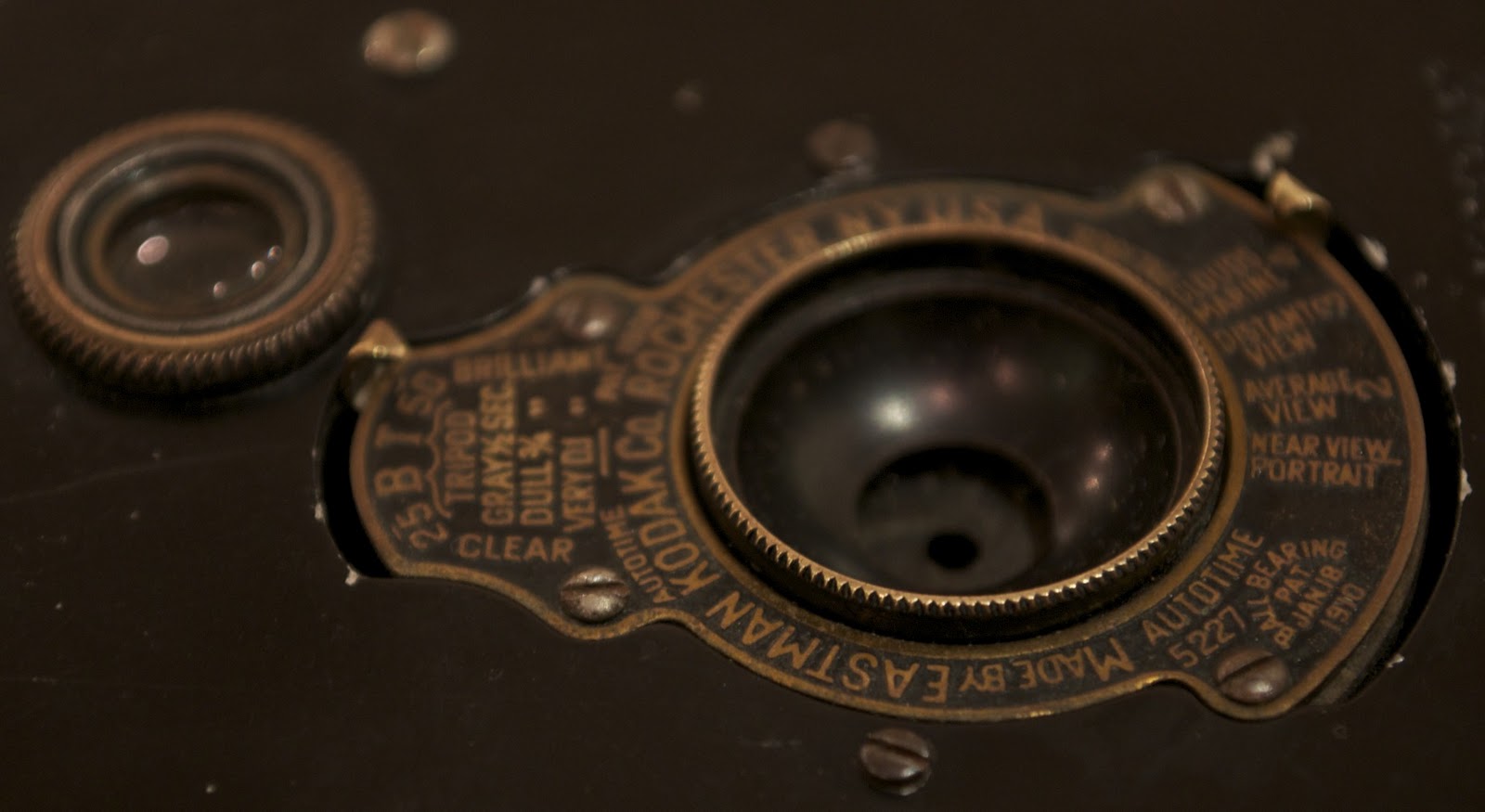
So I thought I'd post the 1910-1920s equivalent: unboxing a beautiful new Vest Pocket Kodak camera (the box says model B, but they look a little different). This looks like the comparatively rarer c. 1915 model.

But don't worry, geeks: I've made sure that there's an iPhone in there if you look carefully. You can see the full set here (or click these selections for bigger versions). If any of you know where I can get film and processing, let me know: I'd like to try this beauty out.


Why so quiet?

What a hell of a day teaching - clashing schedules, absent colleagues, complicated week = chaos. I managed to bore myself 90 minutes into my medieval literature class, so Christ alone knows what the youth made of it. Then straight into a class on new media: the students appeared to have vaguely heard of digital media, but preferred not to express and opinion either way: very difficult to talk about social capital, apply theories of community or discuss what it's done to notions of time and space when nobody seems to care either way.

Ah well. To cheer you up, another contender for worst cover version of all time: Bing Crosby doing 'Hey Jude'. You've got to listen at least until 3.13. I don't like most of McCartney's songs, and I feel sorry for him at this stage.

So much for Lord Hunt…

Lord Hunt is the Tory peer of the realm who - in a bold and radical move designed to really shake things up - is replacing Baroness Buscombe, the Tory peer of the realm who used to be Chair of the Press Complaints Commission, after an exhaustive search by the recruitment panel chaired by Tory peer of the realm Lord Black (Buscombe succeeded - yes, you guessed it - Tory peer of the realm Lord Wakeham).  


She attacked the Guardian and others for suggesting that News International might be hacking into people's phones and behaving rather naughtily. No evidence at all, she said. How did she know? Well, she'd asked News International and they said they hadn't done it. Case closed. 


This new political time-server hasn't got off to a great start. What's the major problem in media regulation, according to him?
surely the major problems occur because of the tabloids? "No," he replies, "I think the greater challenge is with the bloggers
Right. Because it's people like me who spend our days illegally tapping the phones and computers of our political enemies, conducting surveillance on anyone we don't like, printing 'up-skirt' shots (often of famous but underage females), dealing in insinuation and innuendo to an audience of millions, encouraging mass fear of (declining - though we don't mention that) crime, of immigrants, gays and pretty much anybody who doesn't share our particularly narrow-minded and prurient beliefs. For every Guido Fawkes, there's a racist knee jerker like Richard Littlejohn (that links to a magnificent encounter between Will Self and Littlejohn), climate liar Christopher Booker, climate liar Richard North and sperm-stealer, murder victim's taste-disapproving and top famine reporter (apparently Somalian hotels are awful) Liz Jones prepared to lie, distort, and shriek until our public sphere is a vicious, hysterical dystopia in which science, accuracy and altruism are left by the wayside. 


I'm not saying the blogosphere is lacking in trolls, but perhaps Hunt should read a few newspapers before he gets his secretary to show him how the Internet works.

Is he open-minded about where we go next, given that self-regulation has been a complete failure?
"I have a complete hostility to any form of statutory regulation… I come at the job with a fervent belief in self-regulation," he says, "having seen the downsides of statutory regulation."
Oh dear. Not the sign of a reflective mind. 


On the problems of newspaper editors sitting in judgement on their own practices:
He chooses to praise the code – "there is nothing wrong with it," he says firmly.
…admitting that he knows nothing about the internal workings of newspapers
But that's OK because:
he lived next door to the Daily Mail's late editor, Sir David English, for 16 years in Westminster, calling him "somebody who was the epitome of integrity"
Ah, right. He looks up to the long-term editor of the most vicious, hypocritical, racist, reactionary, misogynistic newspaper in the history of the printed word. Everything's going to be fine.

Friday, 11 November 2011

Don't watch that, watch this

Anyone seen the new John Lewis ad? It's a mawkish, emotionally manipulative tale in which a boy waits desperately for Christmas, and we're led to believe he's a greedy little bastard until it turns out that he's simply bursting to give his parents a present. Overlaid with a folk-naif cover of the Smiths' 'Please, Please, Please, Let Me Get What I Want'. (And I don't want to be too picky, but a song starting with 'Good times, for a change' is hardly appropriate for a deep recession).

So your usual Christmas ad then: attempting to disguise naked consumerism with warm fuzzy feelings. After all, a child shouldn't be expected to express love for his parents without a bloody big box of gifts, despite being economically inactive.

However, an alternative narrative is viable. By replacing the tinkly music (and how Morrissey must be turning in his grave hearing his mournful self-pity turned into a feel-good gizmo-flogging tool) with the organ from The Shining, it soon becomes clear that this troubled, lonely child is going to present his sinister parents with a dog's head, or something equally disturbing. That's the real spirit of Christmas.

Music for Remembrance Day

Although - as I pointed out earlier - I won't wear a poppy for a host of reasons, I'm not opposed to publicly remembering the victims of war, which I see as very different to the triumphalist, self-deceiving jingoism of the armchair generals and politicians who go on about freedom, sacrifice and the Glorious Dead.

War for many combatants was not voluntary, heroic or admirable. It was savage, vicious and a mark of social failure. Harry Partch, the WW1 veteran who died recently aged 111 described it as 'organised murder'. I'm no pacifist - I'm proud of my ancestors who fought against the British in the Boer War and the Easter Rising, for instance, and those who opposed Nazism, but I'm deeply suspicious of those who romanticise military service, and use it as cover to justify war. We forget that millions of soldiers came home determined to create a better, peaceful world rather than boast about their deeds.

One of my final-year students is writing her dissertation on poetic responses to the First World War (hopefully not the overly-familiar texts we all know too well), so my thoughts drifted to Ralph Vaughan Williams, the composer who volunteered for service even though he was 41. Perhaps he was caught up in the patriotic fervour of the moment - though in many ways he was a critical thinker - but the effect didn't last. He survived the war and responded to the horror by composing music which expressed disquiet about the myths of the 'Great' war, especially in his Pastoral Symphony, which uses a military bugler's false note as a key motif through which to explore the nature of war and the hoped-for peace, under the deceptive prettiness of the work's other themes.


His 'Dirge for Veterans' refuses to glorify war either - it's a serious-minded elegy for the victims of those comfortably sitting far behind the lines sending men out to die.


The other war-related piece VW produced was his 1946 Symphony No. 6: a surprise from a man popularly associated with contemplative nostalgia: it's often interpreted as a vision of the horrors of the 1939-45 conflict, and dread at what seemed to be the imminent nuclear war.

Life without the Murdochs

I've posted this clip before, but I was telling someone (can't remember who) about it recently, so thought I'd stick it up again. It's Fry and Laurie's parody of the Frank Capra film It's a Wonderful Life, in which a small-town banker facing ruin thanks to his own generosity and the machinations of the Big Banks, contemplates suicide.

The film was made during the Depression, and mixes sentiment with populist distrust of Wall Street: it's not exactly socialist, more a kind of moralism. As he stares into the abyss, a trainee angel called Clarence shows him what would happen to the community if he'd never existed, and it's a mean-minded, grasping struggling place.

Unlike life without Murdoch:


(Oh, and have a look at Matt's latest comic triumph in the Daily Telegraph)

Earth to Nadine Dorries

If you're not familiar with Nadine Dorries, she's an abrasive Tory MP with an unhealthy interest in teenage girls' uteruses (uteri?) and a fine line in abusing colleagues and constituents, inventing statistics and generally making things up.

But now isn't the time to get into all that. Instead, this is just a quick corrective. In the course of her many hectoring and untrue statements on the BBC's Question Time this week, she announced that the government's intention is to get NHS safety up to the level of the private sector.

Now, I'm from a family which has both worked for and benefited hugely from the NHS. I've seen the best and the very worst of it. But I'm not having this kind of nonsense from a reactionary blow in. Two facts:

1. The NHS was founded because the private sector failed completely. The poor were treated only by charities, in extremes. There was simply no health care: ongoing treatment, vaccinations and so on. Hospitals were often filthy, unsafe and underfunded. Dorries' so-admirable private sector specialised in the kinds of back-street abortions which killed mothers and ruined lives.

2. If something goes wrong in a private hospital, you don't get some kind of 4-star care. They call an ambulance like everybody else, and you join the queue at your NHS A+E ward. That's the secret of profitable private health: they only do easy, quick things that make a lot of money. Anything complicated, like emergency medicine or chronic conditions - off to the state with you.

Now the NHS is being privatised, it's Forward To The Past. I look forward to my children contracting retro diseases like rickets and consumption.

Meanwhile, watch David Cameron talking about the NHS as 'a business'.

Thursday, 10 November 2011

Clear your desk!

No, I'm not being fired (yet), but I have been sent Tips for an Organized Desk.

What can I say? This is my desk. It's quite tidy, for me.


What can I say? I teach in two subjects, both of which are largely book-based, and I'm trying to get some research done. The books lined up at the back are mostly related to either Anne of Green Gables or Welsh travel writing and theory. Those in the foreground and to the right are largely things I'm teaching at the moment. They're there because my bookcase is full. As is the one next to it, which I've appropriated. There are even piles on top of the bookcases. Though there is good news: only two books have come in this week, Mary Gentle's Ash and Ken Livingstone's memoir, You Can't Say That

I would like a tidy desk, but only because my office-friends are neat and tidy, and the sight of my stuff encroaching like a paper scum must horrify them. To them, I apologise. I don't particularly mind the mess per se: I am a little disorganised in some ways, but this is just surface detail. Every summer, I clear the desk completely. Then every term, it all comes creeping back.

Some of these tips are OK, but some are a bit glib:
Have as few things as possible, and you don’t need to organize.
Try to keep the desk clean, leaving only the essentials on its top. The rest goes into the drawer, boxes, the archive, or the bin. Your computer, the phone, and the paper you are currently work on is enough. 
Right. When I have one job, and less teaching: perhaps. Or an office of my own (which in some ways I'd hate - some of the best educational moments I've benefited from have been chatting with my colleagues). 
Keep everything in its own place so you don’t have to look for anything, it is immediately to hand.
I do. I keep everything in piles right by my hand. 
Purchase 1 picture frame and fill it. The easiest way to stay organized is to stay motivated, and the best form of motivation is to remember what’s important. A daily glimpse of your friends, family, pet, etc. will bring an instant smile to your face.
Ugh. I can taste a little bit of sick. As if you should ever dignify work by reference to relationships. If you're reluctantly pushing paper around for some corporate behemoth, admit it. Don't poison your genuine relationships by allowing work to appropriate some of the emotional significance. If, on the other hand, your work is intrinsically important to you - and mine is, despite occasional frustration - you shouldn't need the grinning fizzogs of your family to add emotional weight. Personally, a photo of my family would a) take up most of the desk-space and b) bring me out in hives. Given the above average sibling rivalry, and the way it's usually expressed in criticism and (if I'm lucky) needling, a photo would drive me to commit some kind of spree killing. 

There's a branch of management studies which examines corporate spaces, but I don't know enough about the field to pontificate about it. My decorations reflect my interests (communist kitsch and memorabilia, Welsh references, literary humour and a print of a photo I took), and a load of framed prints which are only here because I've filled the wallspace at home with bookshelves and don't have anywhere to hang them. Instead of pointing you towards management studies, here's a trailer for Office Space, which expresses beautifully the deadening effect of corporate blandness. The sub-plot of the waitress's battle against enforced gaiety (expressed through the 'voluntary' addition of 'flare' - badges to you and me) is a case-study in capitalism attempting to fake emotional depth.


My space is a self-selected narrative of me: largely voluntary, though not entirely. In a sense, I'm 'curating' my work-identity. It's important to academics to demonstrate their professional status, and one of the ways we do it is to assert our individuality in this way more than most people are allowed to. We aren't part of a corporate machine, we hope, and so messiness proclaims our independence. Except that our difference is minimal: most of us like endless shelves groaning under the weight of books, a bit of academic humour and a little politics. Belonging to our tribe and declaring independence might seem mutually exclusive, but somehow we manage it. 

What are your spaces like?

My Two Cents

The Guardian Higher Education Network asked for my thoughts on yesterday's student demonstration - read it, and some rather better reactions, here.

This bit caught my eye as a sign of things to come:
Coventry University College, will be opening its doors next autumn – with classes seven days a week, from 7am to 10pm weekdays and until 4pm on weekends, charging students a mere £4,800. Students will have no access to Coventry University's library, IT facilities or sports centre – despite the college being an offshoot of the university. What kind of education will be on offer to students? The spectre of similar universities, or others with worse conditions, is on the horizon.
Despite this, the government claims that all degrees will continue to be of equal value. I cannot see how a student without access to an academic library, can possibly reach the levels of a student with access to decent material.

Football's brave new frontier

Newcastle United has just announced that St. James' Park (which is next to a real park, with actual cows painted black and white to match the team's colours) is to be renamed after its owner's company: the Sports Direct Arena. For some reason, this has caused more grumbling than Arsenal, Manchester City and Lansdowne Road all being renamed in the pursuit of cold hard cash.

Naming rights to this NUFC fan's belly are still available


It bothers me because football clubs are the quintessence of real places: usually founded by local groups of enthusiasts and often staying in the heart of their communities. When clubs are taken over by financial speculators or rich men looking for a plaything, they start to become 'non-places': signified by names which are adverts and identical architecture. My own club fell victim to this in the early 90s: Stoke played at the Victoria Ground, a picturesque but semi-derelict stadium: now it's at the Britannia, named after the building society which was hurriedly taken over by the Co-op (with whom I bank) before it went bust. The new ground is exactly as you'd imagine: a smaller version of the same design you get everywhere else.

The reason for all this is - obviously - capitalism and its discontents. Corporations have (or had) the money, but they lacked one thing: warm fuzzy feelings. What they want to buy is our emotions, and there's no surer way, they thought, to make a community love a company than through its local football team. So they buy the naming rights and help build a stadium. Ironically, this is where it all goes wrong for the company and the club. Fans don't love companies - they're either indifferent, or hostile to an important part of their culture being wiped out for temporary financial gain. The stadium, too, becomes a symbol of rootless capital, rather than a palimpsest of the local.

Look at these:


The first one is Craven Cottage, Fulham's ground. It's cute, individual (especially now there's a gilt Michael Jackson statue outside) and distinctive. It's probably a financial headache for the owners and a firetrap.  The second one is the Britannia: it could be anywhere, and is in fact perched on former wasteland miles from anywhere, virtually inaccessible on foot and strangled by dual carriageways. Neither the clubs nor the companies get it: the sponsors haven't bought affection - the clubs have sold it. Sponsor names dissolve the bonds between a club and its fans. Not that the owners care: the advertising to distant viewers is far more important than the affection of local supporters.

Oh Say Can You See…

America's finest political candidates:


I'm not sure which is more depressing - that the front runner for the Republicans wants to abolish the Departments for Education (librls conspirin' to tell kids stuff what we don't want 'em to larn 'bout) and Commerce (all those nasty rules) and rip up the Environmental Protection Agency, or that he's such an inarticulate dumbass. He's George Bush's successor as Texan governor, so perhaps it goes with the job. But he's starting to actually look like Dubya. Must be all the oil seeping into their genes.

Wednesday, 9 November 2011

Words of the day

1. Mountweazel: a fake article in a reference work designed to identify plagiarists. The term is a homage to Lillian Virginia Mountweasel, the famous and entirely fictional author. Margaret Drabble (rather excellent author famous mostly for feuding with her famous author sister A. S. Byatt) put one in her Oxford Companion To English Literature.

SPOILER ALERT:

There isn't a Graeco-Roman author named Pycletius, whatever Enotes (follow that link) thinks. 

Is this a smug liberal ivory-tower parlour game? Perhaps, to an extent, but it does serve a serious purpose, and is genuinely funny. Personally, I'd like to nominate Martin Amis as a fake: I'm convinced that his father Kingsley invented him in cahoots with his friend Philip Larkin as an example of everything they thought wrong with literary fiction.

Lillian Virginia Mountweazel:

Weep for West Bromwich

I don't know if you've every been to West Bromwich. If you haven't, don't: it makes The Dark Place look like New York in the Roaring Twenties. Unless you're going to support their very fine football team (something The Dark Place entirely lacks). Otherwise, it's a case study in post-industrial decline, poor urban planning, democratic failure and political contempt.

What does a poor, abandoned town need? A bloody big 'iconic' building of course! If you give it curvy windows and a wacky name, the jobs and vitality will come coursing back. It's what Augé called a non-space and what Owen Hatherley et al. decry as the moral and intellectual bankruptcy of post-socialist politics: superficial, tricksy postmodernism which masquerades as democratic populism but is actually a cynical evasion of the tangible and unpostmodern problems facing places like West Brom. And so:


This is The Public. It was meant to be an arts centre of some sort, at a cost of £19m - because modern cultural policy assumes that people who used to make things will suddenly find themselves living in a Wonderland of jobs and aesthetic beauty if a big postmodern box is dropped on them. I think this is hugely patronising: it's cultural policy by helicopter.

It cost £31m. Nobody knows what it's for. Nobody goes there. It's going to be closed or demolished: the Arts Council of England called its own decision to build it 'a gross waste of public money', as Charlotte Higgins notes in her damning summary.

Next time, how about asking the people of West Brom what they need. They might be poor, but they ain't thick. My guess is that serious economic intervention might help. But what do I know?

Fighting your corner

Thousands of students are converging on London to speak up for the poor and young who want to better themselves.

Except from The Dark Place:
London Demo 2011: Find out why we're not supporting it, as we present our Alternative to the National London Demo...
They're putting on a Question Time debate tomorrow (I'm on the panel), but I have to say that this is disappointing. Sometimes, mass numbers on the street focus the minds of the public and politicians in a way that polite letters just don't.

I do worry about our SU: it's under the thumb of the university executive and seems to have lost all confidence in asserting the rights of its student. They've got shiny offices and ranks of computers, and seem to think that that's enough.

We have 23,000 students: 99% working-class, 45% mature students: exactly the kind of people who are already suffering. Their voices should be heard.

The annual, weary, poppy debate

It's that time of year, when social pressure means that anyone in the public eye is compelled to wear a poppy for Remembrance Day, and anyone not wearing one is looked at funny.

Why don't I wear one? Because David Cameron is just plain wrong when he says that:
wearing a poppy [is] to remember those who have given their lives for our freedom 
The poppy appeal raises money for British Army veterans and their families. It doesn't restrict funding to those who fought in the one justified war the British have fought in past centuries (WW2, in case you're wondering). It represents one side in a string of conflicts, many of which can't be justified: Ireland over the centuries, India, Kenya, Malaya, South Africa, Suez, Iraq, Afghanistan (repeatedly) and a whole string of other vicious wars of conquest and oppression which can't be justified. Most of these people haven't given their lives for 'our freedom', but for colonialism, capitalism and racial supremacy. I can't see how 'our freedom' was served by invading Iraq, arming Saudi Arabia or bombing Libya: there are arguments for and against these actions, but no Saudis have been freed, let alone the rest of us.

The usual counter-claim to this is that we're helping and remembering the soldiers, who don't make policy. There's something to this: economic conditions drive people into the armed services very often, and I wouldn't blame individuals for that - though I do note that the UK Armed Forces are professionals: nobody's been conscripted. If the poppy symbolically represented all those who did what they were told without being responsible for wars' intentions, then we'd remember all those German conscripts too.

I will wear a poppy one day: when it represents all those killed in war, without regard to which side they were on, or whether they were military or civilians, such as the Bloody Sunday victims. It's time that public discourse on this grew up: the British state is not and rarely has been unequivocally supportive of freedom and democracy. Not every war has been a 'just' one.

Support your local students

They haven't gone away you know, as a great man once said. While the newspapers have been distracted, the students have been planning another big demonstration today (though there's no sign of it here at The Hegemon).

It's the same issues: fees, the effective privatisation of universities, and the government's decision to penalise future generations for the failings of the economic models they and their predecessors promoted. It baffles me: every government (rightly) talks about the need for a high-tech, knowledge economy - but no government will ever admit that this a) costs money and b) is a public good.

So what do they do? The Metropolitan Police have decided to put down the brown envelopes for a day, and have spent the last week loudly talking about using plastic bullets - like it's Ireland in the 1980s - and harassing those they arrested last time, whether they were charged with anything or not. Clearly they've missed the days of the Miners' Strike and the Poll Tax riots, and fancy a spot of teen-bashing.

Except, of course, that it's not just spoilt teenagers. My university's intake is 40% mature students trying to retrain themselves just as governments always tell them to. A large proportion have children or other dependents. The vast majority of our intake - of any age - is from the lowest economic centime: just the kind of people to whom the EMA, or a decent level of support, will make the difference. These people aren't scroungers, demanding something for nothing: they're the nurses, classroom assistants, teachers and social workers of the future, who quite rightly don't fancy taking on £50,000 of debt to qualify for a low-to-moderate salary and a slashed pension. Would you? They ARE the big society… and they're being cut off at the knees.

Follow the protests live here.

Tuesday, 8 November 2011

My Nuremberg

In advance of the UCU lecturers' strike (that'll show 'em) on November 30th - defending our pensions - our hitherto moribund SU is hosting a Question Time on Thursday, 5-7, in place of actually supporting us. In the absence of anyone better, I'll be on the panel with Melanie Philips, Alan Sugar and Alex James some SU representatives, students and university officials.

Post questions in advance or just turn up - it'll be enormous fun.

As a service to students

Head on over to the Can I Skip Class? calculator! Input how much you've attended so far, what the content might be, whether you can borrow somebody else's notes, and voila: automated absence! It reassures me that our one-day strike won't result in a lifetime of hobbled opportunities for aggrieved students. (Thanks to MfD, who posted the link in the midst of a fascinating discussion about educational technology and rhizomatic education - the rather difficult and abstruse Deleuze + Guattari theory about education often being informal, non-linear, non-hierarchical. I think it stresses connections and quests rather than certificates and objects, but I'm not too sure, to be honest).

Talking of which: let's get our troubles into perspective - this appeared in Brighton this week:

Is journalism rotten?

Here's a little anecdote that suggests journalists have completely lost their way. A few days ago, a live microphone picked up Nicolas Sarkozy telling Obama that the Israeli PM is 'a liar', to which the American responded 'I have to deal with him every day'.

Interesting - an insight into the true nature of political relations which are usually hidden behind glib press conferences assurances of respect and accord.

The real story is this:
the reporters agreed not to publicise the remarks because of their sensitive nature
We teach media ethics here. One of the things we discuss is news values, and I have repeatedly made the point (derived from Milton, Mill, Jefferson et al.), that democracy is guaranteed by an independent press. However, if news organisations are suppressing news at the behest of power - and remember, this isn't a matter of life and death at a time of war, for example - then the citizens of France, the US, Israel and Palestine have no way to ascertain the true state of their political affairs. We become passive, excluded drones rather than active citizens, hooked on TOWIE rather than holding our representatives to account.

Hope for humanities!

My colleague Zoot Horn sends me this optimistic cartoon about life as an English literature graduate.

I'll balance it with this quotation from Jeanette Winterson's abusive adoptive mother, justifying banning books from the house:
"The trouble with a book is that you never know what's in it until it's too late,"
I find it rather movingly profound. It's why I read for pleasure and profession. A book might make you cry, laugh, howl or groan. It might soften or stiffen your brain (or other organs). Most of the time, a book is a portal to a richer, more interesting world - sad, I know, but often true.

So hurrah for Mrs. Winterson, however evil she was towards little Jeanette.

Talking of high culture, I watched some of She's The Man last night, in which a teenage girl disguises herself as her brother to prove to the world that she's a top-class football player, moving into his boarding school, falling in love with her/his room-mate and having other girls fall in love with him/her.


There was rather too much prurient interest in teenage girls' bodies for comfort, but it did have the huge bonus of Vinnie Jones's presence as the soccer coach. His acting was so bad that this English footballer's English accent sounded like a bad American imitation - almost as bad as Daphne's brother in Frasier (who appears to be a fake Cockney worse than Dick van Dyke in Mary Poppins despite the family supposedly hailing from Manchester). The film was interesting because all the humour was based on the potentiality of gender disguise removing essentialist qualities, there was plenty of bawdy humour and yet the film was paranoid about closing down the possibility of viable same-sex relationships - having its very conservative cake and eating it too.

She's The Man is of course a retelling of Twelfth Night. Poor old Shakespeare.

Monday, 7 November 2011

Constructing audiences

We had a long and fascinating seminar discussion on audience construction today: how texts are constructed to create a particular (temporary, fuzzy) audience. We watched this trailer, for Synecdoche New York and talked about cinematography, sound, narrative, title, casting, class, age, and education.


Then we talked about Top Gear. Sadly for Clarkson's dreams of world domination, even the car-fan young men knew very well that he's a cartoon character and not meant to be taken seriously.

Neighbourhood Watch

I went to see this play at the weekend, Alan Ayckbourn's latest. It was largely magnificent: a comic examination of the latent fascism in the heart of every Daily Mail reader. An ageing brother and sister move to a housing estate perched on a hill overlooking a rough council estate. Class hatred leads to paranoia, fear and a siege mentality as the central couple and their new neighbours interfere every more intrusively into the lives and mores of their community, justified as enhancing safety: democracy is quickly forgotten.

The gradual shifts into moral and physical oppression were done beautifully: the audience - largely  exactly the same age, social class and sartorial appearance as the characters - chuckled in agreement as those on stage expressed the kinds of moralistic, unjustified attitudes they themselves shared: but not all of them quite understood that they were being satirised. Ayckbourn understands his audience perfectly: he takes them seriously while making it clear that they too should examine their prejudices - and he's funny to boot. One character's

The only jarring note was the rather gratuitous introduction of a lesbian sub-theme. The brother and sister at the heart of the play were also the causes of this dystopia's downfall: despite their respectability, they condoned lynch mobs and gangs of heavies, and both of them gave in to their repressed sexual desire: he for the wife of an inadequate comrade, she for the abused wife of a neighbour. Two other characters, who never appeared, were also lesbians - a naval officer and a judo instructor. It just felt a bit forced, as though an ageing playwright was putting in a dash of something risqué for his audience, without quite being sure of his cultural grounds: the lesbian element felt too insubstantial to be a serious theme, and therefore I wasn't convinced that it wasn't a bit of titillating decoration.

Overall, I thought the play worked very well, and the acting was magnificent: changes of pace and tone portrayed beautifully, character traits expressed through appearance and verbal tics very subtly. Last week, I gave a lecture on security-conscious architecture actually contributing to fear and social decay: how I wish I'd been able to send the students off to watch this play.

Dirty old town…

What is it about Birmingham that makes fat, bearded artists hate it so much? Edward Burne-Jones 'claimed he didn't know he had a soul until he left Birmingham', and said 'I can't think it matters at all how I paint or what I am if I ever had the baseness to be born in such a hole': he called it 'blackguard, button-making, blundering, beastly, brutal, bellowing, blustering, bearish, boiler-bursting, beggarly, black Birmm'. (All quotes from Fiona MacCarthy's magnificent - and massive - new biography of the Victorian medievalist artist.

Monsieur L'Artiste

Edward Burne-Jones


Over a hundred years later, Steve Bell, my favourite cartoonist, has a similarly dismissive approach - he recalled that after a year teaching art there, he resolved to a) never teach again and b) never visit Birmingham ever again (he'd 'rather live in a blocked toilet than live in fookin' Birmingham'. Since then, he's consistently drawn Birmingham as a network of dystopian flyovers and canals littered with dead dogs, floating paws-up. (Link above leads to full-size version).


Is Birmingham so bad? Yes, it's suffered the depredations of heavy industry, political oppression, the Luftwaffe, local planners, economic insanity and the cynical short-termism of property developers (if you think the Bullring complex is decent urban design, you're mad), but I rather like it. There are some decent pubs, identifiable 'quarters' that aren't the fantasy of some 'regeneration consultant', and an interesting identity which derives from a fascinating history. OK, it's ugly, damp and knackered - but from here in The Dark Place, it's the Shining City on the Hill.

Friday, 4 November 2011

Ears bleeding for culture…

There's a piece about one of my favourite composers, Krzysztof Penderecki, in the Guardian today. He's the perfect example of late modernism. The theory goes that the world isn't a pretty, and coherent place. It's confused, confusing and filled with pain. Music shouldn't deny that, it should be honest. I must play some to my students…

Not being a fan of horror movies, I didn't realise that his work has been used widely in the genre, but I can understand why: here's his Threnody for the Victims of Hiroshima. Don't have nightmares!


and a chunk from Polymorphia. I used to play these when I wanted everybody to go away. It always worked.

This is how the week ends: not with a bang, but a whimper

Well, my neat list of things to do today failed immediately.

The lettings agent who was meant to inspect my flat at 11 turned up at 11.30. She took pictures and carefully didn't listen to my (short, reasonable) list of problems with the flat. So I had to take her hostage.

That meant I missed my pre-meeting meeting. And then my meeting. But I did make it to the Guardian Higher Education live chat about balancing research and teaching. And despite Music For Deckchair's teasing, I was thoughtful, calm and reasonable. Probably. I managed to juggle that with marking a Shakespeare online forum. They were very impressive, though I will give them a hint: this is a quarto and this is a Quattro. Try not to mix them up again.

After that, it was a deeply unpleasant plunge into the swimming pool after a couple of weeks away - not a joyful return, but after doing drleehw's survey on self-image and eating habits, I decided to skip the usual Lard Sarnie for lunch and do some exercise instead. No doubt I'll feel the benefit later in life, but right now I'm mostly feeling bitter and resentful. Good job it's the weekend.

Non-sequitur Friday conundrum

Two slogans have caught my eye this morning.

1. Love Music, Hate Racism.
2. Violence to children must stop. Full stop.

I must confess to not feeling any less racist or violent towards children having absorbed these messages. I don't hit children or hate people based on their race anyway. But I have developed an irrational and violent hatred of sloganeers.

Who on earth came up with the idea that there's something inherently contradictory about loving music and being racist? Certainly not a Wagner fan, the Macc Lads, Skrewdriver, or the man who told me that I should listen to Bruckner because 'the Fuhrer' played his music after dinner every evening. Plenty of people love music and racism, sadly. I'm sure there are lots who hate both. Or are indifferent to one, the other or both. Let's try a commutation test. Does 'Love Racism, Hate Music' make any sense? Of course not. Music and racism are apples and wardrobes - there's no logic in the opposition here at all.

As for the NSPCC slogan - why? I cannot believe that anyone inclined to abuse children will have spotted the poster and decided to call it a day. Nor do I think that anyone disposed to prevent cruelty to children will have redoubled their efforts. It's such an empty phrase, akin to New Labour's verb-free slogans like 'A brighter tomorrow'. Fine, but let's have some details.

Have you got pet phrases which annoy you? Use the comments section.

On the menu

What a disruptive week it's been - lots of extra lectures and meetings. Today's schedule is:

1. Mark last week's Shakespeare online forum.
2. Landlord's inspection of my flat. I have hidden the bodies and mopped up the blood.
3. Pre-meeting meeting.
4. Meeting.
5. Contribute to the Guardian Higher Education live chat on teaching and research.
6. Finally go for a swim - first time in two weeks thanks to extra work.

Only the first activity and fifth are even remotely pleasurable, and I never thought I'd say that about marking!

If you've a few minutes to spare, help out a very fine colleague by doing his research questionnaire on eating habits. Free doughnuts to the first participant (no, not really).

Thursday, 3 November 2011

Tune in tomorrow

Lots on tonight and tomorrow. Mostly cleaning tonight, sadly, and hoping Stoke City put the recent run of bad results behind them.

But tomorrow - after a flat inspection by the landlord and a meeting about our absurd system of fining people for allegedly not using teaching rooms - I'm on the panel for another fine Guardian Higher Education debate, this time on integrating research and teaching. Or in my case, failing to integrate the research I'd like to get round to doing into the teaching I do rather a lot of.

Post questions now, and it'll be live 12-2 tomorrow, though I'll be a little late thanks to meetings.

I apologise for the advertisement. DO NOT buy Peter Kay's DVD. It will be very poor indeed. You can while away the hours trying to work out why a reggae artist thinks that 'Lecturer' is a good stage name. Here's 'Lecturer Riddim', which I believe I've always had.
And on that note, I'm off home to gnaw on a pig's leg I prepared earlier.

It'll never catch on…

(No, not my former opinion of Twitter). So said the Manchester Guardian when faced with a new medium. 'No good will come of it', he said - he must be spinning in his grave every time a Guardian journalist types yet another breathless paean of praise to The Wire and The Killing. It would destroy the social fabric, said others - people would retreat to their individual homes rather than congregate gregariously.

Here's the song commissioned for the first UK public demonstration of television in 1936. 10,000 homes got TV before service was suspended for the duration of the war.

Thursday conundrum

This one courtesy of a domestic chemicals company:
Are you disappointed when you stop noticing your plug-in?
Er… no. Surely 'disappointment' is a form of noticing? And we'll pass over the deliberate implication that we all have 'plug-ins', and the concomitant implication that without an electrically-powered chemical-release system, our houses would revert to the conditions prevalent during the Black Death.

My house smells of paperbacks and vinyl records, overlaid with top notes of sweaty sports equipment, fresh ironing and of course bitterness. I intend to bottle it for the Christmas market. I've got a slogan too: 'Splash on some Plash!'.

The murmuration

I've seen a much smaller version of this over Shrewsbury, and it was awe-inspiring. Whatever mood you're in, this will change it.


Murmuration from Sophie Windsor Clive on Vimeo.

Wednesday, 2 November 2011

The Biblionerd's Holy Grail: The Book of all Books

I've just received the most fascinating - and nerdiest - books ever. It's Volumes 1 and 2 of The Arthurian Annals by Daniel Nastali and Phillip Boardman. It's not your crowd-pleasing stories of knights in armour of Celtic mysticism.

Much better than that. Volume 1 is an 800 page bibliography (in A4 size): a list of books. Volume 2 is the index: 250 pages telling you where in the list of books in the other volume you can find a particular book. It is utterly wonderful. Basically every reference to Arthur, the Arthurian world and related character between 1250 and 2000 is recorded here, from 'high culture' to sword'n'sorcery pulp.

For example:
Garrido, Mar,  Once Upon A Kiss, series creator Eileen Goudge, Eileen Goudge's Swept Away 6, New York: Avon Flare Books
A novel in a series intended for young girls in which the heroine travels back in time to Arthur's court by means of a computer named Merlin. There she meets Tristan, her image of a perfect boyfriend until he returns to her own time. 
Garrido is actually Eve Becker, prolific teen pulp author - Sweet Valley etc. According to this, Once Upon A Kiss is part of a series depicting feisty postfeminist teens meeting classic macho heroes from the past and (vomit) learning about love from each other:
Taking a nod from historical romances who dipped into the fun-fantasy realm of time-travel with 80′s women thrust back in time to face pirates , swordsmen and the wild west all armed with the knowledge and savvy of woman’s lib , pantyhose and contraceptives to butt heads with the stubborn, sexy men of yesteryear. Swept Away did just that – each heroine is a girl at a fictional highschool – O Henry High who mutually meet or are friends with Ashley Calhoun a wizard with computers ( obviously ) who has created a computer program that has allowed her to travel back in time. 
Sadly, even the denizens of the web haven't seen fit to post an image of the cover, but here's one from the same series:

Even I won't be buying a copy, though I bet it's interesting. How about:
Gilkyson, Eliza,  Pilgrims, recorded music, Los Angeles, Calif.: Gold Castle Records. Issued as GC-1007. Rereleased by Silver Wave Records in 1996.
An album by a folk singer with a strong New Age following. The album was inspired by the Tristan and Iseult legend and features several songs of troubled love, but none is explicitly associated with the story. 
And thanks to the bounty of the Internet, here's a track from that very album: play it at your own risk.

Meanwhile in America…

Your Republican candidates:
1. Mitt Romney - billionaire who claims the Republicans are about looking after the 'little guy'. Believes that Americans (but not the native ones or the black ones) are the lost tribe of Israel and that God gave them some new commandments on solid gold slabs which were carelessly misplaced. He also believes in converting your dead ancestors, which is how it came about that the Jewish and other victims of the Holocaust are now officially all Mormons.


He's the man in the middle:


Caption competition: 'these are much easier to carry round than gold tablets'? Or 'Wow, I didn't know these came in lower than $500 bills. How cute'. 


2. Rick Perry. Governor of Texas and very much in the GWB mould (i.e. vicious and dumb and not averse to the N-word): he's already accused the chairman of the Federal Reserve of treason and applied Biblical wisdom to the recession and the BP oil spill:
"I think in America from time to time we have to go through some difficult times — and I think we’re going through those difficult economic times for a purpose, to bring us back to those Biblical principles of you know, you don't spend all the money. You work hard for those six years and you put up that seventh year in the warehouse to take you through the hard times. And not spending all of our money. Not asking for Pharaoh to give everything to everybody and to take care of folks because at the end of the day, it's slavery. We become slaves to government." 
3. Hermann Cain: sex pest, pizza shill, possibly corrupt, madman. 
'It will be a twenty foot wall, barbed wire, electrified on the top, and on this side of the fence, I'll have that moat that President Obama talked about. And I would put those alligators in that moat!" - Cain on his illegal immigration plan.'
He did this as a presidential ad (warning: it will sicken you):


4. Michele Bachmann: 

 ''Carbon dioxide is portrayed as harmful. But there isn't even one study that can be produced that shows that carbon dioxide is a harmful gas.''

“But we also know that the very founders that wrote those documents worked tirelessly until slavery was no more in the United States.”
Er… no, they were slave owners. 
'[Pelosi] is committed to her global warming fanaticism to the point where she has said she has even said she is trying to save the planet. We all know that someone did that 2,000 years ago.''
''And what a bizarre time we're in, when a judge will say to little children that you can't say the pledge of allegiance, but you must learn that homosexuality is normal and you should try it.''
''Normalization (of gayness) through desensitization. Very effective way to do this with a bunch of second graders, is take a picture of 'The Lion King' for instance, and a teacher might say, 'Do you know that the music for this movie was written by a gay man?' The message is: I'm better at what I do, because I'm gay.''
''I don't know where they're going to get all this money because we're running out of rich people in this country.''
''I find it interesting that it was back in the 1970s that the swine flu broke out under another, then under another Democrat president, Jimmy Carter. I'm not blaming this on President Obama, I just think it's an interesting coincidence.''
“The big thing we are working on now is the global warming hoax. Its all voodoo, nonsense, hokum, a hoax.”
Under normal circumstances, you'd assume that Obama would have to be caught in bed, with a goat, wiping his bottom on the Bible before he lost this election. Now, I'm not too sure… Still, it'll be amusing until one of these loons decides to nuke Eurabia (that's what they call Europe now because we're all living under the Muslim yoke. Apparently.  

It's obviously Uppal Day!

Fresh from reeling at the shock of Uppal's letter, I'm bombarded with tales of his latest Parliamentary exploits.

Displaying the mental agility we expect of our secret millionaires, he's demonstrated the breadth of his experience by speaking about two subject close to his heart: gangs and hedgehogs (sadly not in the same breath):

To view this issue from a purely financial perspective is prosaic. From my experience, one reason why many young people join gangs is that are seeking a surrogate or substitute family. This is particularly the case among young men who are often looking for a positive male role model. I welcome my right hon. Friend’s initial response on role models. Will she elaborate on how positive male role models could play a role in this issue?

From his experience? Was Paul Uppal MP a youthful gang member? Did he roam the streets of the West Midlands with a flick knife and bicycle chain? Did he snatch handbags? Was he a teenage glue-sniffer? Were the bus seats of Birmingham slashed by his own blades? Or does he mean that he's read Melanie Phillips in the Daily Mail? You decide, readers! (And let's pass over the fact that this is meaningless guff).

But let's move on to Paul's other specialist subject and the burning debate over slug pellets:
To ask the Secretary of State for Environment, Food and Rural Affairs what steps she is taking to protect (a) hedgehogs and (b) other wildlife from Metaldehyde and Methiocarb slug pellets.
I note that the Secretary of State for Agriculture was not personally present to explain to him that she spends every evening and weekend gently feeding sickened hedgehogs and weaning them back to health, but I'm aware that when the election comes, Uppal and his rivals will be confronted on every doorstep by concerned voters demanding to know what exactly his government has done to salve the plight of Mrs. Tiggywinkle, and why it is that they've spent the past years trying to rescue the economy, provide jobs and bring about world peace.

The answer to his question is frankly obfuscatory. Everyone loves hedgehogs. Chemicals are used very carefully. The government is aware of only ten hedgehogs deaths in the past few years. Which makes me think that they're falling down on the job!)

Perhaps if a male role model gave every gang member a hedgehog to keep safe from slug pellets, we'd have no more teen delinquency. Forward to the sunlit uplands of prosperity!

Occupation comes to The Dark Place

I woke to find these Anonymous/Occupy posters on the street crossings today:


I rather liked the semiotics of sticking it over the green man - associating Occupy with positivity and agency rather than negativity and prohibition. I'm not certain that The Dark Place isn't the victim of capitalism rather than a powerhouse of fiscal oppression requiring occupation, but I'm very pleased that the movement is spreading.

The Oracle Speaks!

Clear the decks folks, I've got incoming! 


Yes, an actual letter, on real House of Commons notepaper, dictated by the great man Paul Uppal MP himself - and it's a peach. 


You may recall that I took issue with this greasy, grovelling speech Uppal made in support of that corrupt fixer Liam Fox, who subsequently resigned as Minister of Defence:
I thank my right hon. Friend for the sterling work he has done in respect of Sri Lanka. Will he elaborate on the work that he has done in relation to the Sri Lanka Development Trust, and specifically on the work that Ministers have done in that regard?
I smelt a rat. It crossed my nasty, suspicious mind that Uppal knew absolutely nothing about Fox's 'sterling work' in Sri Lanka, and was simply kissing bottom in the hope of tangible or reputational benefit - building social capital, in other words. 


So I asked him:

Dear Mr Uppal,
the Hansard record of Defence Questions records you complimenting Dr Liam Fox on his 'sterling work' in Sri Lanka in regard to the Sri Lanka Development Trust. Newspaper investigations reveal that the two bodies forming the Sri Lanka Development Trust, the Sri Lanka Infrastructure Development Fund and the Sri Lanka Charitable Fund do not have the requisite permits to operate in Sri Lanka, and appear to have undertaken no activity other than to pay for Dr. Fox's aeroplane tickets. Could you explain to me a) what the 'sterling work' might be, b) what you knew about the Sri Lanka Infrastructure Development Fund and the Sri Lanka Charitable Fund at the time you addressed the House on this issue and c) the sources of your information on this matter?

If he had done any homework, he'd have found out that the 'Sri Lanka Development Trust' wasn't legally registered in that country, and its only 'work' was to pay for Liam's flights. So it was a front for Fox's dubious huckstering. 


So what does little Paul say?
Though I have never spoken directly to Dr Fox regarding his work in Sri Lanka, I sat in on several briefings for members of Parliament in which his work was discussed. Like yourself, I was surprised with the information that came to light regarding some of the facts regarding the Development Trust. 
To me, this sentence is a weaselly masterpiece: it displays Uppal's talent at what the tabloids call a 'reverse ferret': entirely changing one's opinions without ever admitting that one even had a different opinion, and edging away from the previous object of adoration. It also neatly evades my original question: what was the 'sterling work' Liam Fox was doing? My suspicion is that Uppal has no idea. The 'briefing' was, I suspect, a list of question handed out to obeisant backbenchers ordered to support Fox in his hour of need. The problem with hounds, however, is that they obey the Master, not the Fox: once the order is given, they'll join in the feeding frenzy. Un-Fantastic Mr. Fox was disembowelled by his own. 


The rest of the letter, sadly, rehashed Fox's evasive and dishonest resignation statement, claims that Fox saved Libya, and - worst of all - uses the phrase 'going forward', which in my book is the verbal tic of the scoundrel. 


Now, you might object to me pursuing this one. MP grovels to his superiors in hope of future advancement - what a shocker! But that's exactly what I object to. We're so used to our representatives playing these seedy, dishonest games that we forget that they're meant to have their minds fixed on higher things. If we just accept that they're weaselly chisellers, they've won. We need more people picking them up on the little evasions, the arse-kissing, the contempt for principle - and the public - that they evince so frequently. 


Let's point and laugh every time they ask a planted question, each time they score petty points off each other rather than pursuing the public interest, every time they behave tribally rather than maturely. If we don't make them grow up, nobody will. 

Tuesday, 1 November 2011

I can stop at any time…

I'm beginning to wonder why I buy so many more books than I can read. Is it childhood trauma? Is reading a wall between myself and the world? Is it a result of having all my books taken from me by my 5 bawling and mewling siblings? I keep buying myself these presents to fill a gaping psychological void - where my heart should be, I suspect.

So what's come in this week? Well, it's a big pile of Things Gone Wrong books: dystopias, post-apocalypses, failed states, and failed hopes. Hmm, maybe psychoanalysing my bookshelves is a bad idea.

Although the fault also lies with my colleagues. The problem with working alongside polymathic, curious (in both senses) people is that the bastards always talking about things they've read. I'll nod as though I have a clue what they're talking about, while surreptitiously dialling up certain well-known online book emporia. The volume arrives, and I hope that erudition oozes out of it and into me in a form of logorrheic osmosis. It's just happened again - a learned reader of this very post Tweets with a suggestion (Ash by Mary Gentle), and I'm too weak to resist… And oh look, it's 1000 pages long. I despair, I really do.

Colson Whitehead's witty literary zombie satire, Zone One;
Ian Donaldson's new biography of Ben Jonson;
Ian R MacLeod's 1940s alternative history, Wake Up and Dream in which failed actor turned private eye Clark Gable watches the US drift towards Nazism;
Moira Young's Blood Red Road, another in the seemingly endless cascade of teen dystopian history novels (The Road for teens);
yet another one, centred on surveillance (much on my mind at the moment), Lauren McLaughlin's Scored;
and another one, Robert Swindell's Brother in the Land;
Joan Aiken's The Wolves of Willoughby Chase;
the new Murakami, IQ84, which comes in two volumes;
Norman Davies' massive history of forgotten European states, Vanished Kingdoms;
the new Library of Wales reprint of one of my favourite novels, Gwyn Thomas's All Things Betray Thee;
Marc Augé's Non-Places: An Introduction to Supermodernity: dystopic in its presentation of an urban architecture which erases community, complexity, history and culture.

And it's only Tuesday… this really has to stop.

Walking to perdition…

I just gave a two hour plus lecture on conceptualising the city - Augé on super modernity and non-spaces, the Situationists, the city as contested text and the psychogeographers. Once we got past the broken projector, I feel like it was the best lecture I've given in years.

Sadly, only 6 people turned up, out of 16. And for a change, it wasn't because they knew how boring I can be, because I was guesting on a colleague's module. An assignment was due today. Ho hum. However, despite the lecture being very long, I think that at least three of the attendees enjoyed it, judging by the discussions we had along the way.

Here's a bit of Will Self talking about psychogeograpy, which I explained to the students as a form of occult pedestrian resistance.

Fascists in t-shirts

I worked late last night, and didn't walk home until gone 10 o'clock. As I left the building, I could hear booming bass chants, interspersed with the higher pitch of women's voices - as though a football match was on.

As I got closer, I realised that this was yet another in the monthly series of organised pub crawls for students, put on by a company which charges the students and takes commission from the pubs to which they direct the crowds. I know, it's a shocking symbol of the decline in student standards that they can't organise pub crawls of their own - talk about capitalism appropriating youth culture.

The kids are divided up into groups and given t-shirts denoting which tribe they're in. They're encouraged to wear identical colours from top to toe, which for the women seems to mean matching knickers and little else. Then they're frogmarched around the streets in a tightly co-ordinated schedule - '14 minutes in Revolution, then we're on to Oceana'.

The frightening bit is the speed with which they develop a group identity. The t-shirts turn them into a cadre or a cohort (though really they function as control for the paid leader, and mean that security personnel can narrow down the suspects if anything untoward occurs). The chanting as I passed turned out to be the Blues singing their collective identity like a mantra, while the Orange girls responded with 'You're shit', as though there was some meaningful difference between them beyond the random assignment of t-shirts.

I don't know if you've seen a German film called Die Welle ('The Wave'). It's based on a true classroom experiment in which a teacher demonstrates the ease with which fascism can be inculcated by making a few tiny changes to the group: neater uniforms, better manners and a group name. It's different over here: all it takes is a coloured t-shirt and a few bottles of WKD and we're there… (just ask the EDL).