Happy Monday one and all. There's so much going on between work and the usual dreadful events in the world that I don't feel capable of expressing it all and anyway, you must be bored with me ranting. Instead, how about a musical interlude - a round-up of what I've been enjoying recently?
Firstly, Euros Childs' latest album. He releases a faux-naif solo album every six months or so, always with a hand-written card tucked inside. I've bought everything all the ex-Gorky's Zygotic Mynci personnel have released since they split up. Nothing's quite like the unhinged Welsh teenage psychedelia they specialised in, but nothing they've done has ever been uninteresting. Annoyingly, Euros never tours near me.
Sticking with Welsh psychedelicists, the people behind Ectogram, Parking Non-Stop and various other groups have released what is for them a rather straight-forward album of lovely melodic songs under the name Spectralate.
crocodile tears from Robert Zyborski on Vimeo.
The follically-challenged chap was relentlessly rude to me about my taste in musics twice a week for ten years when I went to Cob Records, but we're great friends now and I have to admit (though you may not agree) that my tastes have if not improved, at least widened.
I've also recently bought the 4CD Bridget St. John album - a 60s/70s folk-rock singer I'd never come across before. She sings like Nick Drake mixed with Nico and the songs are reflective, thoughtful and lovely. Wish I'd come across her work before. The discs include this French live version - delightful to hear an English person speaking passably in another language for a change.
Radio 3 has been making a slight effort to include more female composers recently, which is good. Not because they should play anything by female composers just because, but because there are lots of really excellent ones who've been shamefully overlooked. R3 introduced me to Rachel Clarke's Viola Sonata: I love violas in general and this is a humdinger.
As it happens, I've bought loads of music by female composers recently so here are some of my favourites by Sally Beamish (more viola), Julia Wolfe and Pauline Oliveros (experimental drone accordion - what's not to like?).
I've also bought the latest New Order album, Music Complete partly because I buy everything they do, but partly because something interesting must be going on if they're referencing musique concréte. But I haven't had a chance to listen to it yet, mostly because I've been listening obsessively to Gwenno Saunders' Welsh-language SF-inspired solo album, Y Dydd Olaf. She was in the rather lovely English-language band The Pipettes, but this album is entirely different: electronic, political, futuristic and compelling:
Slowcore heroes Low's new album Ones and Sixes hasn't quite grown on me yet - I'm quite an obsessive follower but this one doesn't have quite the impact so far as the albums I think of as their classics: C'Mon, Drums and Guns and I Could Live in Hope. It may be a grower though.
The final album I've been playing an awful lot is one I'm just not sure about. I went to Andris Nelsons' last concert as conductor of the CBSO, which was marked by a premiere of a new piece by Eriks Esenvalds, the Latvian composer. The piece itself isn't out yet but it was interesting enough to persuade me to buy his orchestral work Liepaja Concerto and one of his choral pieces.
The orchestral one is pretty good - quirky European modernism with a Baltic twist, but Northern Lights is troubling me.
It's just too pretty (I love the glasses though). There are heart-stopping moments of beauty but I'm not convinced that that's what contemporary classical music should be doing. It's where the post-minimalists went wrong, and Esenvalds' choral music is at least partly within the Baltic 'mystic minimalism' strand. I can see where it came from: even extreme modernists like Penderecki went from this to this as religion countered the version of communism in which they grew up. I'm not against beauty per se: we need it, but I do think that modernism in music (and literature) attempted to represent the world as it is – ugly, dissonant, often incomprehensible – rather than as we'd like it to be, and that seriousness requires us to confront what is (not just modernists: hurray from Oliver Cromwell demanding his portrait be painted 'warts and all'). The mystical minimalists (see also non-Baltic Lauridsen and Whitacre and here for a fan's view) moved a musical language on from one which exposed the beauty of structures to one which returned to a form of magical thinking (if I'm not careful I'll start throwing around words like ineffable), or of propaganda, despite often being a pointed response to propaganda.
It's like 21st-century novels which tell a nice neat story about comprehensible coherent characters who overcome challenges to live happily ever after, all within 250 pages. Hard to do with a clear conscience in the midst of decay, decadence, mass murder and environmental degradation. And yet that's what we all (me included) read and listen to most of the time.
Which is all a very long way from Esenvalds, but what I think I'm trying to say is that his choral music is too easy, too comfortable. I know we all need to relax occasionally but I distrust escapism as reactionary. You don't have to be miserable to be serious: lots of humour does it too (I liked Hope: a Tragedy as an example of serious hilarity) but I think my definition of Literature or Culture in general is work which refuses to reinforce the artistic status quo, even if only in small ways. It should unsettle, or nudge your perceptions in some way. Gwenno's Y Dydd Olaf does that musically, lyrically (for non-Welsh speakers, just by being in Welsh) and politically. While existing in the far reaches of 'high culture', Esenvalds manifestly does not.
And now I'm going to listen to Pantera's Vulgar Display of Power as an antidote.
Showing posts with label art. Show all posts
Showing posts with label art. Show all posts
Monday, 19 October 2015


Tuesday, 4 November 2014
News from Nowhere

Last Saturday, I went to Stoke-on-Trent's Potteries Museum and Art Gallery for the annual Stephen Hagger Lecture (very sadly I was the youngest there by a good twenty years, and too many of them were from the National Trust wing of Morris fans). This year's lecturer was Fiona MacCarthy, design historian and biographer of Edward Burne-Jones, Eric Gill and William Morris, whose life and influence was her subject for the day. What links these three men and those around them is a commitment to art as a way of life: from the production of goods they evolved a philosophy of community, economics and politics – especially Morris. Stoke is the perfect venue for a lecture on William Morris. The industry which sustained the city was pottery: thousands of highly skilled workers producing globally-renowned items of astonishing beauty, and yet the city is a depressing sump of deprivation and unemployment now, and always was ugly: talk about alienation in action.
 |
| Morris, by GF Watts |
Morris seems to have been a force of nature - constantly trying new things, full of energy and also enormous fun: his friend Burne-Jones's cartoons of him are affectionate as well as satirical:


I don't know if Morris's aesthetic appeals to you. I find the wallpaper beautiful but too busy, but the late period 'Arts and Crafts' furniture is really to my taste, and I'd love some of the ceramics designed by his associate William de Morgan.


 |
| a de Morgan pot |
While I can't afford Morris furniture, glass, wallpaper or ceramics (and in the antiques context their cultural meaning is very different from what he intended), I can read his books and poetry, and I have a cheap facsimile of his astonishing version of Chaucer's work. His novel News From Nowhere is perhaps the most accessible.
 |
| News from Nowhere |
It's a Utopian fantasy set in a Britain which underwent a socialist revolution in 1952. Classes, law, finance, private property and cities have been abandoned and the people live in agrarian, peaceful, small villages (we tend to part company here: I grew up in the countryside and it's more Cold Comfort Farm than communist paradise). The details are less important than Morris's underlying assumption that human nature is essentially altruistic. Our faults, he says, are those of industrial, capitalist urbanism. It produces competition, hatred, violence, oppression and (not incidentally, aesthetic ugliness).
it is the allowing of machines to be our masters and not our servants that so injures the beauty of life nowadays. And, again, that leads me to my last claim, which is that the material surroundings of my life should be pleasant, generous, and beautiful; that I know is a large claim, but this I will say about it, that if it cannot be satisfied, if every civilised community cannot provide such surroundings for all its members, I do not want the world to go onReforming work will lead to beauty both internal and external, open to all. In this common weal, beauty is a condition of justice, and vice versa: the inhabitants, we're told, could not be happy knowing that fellow citizens are in prison, or trapped in loveless relations: mutuality is the key to social harmony (in contrast to the current Justice Secretary, who is scrapping the Human Rights Act and has banned sending books to prisoners). This was also the basis of his Socialist League
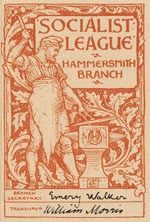
Simply the design of the membership card brings me to the real point of this rambling post. Art and labour brought together. The card is simply beautiful. It proclaims the unity of politics, life and art and above all it is optimistic. Like News From Nowhere, it assumes that the socialist future will transform people's lives for the better. When did we stop believing this? It's still there in Atlee's 1951 Festival of Britain (yes, the Tories took power in 1950 but the Festival was planned under the pioneering 1945-50 Labour government that founded the NHS and did so much more). After that? Not so much. Our supposed leaders are ashamed of the word socialist and whatever they do believe in, it isn't founded in optimism. Nor does it believe in a future which unifies love, life, joy, work, art and politics. Neither Labour nor the multiple far-left splinter groups offer anything positive. We spend our time accepting the ideological boundaries of neoliberalism and finding ways to mitigate the damage it does. I can't imagine the Milibands, Clegg, the SWP leadership or any of the others being able to understand the emotional or spiritual aspects of socialism that are integral to Morris's version.
Stunted by 'politics', they've lost us because they no longer have anything positive to offer beyond technocratic fixes. There's no way of life embodied in modern politics. There is in rightwing politics, but it too consists of joylessness: the Tories and UKIP spend their time saying 'no' to things – foreigners, human rights, the poor, community, altruism. That's OK: beyond Major's lazy fantasy of old maids cycling to communion, capitalist politics has always been about material acquisition. But it's not true of us. The left has forgotten that Marx, for all his talk of materialism, was funny, cultured and engaged with more than just economics - that's why his work is shot through with Shakespeare. Economics was part of his philosophy of life, rather than the other way round. Once the economics was sorted, he thought, our social, spiritual and philosophical ones would be too: happiness was the end, not simply material comfort. Morris knew this, and acted on it.
So why have we ended up with a political culture which would rather have us fulminating against 'scroungers', immigrants, Europe and each other, or competing over who can inflict most austerity to win votes rather than a labour movement which has a positive vision of how life could be. Last week the government gleefully announced that it would rather let African migrants drown than address the causes of their desperation. Every dead African is a vote reclaimed from UKIP, or so it hopes.
When did we forget that politics could be a vehicle for aspiration and happiness rather than a game of beggar-thy-neighbour? I believe, like Morris, that my fellow citizens are essentially altruistic and well-meaning, that given reform of our industrial, political and social structures this altruism could be liberated to achieve a better society. This is why I teach, and why I teach in an unfashionable ex-polytechnic in an unfashionable town (that and being essentially unemployable otherwise). The lesson of Morris is that all are capable of blossoming under and deserve justice and beauty – it's a socialism of humanity rather than just of economics: this isn't the 'art will civilise the brutish lumpenproletariat' argument of people like Matthew Arnold. It's the idea that intellectual and emotional freedom means nothing if it's reserved for the powerful or the 'swinish rich'. Hence Jeremy Deller's Venice Biennale painting:

It's called 'We Sit Starving Amidst Our Gold' as was inspired by Roman Abramovich mooring his mega-yacht in the middle of Venice, obscuring the views adored by Morris's hero Ruskin, without a thought for others. So here's WM, hurling Eclipse (the world's second largest yacht: two helicopter pads, two swimming pools etc.) out of the way. Morris really does seem to be having a moment.
I'd give up if I wasn't an optimist. I just wish there was a political party I could vote for that feels the same way. Suggestions on a postcard?
Wednesday, 4 September 2013
Bad Cover Version
Students: here's a clue. If you come in to university two weeks before the academic year begins because you're worried that you haven't done enough preparation for your dissertation, then you'll probably be OK. It's your colleagues who do exactly the same thing two weeks before the dissertation deadline who should be worried!
I said all the necessary stuff about time management and having something distinctive to say, but I have to confess that I've only ever had a marker's perspective on undergraduate dissertations: my own degree was assessed only by examinations. That suited me, being the kind of person who worked well under short-term pressure and afflicted by habitual lassitude when it came to sustained work over a period of time. It did mean that the MA and PhD dissertations were rather a struggle, however. I'd add one thing that sometimes gets overlooked: for your own sanity pick texts and lines of arguments you'll enjoy, because you'll be spending a whole year with them. Nothing will spoil a major piece of work more easily than boiling resentment. I know it's not always possible (every cohort contains some students who really don't care one way or another), but it definitely helps. I've recently marked dissertations of Foucault and Country House Mysteries (it was a blast), Milton and Pullman, Dystopian Visions, and (too many) World War 1 Poetry pieces.
Everything's worth writing about, providing you think about them carefully enough – the bane of any marker's life is the Fan's Dissertation. In English, that's usually about Tolkien, with the major Brontë novels not far behind. Here's a hint: 'Why Lord of the Rings Is Brilliant' doesn't cut it. However this year I am supervising a dissertation on Tolkien's notions of heroism, and it's looking good because it's analytical and located in JRR's cultural context.
The other thing that caught my eye today is this new line of 'classic' novels (i.e. famous ones that are out of copyright) published with pulp covers by Pulp The Classics.

Aesthetically, I like them a lot. One of my friends collects pulp novels just for the covers – I don't have the room to start another collection, but I can understand the attraction. I'm not entirely convinced by this range though: pulp is a very 50s thing, and I'm not sure a contemporary audience is being invited to re-assess the texts or pulp itself. Certainly there are plenty of 'classic' texts which would justify the pulp treatment, such as the 'penny dreadfuls' and 'yellow press' works of the Victorian and Edwardian periods. Varney the Vampire would do very well.
However, I do like the pastiche art and the wit evinced by this new line: check out the cover text on The Hound of the Baskervilles:

I do rather worry about this quote prominently carried on the publisher's website though:
'It is so great that you are doing this kind of publishing. Turning classics into fun.' - John Bird, founder of The Big Issue
'Classics' is a dubious category, and I particularly resent the idea that they aren't enjoyable per se. Do new covers affect one's reading? I guess they do because they set up a reader's expectations, but I'm not sure the cover would stay in my consciousness as much as the experience of reading the actual words contained in the text. Though on the whole I'm keen on attracting new readers to texts which might otherwise seem forbidding, which is why I'm a huge fan of Clueless, the greatest Austen adaptation (of Emma) in cinema history (oh yes it is).
Original pulp novels are fascinating, and not only for the art-work. They introduced to the reading public subjects unfit for 'polite' society: particularly anything sexual. For instance, lesbian pulp fiction was sold as shocking exposes of the perversion hidden within the midst of normality, yet isolated lesbians in 50s America read them for solace and solidarity, discarding the thin veneer of moralising. The freedom from the scrutiny of cultural gatekeepers was liberating (and perhaps lucrative). Hence The Price of Salt, a 1952 lesbian thriller by 'Claire Morgan', later unmasked as respected author Patricia Highsmith.

They were often exploitative, badly-written and shoddily produced, but they acted as a social subconscious: while people liked to be seen with the 'classics', sales figures tell you a lot more about we really liked to read. Little-read current Nobel Literature Prize winners will give future readers a rich sense of our culture, but Fifty Shades of Grey's popularity tells us what everyone else was interested in.
Pulp publishers had an eye on the money, rather than literary quality. Sensation sold, hence the emphasis on eye-catching artwork. Always keen to save money, some of the original pulp houses had the same idea as Pulp The Classics. Elek's 'Bestseller Library' imprint, for instance, started publishing out-of-copyright 'classics' with often very misleading covers and straplines. They knew that to English-language readers, anything French or Italian was assumed to be Utter Filth (thanks partly to censorious Home Secretary William Joynson-Hicks). As the customs officer at Dover remarks to the hero while confiscating his books,
If we can't stamp out literature in the country, we can at least stop its being brought in from outside.
The rule for buyers, of course, is caveat emptor: once the book is purchased, readers are very unlikely to return it complaining that there wasn't enough sauce, and the publishers knew that very well. No hassle from the police, no comeback from the reader who has accidentally bought some Literature. Even by the tamer standards of the period, The Decameron, the naturalism of Zola and Stendhal, and the stylised desperation of de Maupassant et al. aren't particularly racy: Fanny Hill is far more explicit.


Of course publishers aren't only after the Pervert Pound: they repackage all sorts of work for marketing purposes. I pick up Jane Austen reprints whenever I spot them. Because publishers think women and young people are scared of 'serious' work (and perhaps because they don't think women capable of producing it either, she's being sold as 'chick-lit', which sickens me. The notion of 'chick-lit' is patronising and thin enough, while Austen's work has to be read very much against the grain to force it into the conservative paradigms of stereotypical chick-lit. So the publishers take the lazy way out: pastel covers, handwriting-fonts, superficial blurbs.
 |
| Very much a 'classic' - but at least it doesn't trade on the author's sex |
 |
| Still serious, but now trading on Austen's sex rather than the novel's content |
 |
| Finally! A non-threatening 'girly' edition. Consider yourself marginalised, Ms. Austen. |
Friday, 27 April 2012
Occupy Occupy
I'm a big fan of political art, and of workers' rights, so you can probably imagine my enthusiasm for this Occupy/May Day poster.

The Americans seem so much better at underground political art than the British. Perhaps it's because socialist/class politics is so much more mainstream in the UK than the US. We're dominated by a tradition of prosaic and didactic art, and there's no real tradition of underground political art, though some places have good fly-posters. For the real thing, you've got to look to France. The US has a tradition - at least in some streets - of music posters being more artistic than informative, something I wish existed here. This poster is clearly derived from that tradition. Although I really like some of these British political posters (great exhibition), they don't appeal to the imagination, preferring to tug on familiar heart strings or to scare the voter.
This image isn't perfect: it's pretty opaque if you don't know what Occupy is, you won't learn anything. But I love the feminism, the steampunk juxtaposition of the dress and the skateboard, and the vaguely Nouveau background and the elegant Gill Sans font (or is it Johnston Sans?). It says that solidarity is cool. It's not just male miners and metal-bashers. It's not composite motions and the same dreary speeches. It's whimsical, but it's also hopeful. Over here, we've had decades of defeat as the left and the workers have been attacked as selfish dinosaurs.
What do we want in political art? More whimsy! When do we want it? Time is relative!
It's by Eric Drooker: more here.

The Americans seem so much better at underground political art than the British. Perhaps it's because socialist/class politics is so much more mainstream in the UK than the US. We're dominated by a tradition of prosaic and didactic art, and there's no real tradition of underground political art, though some places have good fly-posters. For the real thing, you've got to look to France. The US has a tradition - at least in some streets - of music posters being more artistic than informative, something I wish existed here. This poster is clearly derived from that tradition. Although I really like some of these British political posters (great exhibition), they don't appeal to the imagination, preferring to tug on familiar heart strings or to scare the voter.
This image isn't perfect: it's pretty opaque if you don't know what Occupy is, you won't learn anything. But I love the feminism, the steampunk juxtaposition of the dress and the skateboard, and the vaguely Nouveau background and the elegant Gill Sans font (or is it Johnston Sans?). It says that solidarity is cool. It's not just male miners and metal-bashers. It's not composite motions and the same dreary speeches. It's whimsical, but it's also hopeful. Over here, we've had decades of defeat as the left and the workers have been attacked as selfish dinosaurs.
What do we want in political art? More whimsy! When do we want it? Time is relative!
It's by Eric Drooker: more here.
Tuesday, 13 September 2011

Wednesday, 3 August 2011
Requiem for a city
I hate car culture: it's turned our cities into machines for crushing communities. But this kinetic sculpture makes all that movement beautiful. Though perhaps that's the secret: movement is pretty rare for urban drivers. Cars promise independence, individuality, escape and self-expression. What you get is isolation, selfishness and confinement. Mike Davies's wonderful history of LA, City of Quartz charts that metropolis's descent into vehicle hell, including the disgusting story of how a cartel of car and tyre maker successfully bought the local railway system solely to close it down - and were fined $1 for their crimes.
I don't drive, though if I had cash and space, I'd have a row of cars as sculpture: 1940s/50s Citröens, a Morris Minor convertible, big curvy American 1940s gangsters' cars.
The Mayor of Vilnius (Lithuania), one of the most beautiful places I've ever been, has a simple way to deal with selfish drivers:
I don't drive, though if I had cash and space, I'd have a row of cars as sculpture: 1940s/50s Citröens, a Morris Minor convertible, big curvy American 1940s gangsters' cars.
The Mayor of Vilnius (Lithuania), one of the most beautiful places I've ever been, has a simple way to deal with selfish drivers:
Monday, 11 April 2011
Santa's been
I've been rather irresponsible with cash recently, which must stop. Today's post was embarrassing - a new camera lens and a reversing ring, two volumes of the US post-apocalypse graphic novel DMZ, and two pieces of beautiful art. One is a limited edition (200 copies) hand-made reprint by Gwasg Gregynog of Social Hymns: A Selection in Celebration of Robert Owen (1771-1858) (he was a prominent social reformer and radical).

The other is a stunning limited edition single sheet of hand-made paper with a Charles Dickens quotation ('There are BOOKS of which the backs and covers are by far the best parts') for the office wall. I should have got a copy for Mark: many of his 15,000 (!) books were bought for their cover art, and he's no intention of reading them.
It will hang next to a photograph of winter in this town I had printed on acrylic, the Evening Sentinel front page the day Stoke City were promoted to the Premiership, a framed poster of the Reds! The Story of the Communist Party of Great Britain conference at the People's History Museum in 2003 and several piles of other art prints which will go on the walls at home once I have a home with more wall than bookcases…

The other is a stunning limited edition single sheet of hand-made paper with a Charles Dickens quotation ('There are BOOKS of which the backs and covers are by far the best parts') for the office wall. I should have got a copy for Mark: many of his 15,000 (!) books were bought for their cover art, and he's no intention of reading them.
It will hang next to a photograph of winter in this town I had printed on acrylic, the Evening Sentinel front page the day Stoke City were promoted to the Premiership, a framed poster of the Reds! The Story of the Communist Party of Great Britain conference at the People's History Museum in 2003 and several piles of other art prints which will go on the walls at home once I have a home with more wall than bookcases…
Friday, 3 December 2010
Brrrr
Shivering in my freezing flat, I was reminded that warmth is very much a class issue, and remembered this from Eric Gill's rambling 1930s book, Typography. How would you like to live in a household shopping at Robinson and Cleaver, Belfast?
He also has these stirring words, which mean even more in an economy predicated on turning our workforce into mechanical adjuncts on minimum wages:
There are echoes of Marx (alienation) of Arts and Crafts and of Tressell's Ragged-Trousered Philanthropist here. What strikes me is that of course the working-class occupations have been reduced to drone-work, but so have the jobs which we self-deceptively call professions. Here I am in a warm office surrounded by books, smugly thinking that I'm free, but it's not true. We're under constant electronic and intellectual surveillance, some of which has been internalised (Foucault had plenty to say about internalised discipline). Our work is being reduced to that which can be conveyed electronically: outcomes and metrics which any decent teacher would reject as reductive, philistine and ridiculous. Anything important I manage to discover in conversation with my students can't be expressed on a module evaluation form, a flowchart or a statistic. Intellectual labour isn't like that - but the institution thinks that measurable things are essential and unmeasurable things are beside the point. The modern lecturer isn't an artist, and nor is the modern student. They should be, but the Browne Report, Cameron, Cable, Clegg, Gove and all their friends would respond to the question of whether they should be with a resounding OF COURSE NOT.
Which is why we're all in it together. As long as 'it' refers to a big bucket of intellectual, philosophical, cultural and economic shit.
'Best blankets at 80s per pair, blankets 'for the spare room' at 65s, blankets 'for servants' bedrooms' at 25s, and blankets 'for charitable purposes' at 18s'.
He also has these stirring words, which mean even more in an economy predicated on turning our workforce into mechanical adjuncts on minimum wages:
'…the most monstrous characteristic of our time is that the methods of manufacture… of which we are proud are such as make it impossible for the ordinary workman to be an artist… That the ordinary workman should or could be an artist, could be a man whom we could trust with any sort of responsibility for the work he does… is an idea now widely held to be ridiculous; and the widespreadness of this opinion proves my point as well as I could wish. When I say no ordinary workman is an artist, no one will say I am lying; on the contrary, everyone will say: Of course not'.
There are echoes of Marx (alienation) of Arts and Crafts and of Tressell's Ragged-Trousered Philanthropist here. What strikes me is that of course the working-class occupations have been reduced to drone-work, but so have the jobs which we self-deceptively call professions. Here I am in a warm office surrounded by books, smugly thinking that I'm free, but it's not true. We're under constant electronic and intellectual surveillance, some of which has been internalised (Foucault had plenty to say about internalised discipline). Our work is being reduced to that which can be conveyed electronically: outcomes and metrics which any decent teacher would reject as reductive, philistine and ridiculous. Anything important I manage to discover in conversation with my students can't be expressed on a module evaluation form, a flowchart or a statistic. Intellectual labour isn't like that - but the institution thinks that measurable things are essential and unmeasurable things are beside the point. The modern lecturer isn't an artist, and nor is the modern student. They should be, but the Browne Report, Cameron, Cable, Clegg, Gove and all their friends would respond to the question of whether they should be with a resounding OF COURSE NOT.
Which is why we're all in it together. As long as 'it' refers to a big bucket of intellectual, philosophical, cultural and economic shit.
Monday, 1 November 2010
Off to the Biennial
Biennially is about as often as I make it to art exhibitions, so I, along with colleagues and friends, am off to the Liverpool Art Biennial on Saturday, which should be very exciting.
You can read Follow The Yellow Brick Road's marathon/express review here, but I was most impressed by this exhibit, which is exactly the kind of thing I'd install on every street corner in the world:
You can read Follow The Yellow Brick Road's marathon/express review here, but I was most impressed by this exhibit, which is exactly the kind of thing I'd install on every street corner in the world:
visitors can also explore artworks such as The Marx Lounge by Alfredo Jaar, which includes three copies of every work ever written by, or about Marx, complete with comfy sofas should you wish to peruse them.
Thursday, 2 September 2010
Record/heart breaker

Monday, 14 June 2010
Macritte
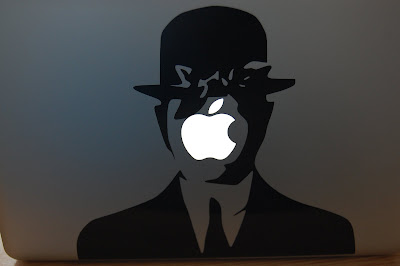
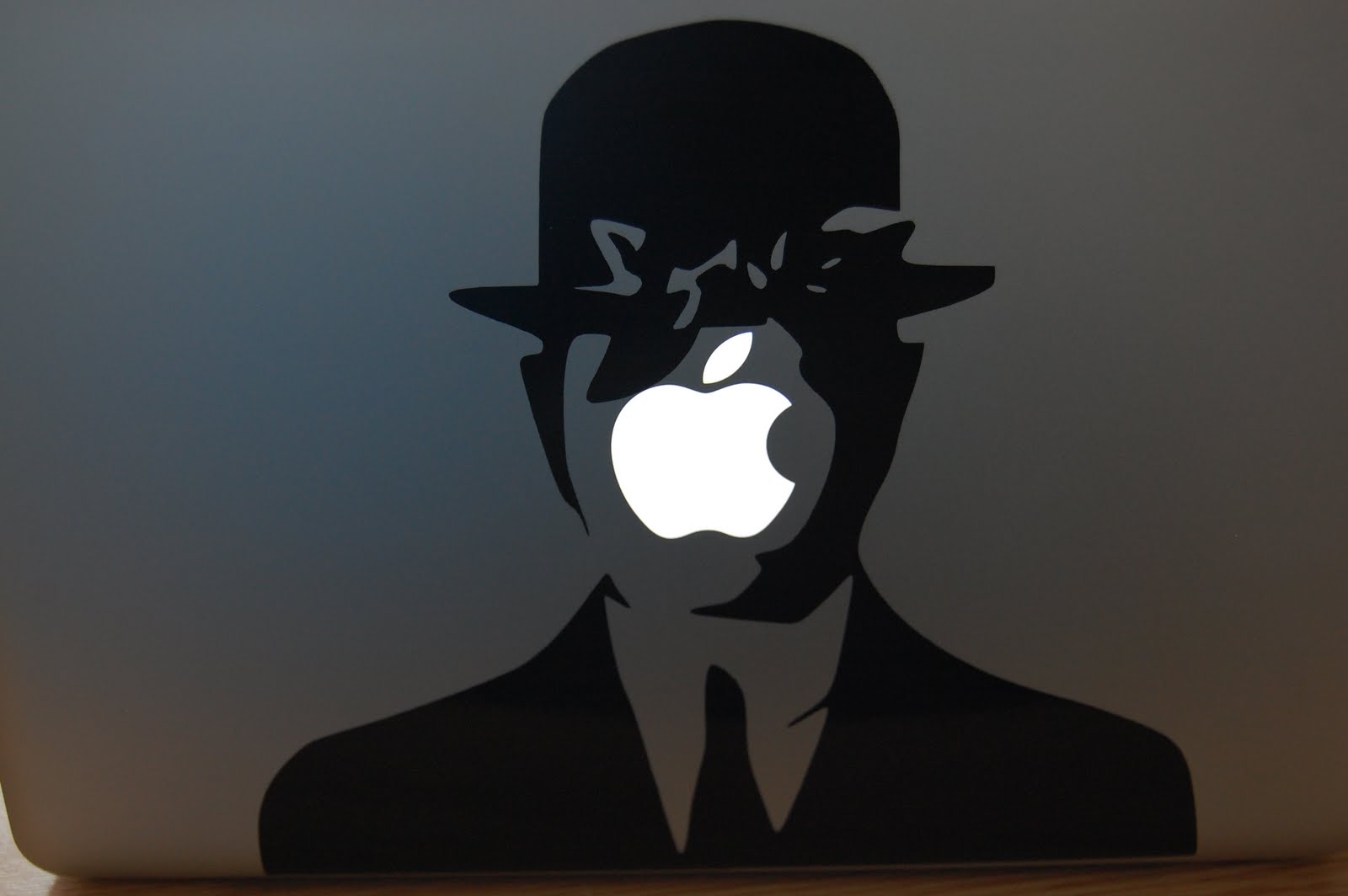
I've attached this decal to my MacBook, as I'm a fan of Magritte's work and thought it was witty. The designer has it laser-etched onto his machine - wish I had access to such technology.


Wednesday, 28 April 2010
Say cheese!

There's an interesting new exhibition on at Tate Britain from September: the photographs of Edw(e)ard Muybridge, a pioneer of photographing motion in the 19th century. He liked sportsmen, horses and naked women as subjects, and was acquitted of murdering his wife because the American jury thought that her adultery was a graver offence.

Wednesday, 17 March 2010
They don't know much about art…
Wednesday, 3 March 2010
Pop Art!
The song's not much cop, but this video is brilliant (and a little bit cheeky). A genuine prize if you can list every single painting referenced!
The band is Hold Your Horses, the song is 70 Million. Originally posted by Intelliwench.
The band is Hold Your Horses, the song is 70 Million. Originally posted by Intelliwench.
Monday, 1 March 2010
Good morning. The sun's shining, my office is empty and I've some enjoyable work to do (research, proofreading, and allied tasks).
Apart from the Chilean earthquake (donate to the Red Cross here), it's been a good weekend. Friday night saw me sipping a single pint while listening to Cruel Brother (consisting of friends/colleagues) at an open mic night in a suburban pub. They were good - but were overshadowed by the next act. This unnamed duo consisted of a fantastically cool, dreadlocked Afro-Caribbean blues-jazz guitarist with a great voice, and a 6ft tall woman with flowing blonde hair, big hands and a bigger voice - she is either a transexual or a transvestite - who is also a stunning guitarist. I should admit that I admired their technical skills more than I enjoyed what they played, because 'noodling' isn't my preferred style, but they certainly had stage presence.
Saturday saw the arrival of Cynical Ben and Kerrywoman. Off we trotted to an art gallery in a beknighted hole: Four Ashes, the Mordor of the West Midlands. The gallery is owned by Frank Cohen, a hugely rich businessman who buys a lot of art. It's an odd place: 2 units on an industrial estate, currently hosting a collection of British and Scandinavian minimalist art, some good, some not so good. I did like the cupboard designed for hiding in by people scared of alien invasion though. The guy on the desk hadn't had any visitors for a while, and seemed grateful for human interaction, so go there!
Then to the pub to make the English amongst our group watch their egg-chasers lose to Ireland's egg-chasers, and we saw the first half of Stoke-Arsenal. At 84 minutes, we were on for a satisfactory 1-1 draw. By 90 minutes (+et) it was 3-1 to them and a Stoke player had inflicted an horrific, accidental, leg-break on one of their players. What a way to end an unbeaten run.
The rest of the night consisted of Thai food and lounging around playing amusing music and talking nonsense - perfect. Sunday consisted of much the same - lots of newspapers and enduring Emma's triumphalism as Manchester United stole the FA Cup from Aston Villa.
Apart from the Chilean earthquake (donate to the Red Cross here), it's been a good weekend. Friday night saw me sipping a single pint while listening to Cruel Brother (consisting of friends/colleagues) at an open mic night in a suburban pub. They were good - but were overshadowed by the next act. This unnamed duo consisted of a fantastically cool, dreadlocked Afro-Caribbean blues-jazz guitarist with a great voice, and a 6ft tall woman with flowing blonde hair, big hands and a bigger voice - she is either a transexual or a transvestite - who is also a stunning guitarist. I should admit that I admired their technical skills more than I enjoyed what they played, because 'noodling' isn't my preferred style, but they certainly had stage presence.
Saturday saw the arrival of Cynical Ben and Kerrywoman. Off we trotted to an art gallery in a beknighted hole: Four Ashes, the Mordor of the West Midlands. The gallery is owned by Frank Cohen, a hugely rich businessman who buys a lot of art. It's an odd place: 2 units on an industrial estate, currently hosting a collection of British and Scandinavian minimalist art, some good, some not so good. I did like the cupboard designed for hiding in by people scared of alien invasion though. The guy on the desk hadn't had any visitors for a while, and seemed grateful for human interaction, so go there!
Then to the pub to make the English amongst our group watch their egg-chasers lose to Ireland's egg-chasers, and we saw the first half of Stoke-Arsenal. At 84 minutes, we were on for a satisfactory 1-1 draw. By 90 minutes (+et) it was 3-1 to them and a Stoke player had inflicted an horrific, accidental, leg-break on one of their players. What a way to end an unbeaten run.
The rest of the night consisted of Thai food and lounging around playing amusing music and talking nonsense - perfect. Sunday consisted of much the same - lots of newspapers and enduring Emma's triumphalism as Manchester United stole the FA Cup from Aston Villa.
Thursday, 17 December 2009
Bye Donal. Don't go alone
Finally, a senior clergyman has resigned over the many, many, Irish sexual abuse cases. A recent report identified several named Bishops as involved in the cover-ups - moving abusive priests on to fresh new territory, refusing to investigate accusations and the like. Donal Murray, Bishop of Limerick was merely one of this cabal who decided that the strength of the Church outweighs the needs of raped children, their families and the community.
More need to go. Schools need to be handed over to the State (they're still run 'for' the State by religious institutions in Ireland, and the Pope needs to 'fess up. In his previous job, Prefect of the Congregation of the Doctrine of Faith (it probably sounds cooler in Latin), he had responsibility for all this stuff. He knew, and said nothing.
Ireland used to be the hope of the Catholic Church. While other nations slipped away into atheism or (worse) Protestantism, or developed strands of Liberation Theology (the idea that Catholic priests should identify with the poor and the oppressed rather than bolster the ruling classes), Ireland's Catholics stayed obedient, reactionary and devoted. They handed their children over to the Church and received in return a ruling class that never lifted a finger without checking with Rome first. One image serves well: all of the government and senior oppostion, with the brave exception of Noel Browne (an all-round hero), waited outside the funeral service for the President of Ireland, Douglas Hyde (owner of a splendid moustache), because the Catholic church forebade its members from attending Protestant services.
Catholicism's on my mind today. I certainly don't have any nostalgia for my days as an altar boy or choir boy, but it leaves its effects, positive and negative, even on we liberated atheists. I'm definitely a Catholic Atheist! In London the other day, Adam and I visited the National Gallery's The Sacred Made Real exhibition, a collection of paintings and statues from the 17th-century Spanish Counter-reformation. All the statues are hyper-real: John the Baptist's head is painted, and moving around the glass case reveals a neck complete with windpipe and bloody flesh. The Christs are all heavily scourged and wounded, the tears dripping from Mary's eyes are made of crystal.
It's the iconography of a church which feared and distrusted its congregation. Not for them the tales of liberation and joy available in the New Testament. Instead, the emphasis is on suffering and sacrifice: Jesus crucified and the gory martyrdoms of various saints, all dwelt upon with a dark kind of pleasure. The people, clearly, were urged to identify with the misery and pain of these events, rather than to consider the positive aspects of the religion. It's a very personal, inward-looking kind of belief, designed to encourage the faithful to resist the wider social and moral attractions of rival denominations. As art, the images are disturbingly beautiful. As theology, they're terrifying. This is what lies at the heart of the Irish scandal.

More need to go. Schools need to be handed over to the State (they're still run 'for' the State by religious institutions in Ireland, and the Pope needs to 'fess up. In his previous job, Prefect of the Congregation of the Doctrine of Faith (it probably sounds cooler in Latin), he had responsibility for all this stuff. He knew, and said nothing.
Ireland used to be the hope of the Catholic Church. While other nations slipped away into atheism or (worse) Protestantism, or developed strands of Liberation Theology (the idea that Catholic priests should identify with the poor and the oppressed rather than bolster the ruling classes), Ireland's Catholics stayed obedient, reactionary and devoted. They handed their children over to the Church and received in return a ruling class that never lifted a finger without checking with Rome first. One image serves well: all of the government and senior oppostion, with the brave exception of Noel Browne (an all-round hero), waited outside the funeral service for the President of Ireland, Douglas Hyde (owner of a splendid moustache), because the Catholic church forebade its members from attending Protestant services.
Catholicism's on my mind today. I certainly don't have any nostalgia for my days as an altar boy or choir boy, but it leaves its effects, positive and negative, even on we liberated atheists. I'm definitely a Catholic Atheist! In London the other day, Adam and I visited the National Gallery's The Sacred Made Real exhibition, a collection of paintings and statues from the 17th-century Spanish Counter-reformation. All the statues are hyper-real: John the Baptist's head is painted, and moving around the glass case reveals a neck complete with windpipe and bloody flesh. The Christs are all heavily scourged and wounded, the tears dripping from Mary's eyes are made of crystal.
It's the iconography of a church which feared and distrusted its congregation. Not for them the tales of liberation and joy available in the New Testament. Instead, the emphasis is on suffering and sacrifice: Jesus crucified and the gory martyrdoms of various saints, all dwelt upon with a dark kind of pleasure. The people, clearly, were urged to identify with the misery and pain of these events, rather than to consider the positive aspects of the religion. It's a very personal, inward-looking kind of belief, designed to encourage the faithful to resist the wider social and moral attractions of rival denominations. As art, the images are disturbingly beautiful. As theology, they're terrifying. This is what lies at the heart of the Irish scandal.

Monday, 26 October 2009
Should we kneel?
The rather wonderful Follow the Yellow Brick Road is at no. 16 on Creative Tourist's list of 25 Best Arts Blogs - and rightfully so. Er, I mean, she belongs on the list, not rightfully at 16. Higher! Higher!, as Brucie would say. Go there, learn shame.
…then back to the art
After lunch at Gaby's, a wonderful falalel and all things Eastern café (near Leicester Square) on Steve's recommendation, we trooped off to the National Gallery's medieval section - I love the way the pre-Renaissance artists combined odd perspectives, deep blues and golds, religious stories and (mainly) Italian politics and landscape, such as this by the Clarisse Master (1265 or so), this Bellini, Botticini's Assumption of the Virgin featuring several local Italian bigwigs, and this stunning da Messina of St. Jerome in his study (click for larger image), which plays with perspective wonderfully.


After that, we stopped for Holbein's The Ambassadors, one of the best few paintings in the world - every item, every fold, every stroke is multiply significant - and across the bottom is this streak of paint which (if you stand in the right place), resolves itself as a skull, subverting the power and glory of the two men featured with all their riches, achievements and ambitions. You really need to click on it to get the big picture (sorry).

After all that art and excitement - how to unwind? How about Honey and Ginger Ice-cream Sundae and iced mint tea at Fortnum and Mason's? Positively sybaritic.
Sunday was relatively relaxed: I went to watch Manchester United lose, in the Hogshead, with Neal and Emma (a Man U fan), for whom I cooked a scrumptious meal of roasted fennel, celeriac and various other vegetarian objects, while we all read the Sunday newspapers and watched In the Loop, which loses none of its sharpness with multiple viewings. Watching the footy was a particular pleasure, Stoke City having won too…
I got me some art-learnin'
Hi all. How was your weekend (bank holiday weekend, for the Irish and New Zealanders)? Mine was glorious. Firstly, I did no work at all. In fact, I did the opposite of work, much of it the company of colleagues who were similarly determined to not even think about work.
Friday - to the pub, of course. But Saturday saw me on a train to London to see the Anish Kapoor exhibition at the Royal Academy of Arts. I turned up early to see the Wild Thing exhibition - Epstein, Gill and Gaudier-Brzeska, which was fabulous and still shocking in many ways. They reintroduced 'direct carving' (i.e. chisel on block rather than making clay and plaster casts for technicians to reproduce. They revisioned sculpture and heavily influenced each other. If you want to see lots of Epstein, go to Walsall Art Gallery - their collection is based on Epstein's own work plus that collected by he and his wife. Here's a photograph of Epstein's Rock Drill, which was so advanced that it was totally rejected by the critical establishment. He took it apart, did a bronze cast of the head and torso and chucked the rest away - the version in the exhibition is a 1970s reproduction. I've gone on about Eric Gill far too much, so won't dwell on his manichaean genius any further here.


This is Gaudier-Brzeska's Ezra Pound, the poet.

Kapoor's Savayambh, pushing through the door.

Kapoor's The Tree and the Eye.

The Wolverhampton University Culture Vultures.

The Wax Cannon.
Friday - to the pub, of course. But Saturday saw me on a train to London to see the Anish Kapoor exhibition at the Royal Academy of Arts. I turned up early to see the Wild Thing exhibition - Epstein, Gill and Gaudier-Brzeska, which was fabulous and still shocking in many ways. They reintroduced 'direct carving' (i.e. chisel on block rather than making clay and plaster casts for technicians to reproduce. They revisioned sculpture and heavily influenced each other. If you want to see lots of Epstein, go to Walsall Art Gallery - their collection is based on Epstein's own work plus that collected by he and his wife. Here's a photograph of Epstein's Rock Drill, which was so advanced that it was totally rejected by the critical establishment. He took it apart, did a bronze cast of the head and torso and chucked the rest away - the version in the exhibition is a 1970s reproduction. I've gone on about Eric Gill far too much, so won't dwell on his manichaean genius any further here.

When my comrades turned up, we trooped into the Anish Kapoor exhibition. His interests are in space, form and the body - one room contained pallets of extruded concrete, reminiscent of turds, maggots or intestines. Another contained a long, writing intestinal tube which ended in a shiny red vulval aperture, while Svayambh consists of a 30-ton red wax carriage endlessly moving through 5 galleries, squeezing through each ornate doorway and leaving wax splattered over the walls and edges - it's hard not to think of childbirth. Elsewhere, a cannon fired red wax onto the wall every twenty minutes (no, me neither).
Kapoor plays with perceptions too - the perfect white pregnancy bump (or malignancy bump) on the wall which can only be seen from one oblique angle, the fairground mirrors, the deep receding yellow hollow: spatial perception is warped throughout, as is the nature of art and the role of the gallery. The sculpture outside (The Tree and the Eye) is also interesting - at first it just seems a little flashy, but then I realised that it's doing two things: warping your perception of the severe classically-designed buildings surrounding it, and turning you into the art: to look at it or take pictures of it is to publicly proclaim your narcissism - there's no way to view this art without gazing at yourself, so that every picture is a self-portrait (should it be The Tree and the I?).
Here are a couple from the exhibition and some more of the day here. The bad ones are of Ezra Pound by Gaudier-Brzeska, and Kapoor's Svayambh - rubbish quality because photography isn't technically welcomed, so I used my camera phone. The others are of my fellow cultural refugees.

This is Gaudier-Brzeska's Ezra Pound, the poet.

Kapoor's Savayambh, pushing through the door.

Kapoor's The Tree and the Eye.

The Wolverhampton University Culture Vultures.

The Wax Cannon.
Tuesday, 6 October 2009
Bye Tracey! Take Damien with you?
Tracey Emin is planning to leave Britain because tax will rise to 50% on any money earned over £150,000. Brilliant. All those one-joke, limited, attention-seeking ligging artists whose work is funded and bought by shyster Tories like Saatchi can get lost: they're the spirit of vacuous, consumerist 90s Britain, rather than commentaries on it.
Rich wankers always promise to leave - Phil Collins, Paul Daniels, but they never do. Let's try to get a written contract and sue if they don't. Paying tax is a social duty from which we all benefit. We should be publicly shaming corporations and individuals who evade it.
Subscribe to:
Posts (Atom)