Showing posts with label Labour. Show all posts

Thursday, 23 July 2015

Labour! Back to the Future with Morris and Kropotkin!

I've largely kept my own counsel about the Labour Party leadership election. It's proving so divisive, and the arguments are so tediously familiar that it's hardly felt worth joining in. I'm a Labour member despite the attractions of more radical, purer and (sometimes) open-minded alternatives to the left such as the Greens, Plaid and various groupuscules. Mostly I'm in because I don't like vanguard parties: those who would far prefer having another purge of ideologically suspect splinter factions than actually make any effort to attain power. Labour, for all its myriad sins, wants to be elected and actually run the country. Also, the SWP is run by a rapist and his rape apologist friends. If any one of the revolutionary parties actually showed any sign of getting a revolution going, I'd be tempted but I strongly suspect that they're actually just fantasists.

So anyway, that leaves us with Labour and its interminable election. The party which encouraged its MPs to 'lend' left-winger Jeremy Corbyn enough nominations to 'widen the debate' beyond the three centre-to-right Oxbridge wonk candidates and whose higher echelons are now screaming blue murder because people listened to the debate and seem to have decided that they rather like what Mr Corbyn has to say. We're not quite at the stage of Dick Tuck's 'The people have spoken, the bastards', but several rival candidates say they wouldn't serve under Corbyn while the newspapers are full of threats to stage a coup against him if he wins. That implies that New Labour hasn't yet grasped the point of democracy yet.

The New Labour argument is that the people are now very rightwing, and if you don't become equally rightwing, you can't be elected. If you think back to the Blair government, the discourse around the poor, minorities, civil liberties etc. seemed to imply that the Masses are small-minded racists who should be pandered to, while simultaneously providing some social support to make up for the determination to become a fully-fledged neoliberal economy.

There's also the – very real – threat of the press. Politicians need the press because there's no way to communicate with the electorate in an unmediated fashion. Yes, there are social media but the research I've read suggests that it's far less important than we might think. The printed press is overwhelmingly Conservative and the BBC long ago adopted the discourse of the right.

So that's the message from Cooper, Burnham, and Kendall. The market has won, the people hate scroungers and foreigners, the state should shrink and shut up. It's the politics of fear, and of failure: they have abandoned any attempt to formulate a set of principles, and to attempt to persuade the electorate of the virtues of said principles.

And then there's Jeremy Corbyn. I read this short profile and found myself nodding. He attended a polytechnic for higher education, a much more common experience than the elevated world of the others. He grew up in the rural provinces – Wiltshire and Shropshire – and moved to London, so he's seen several sides of life. Like me, he's a socialist and a member of the Campaign for Nuclear Disarmament, and opposed the war in Iraq. He opposed apartheid actively and made links with Sinn Féin in an effort to end the war in Northern Ireland, years before it became fashionable. He supports the Palestinians without being an anti-semite. He's a cycling vegetarian who also takes the train, and he likes his stimulants to be of the Fairtrade variety.

In sum, he's everything that Orwell hated about the left back in the 30s, and that the sharp-suited managers of neoliberalism who run Labour abhor. He's that most tedious of things, a true believer. He has principles which alter not when he alteration finds.

“One sometimes gets the impression that the mere words ‘Socialism’ and ‘Communism’ draw towards them with magnetic force every fruit-juice drinker, nudist, sandal-wearer, sex-maniac, Quaker, ‘Nature Cure’ quack, pacifist, and feminist in England.” (Orwell, The Road to Wigan Pier)

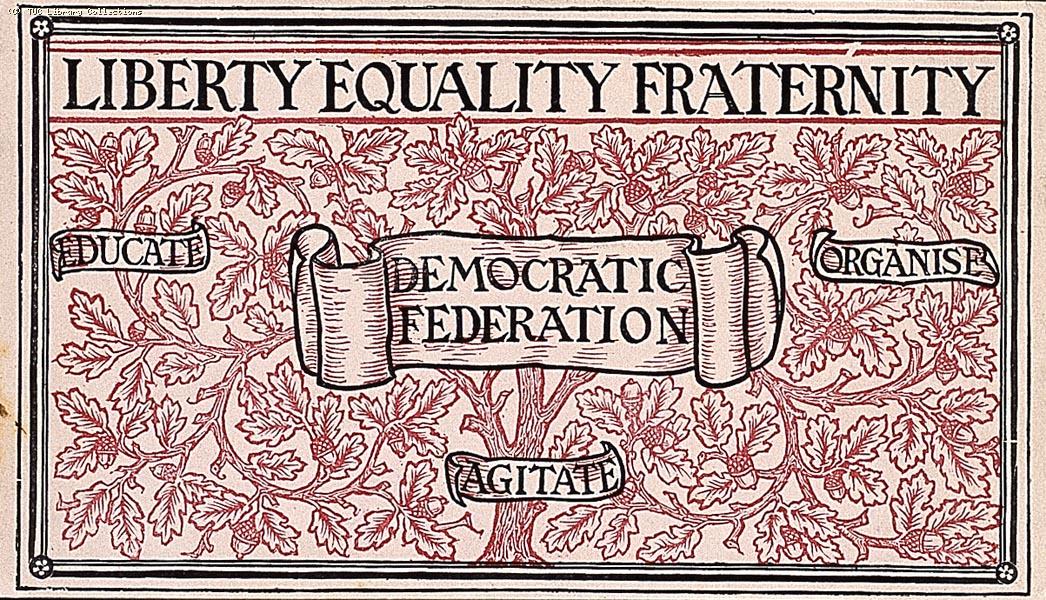
A few months ago, I suggested that Labour would win if they returned to the optimistic vision of the pre-Labour socialist movements, particularly William Morris. It's been a bloody awful century or so for Labour: always on the back foot, always struggling to protect those battered by the worst depredations of capitalism and global realpolitik (when it bothered, that is). Labour has been so preoccupied with defensive manoeuvres that it forgot to articulate any positive vision: the big ideas have all been from the right, and Labour has, in government, attempted to ameliorate them round the edges.  But if you look back to the late 19th century when London was a hotbed of leftwing debate from Kropotkin to Marx, Crane, Morris and the Socialist League, you see a left that thought the future belonged to the workers, that a new society was possible. They were confident, optimistic and articulate. That their campaign material was beautiful made the point: a socialist future was a beautiful, fulfilling future which was within reach.

Walter Crane
I can't imagine Morris or Crane designing this, for instance:


I'm being told that a vote for Jeremy Corbyn is a vote to make Labour just another purist sect with no interest in governing; that a vote for any of the others is 'serious', a commitment to seizing the reins of power. What I don't see from them is any indication that they know what to do once they get there: they are neoliberal technocrats. I don't know whether they have any beliefs because all I hear from them is tactics. Do they really think the British people are mostly selfish racists, or is it just a tactic? Either way, they depress me.
Walter Crane

I genuinely believe in most of what Jeremy Corbyn stands for. But more importantly, I think he has a value system and a programme which goes beyond triangulating the results of focus groups. I think he – perhaps naively – believes that his fellow citizens are at heart kind and thoughtful, and that if he articulates a clear vision of a better society, they will vote Labour.

Neither I nor, I suspect, Corbyn, is quite the unreconstructed Dictatorship of the Proletariat socialist he's being painted by his Labour or external opponents. We all know that industrial, economic, social and global upheaval means that a movement based on and only obsessed with skilled manual labour has little future. The miners, millworkers and factory hands are largely gone. Their work has mostly been shipped off to dictatorships so that we don't have to think about it. In its place here is a working life of insecurity and invisibility: for now it's the cleaners and call-centre workers who are exploited, bullied and fired without cause. But soon it will be almost all of us. Our jobs are becoming weightless: we work in isolation, on zero-hour contracts. Not just the immigrant cleaners and traffic wardens but the university lecturers, those who care for our old folk and those who grow our food. Being middle class won't help: virtually every job can be automated (check your job via that link). Our climate sickens and dies, but we get cheap flights and cheap clothes (thanks, Indonesian toddlers).


Trained to be individualists and isolated in the way that the factory workers and miners weren't, we've been stripped of the means to resist, but also stripped of the opportunity to formulate positive alternatives: those obsessed with the promise of Big Tech and the 'sharing economy' might like to recall that Google, Apple, Pixar and Co engage in some very Old Economy behaviour: tax avoidance and ganging up to stop its workforce becoming mobile and demanding a fair share of the profits. It is a new world, and forward-thinking socialists must generate new solutions to new problems, new ways to organise, new conceptions of the state and new arguments formulated in collaboration with the people. I think that Corbyn will, whereas I think the other candidates don't even see them as problems at all. The ultra-poor don't vote, so why bother worrying about them?

I'm voting for Corbyn because I think that a point comes where you have to shake off the fear that drives political calculation and express faith in a set of principles. I think people are sick of the petty differences between essentially indistinguishable parties. I would like to elect a leader who thinks that persuading the electorate is his or her job, rather than to assume that its darker impulses are its overriding values. In the end, I'm a democrat. I think that most people, given the chance, want to be kind, supportive, co-operative, peaceful and fair to each other: tendencies despised and rejected by the current political model. All we need is the political space to express those instincts, and I think a Labour Party led by Mr Corbyn could go some way to creating that space. And if I can't vote according to my principles in an internal party election, when can I?

Friday, 20 September 2013

Of Sluts, and Strikes, Or, Forward to 1912!

One of the interesting things about postmodernism is that with language and meaning sundered, anyone can appropriate it for their own purposes. 

Take this clip of Godfrey Bloom, Member of the European Parliament and former habitué of Hong Kong brothels, berating – and hitting – journalist Michael Crick for his supposed 'disgraceful' racism, after the Channel 4 hack pointed out that UKIP's conference material didn't stretch to a single non-Caucasian face.


This is the Godfrey Bloom whom this morning described women in politics as 'sluts' and referred to Africa as, well, see for yourself:


Somewhat unfashionably, I'm quite a supporter of 'political correctness', or to put it more simply, politeness. Anyone with a serious argument to make doesn't need to reach for personal, racial or sexual comments to further said argument. Bloom's dyspeptic accusation of racism is laughable on one level, but also dangerous: it's a deliberate attempt to render the term meaningless so that it can't be used against him and people like him when they say racist things.


Perhaps UKIP couldn't find a single black person for their publicity because they don't have any black candidates or even members. In a sense, their brochure may be honest at a deeper level: where other parties (and even some advertisers) feature people from ethnic minorities to look inclusive and progressive, UKIP is clear: they just don't want black people in their party. The leadership might not say so out loud, but the membership speaks volumes. They see all black people as foreigners and would happily see them deported. 


It's easy to dismiss UKIP as the latest manifestation of red-faced blustering Tory golf-club bar bores calling for 'a small libation for my good lady wife' and dreaming of bringing back the birch. For good reason: that's what they are. But they're far more important than that. The UK has a shrill, rightwing media which concertedly plays on the prejudice of bourgeois reactionaries while tacitly encouraging the dominance of another group of rightwingers, the financial engineers. The little-Englanders attract votes for neoliberal parties through dog-whistle politics while the parties they elect get on with cutting wages, axing pensions, privatising hospitals, denying climate science and removing workers' protection. On some of these things, the UKIP voters agree with the money-men; on others, they just don't care. Currently, the rightwing newspapers loathe the Coalition government and use UKIP to drag the Tories further to the right, economically and socially. This contradiction in the strands of conservatism is encapsulated in Nigel Farage: while he talks endlessly about the conservative culture wars (hating political correctness, the little man being crushed by Brussels etc etc), he made millions in the City, exactly the kind of 'socially useless' gambling which erodes the supposedly 'English' or 'British' values many of his members purport to endorse. Given the opportunity, he would privatise everything in sight, yet his members are staunchly against the free-market free-for-all for which their monetarist cousins yearn. Farage wants a low-wage economy in which shareholders take what the workers should be paid: whatever he says in public, he knows that a globalised, mobile proletariat is key to maintaining this capitalist Utopia. Truly, being a conservative politician is to ride two horses straining to gallop in different directions. 


Giving UKIP the oxygen of publicity makes them seem important, provoking the Tory Party to chase their votes by shaping an even more reactionary agenda. We all know UKIP's leadership are bluff 'common sense' buffoons who'd steer the country into a ditch on their first day in office, or liek Farage, appear to be bluff common sense buffoons while actually pursuing a private agenda inimical to their own voters. But they're important because they're being given the opportunity to make the political running, despite their minimal size and lack of elected representatives. We're being dragged to the hard right. 


The Tories have accepted this drift from respectable conservatism to fringe lunacy as the price of power, becoming a Tea Party in tailored suits. So much, we'd expect: the Tories value political survival way above principle or ideology. But Labour should be ashamed. Ever since the dark days of Blair, the Oxford-Party HQ-SpAd-Safe Seat brigade who run the party have assumed that the working class is made up of thuggish racists. Needless to say, virtually none of these Bright Young Things have ever worked for a living, originated in the working class or lived amongst them. But they've read about them, and they know that White Van Man reads The Sun and hates Gypsies, women, foreigners and 'poofs' (his boss reads the Mail and expresses his identical prejudices in politer language). 


Rather than assume that a misinformed population has better instincts which can be awakened by discussion, education and reason, New Labour decided that it would be easier to pander to these prejudices, hence the vile race-baiting perpetuated by Labour ministers like Reid, Blunkett and Woolas, the immigration minister who claimed that 'illegal immigrants' and al-Qaeda wanted the Lib Dems to win in his constituency:


So what we now have is a political system in which all the major parties have decided that a) the voters are vile scum and b) their perceived prejudices should be adopted as party policy. UKIP is merely the latest boogie-man used by Murdoch et al. to make potential governing parties stay at heel. 


I'd like the Labour Party, at least, to return to the 1930s. Back then, it was forced by the Independent Labour Party and the Communist Party to remain agile, radical and close to the electorate without adopting the darker impulses of the populus. It had confidence in the people's intelligence and goodwill. Now, we have parties which fear and resent the population, a political class which wants to be left to get on with things unhindered by the mere citizenry. One section of the left was Syndicalist. Their vision of the future was workers' co-operatives running each industry and negotiating with other industries to the people's mutual benefit, without government. You may or may not see this as a good idea, but the Syndicalists had a very keen eye for the pitfalls of representative politics such as the UK adopted. Here's what the 1912 South Wales Miners' pamphlet The Miners' Next Step has to say about political and trade union leaders' inherent conservatism:


In the main, and on things that matter, the Executive have the supreme power. The workmen for a time look up to these men and when things are going well they idolise them. The employers respect them. Why? Because they have the men - the real power - in the hollow of their hands. They, the leaders, become "gentlemen," they become M.P.'s and have considerable social prestige because of this power. Now when any man or men assume power of this description, we have a right to ask them to be infallible. That is the penalty, a just one too, of autocracy. When things go wrong, and we have shown that they have gone wrong, they deserve to be, and are blamed. What really is blameworthy, is the conciliation policy which demands leaders of this description.

For a moment let us look at this question from the leaders' standpoint. First, they are "trade unionists by trade" and their profession demands certain privileges. The greatest of all these are plenary powers. Now, every inroad the rank and file make on this privilege lessens the power and prestige of the leader. Can we wonder then that leaders are averse to change? Can we wonder that they try and prevent progress? Progress may arrive at such a point that they would not be able to retain their "jobs," or their "jobs" would become so unimportant that from their point of view, they would not be worth retaining.

The leader then has an interest - a vested interest - in stopping progress. They have therefore in some things an antagonism of interests with the rank and file.
The ordinary people, they say, are reduced to the status of fans at a football match: while they might have picked the team, they no longer have any say in how play is organised. For the Syndicalists, betrayal was inevitable. The leaders would go to London, sit in negotiating rooms with the opposition, visit their tailors, drink their whisky, pick up their discourse and before long, those outside would find it hard – to nick Orwell – to tell the difference between the pigs and the men. 

Reading today's revelations about New Labour's infighting in the dying days of the Blair regime, it's depressing to note that neither Blair's nor Brown's minions give a moment's thought to political principle, to the hopes and dreams of their party members or the people they're elected to govern. The people are an inconvenient embarrassment, carping and jeering while their leaders try to look dignified in the offices of The Sun or Goldman Sachs. Again, those miners knew what they were talking about in 1912: the leader

sees no need for any high level of intelligence in the rank and file, except to applaud his actions. Indeed such intelligence from his point of view, by breeding criticism and opposition, is an obstacle and causes confusion. His motto is, "Men, be loyal to your leaders."
In order to be effective, the leader must keep the men in order, or he forfeits the respect of the employers and "the public," and thus becomes ineffective as a leader.
Paid-up members of what Sampson called 'the political class', this is politics reduced to a game of who's up and who's down, who's in and who's out. That lives, communities and futures depended on how they behaved appears not to have occurred to Blair, Brown, the Blairites and the Brownites. Bereft of any political principle, they'd read Francis Fukuyama's The End of History and agreed that ideological differences were dead: we were all free market capitalists now (a weak argument demolished along with the Twin Towers) and all that remained was to bicker over who would referee the bunfight. As usual, the Tories were hatefully honest: they never believed that the war was over. Not until the last worker is reduced to peon status, the last job exported to some North Korean slave factory will they declare victory over us. There's no humbug in the Tory wing of the Capitalist Party, unlike the Lib Dems or Labour: they hate and fear us and aren't afraid to say so, sure that false consciousness will deliver them enough votes to be in with a shot of power at each election.

Ed Miliband shows signs of understanding this, but there's little hope of success without as much pressure from the left as there is from the right and the media conglomerates who serve as the PR wing of Big Money. Which brings us back to dear old Godfrey, Boris and Co. They're the jesters of Big Money. They raise a stunned gape at their knowing use of language and ideas previously thought beyond the pale. Like comedians relying on rape jokes, the shock diminishes but the ideas permeate into polite society, disguised as 'speaking your mind' or 'common sense'. Exaggerated by an echo-chamber media pursuing other private interests, their plain-speaking is seen as attractive to the serious politicians and we're dragged, one gaffe at a time, into a smaller, meaner, less hospitable, more suspicious condition. 


Other than that, I'm quite relaxed at the moment. Looking forward to teaching next week. Toodle-pip!

Wednesday, 10 April 2013

Democracy in action: part II

Yesterday I emailed my prospective Labour Parliamentary Candidates about their platforms. You can read it here.

Today I got a reply from one of them. He misspelled my name and dropped some apostrophes, but as you can see, it's a pretty evasive response to my specific queries: so evasive as to constitute a f••• you, I feel.


Thank you very much for taking the trouble to write. I am looking forward to meeting all members of the CLP soon and engaging in robust face-to-face debate. This will be an excellent opportunity to set out my political stall and answer members questions and concerns. I trust that you will be an active participant in this process and hope we speak soon.
With best wishes Sundar Thavapalasundaram

Update: I got a reply from Mr Marris too (his responses are in red). Compare and contrast, then guess for which one I'm going to vote!


Presentation
I notice that Mr Marris provides a full Wolverhampton address and landline telephone number.  Don't worry, Rob:  I won't be popping round for a chat!  
 
Yes:  whilst I had the honour to be WSW MP, my home phone number was always in the telephone directory. 

Personal history
Mr Marris, you stress your long experience in the constituency, though you slightly gloss over losing the previous election, and you don't mention your work as a solicitor. 
 
There is no “glossing over”.  That I did not get re-elected is a matter of public record, known I believe every member of the CLP; including me, who now has to live in a constituency with a Conservative MP – something I spent a lot of time over many years trying to change. Whilst I am not currently practising as a solicitor, I remain qualified so to do.  I am employed by the National Union of Teaches as a Regional Officer. 

Political Positions
Mr Marris, you provide a long list of political principles, opposing privatisation, making the case for an empowering state, opposing student tuition fees, academies and free schools and deregulation, while supporting the nationalisation of railways, higher taxes for the rich, banking break-ups and so on.  I tend to agree with most of these positions.  However, I was a constituent while you were an MP.  I distinctly remember you voting for most of the things you now oppose.  Time and time again you behaved as lobby fodder for a government which established academy schools, curtailed civil liberties, introduced tuition fees (though you did oppose this), voted for one illegal and two foolish wars, strengthened NHS privatisation, deregulated the finance system, reduced taxation for the rich until very late on (and was 'intensely relaxed about people getting filthy rich', failed to build social housing, oversaw the disastrous railway franchising scheme, and systematically weakened employees’ rights. I distinctly remember Mr Blair boasting about British workers having the least protection in Europe (the 'flexible' workforce).
So my worry is this, Mr Marris:  either you believed in what you did then, or you believed in what you say now.  Which is it?  Or perhaps you simply did what you were told, despite being a member of a massive majority.  If re-elected, will you simply follow the party line once more, or will you vote according to your principles?
I hope you see my quandary.  In Mr Marris we have a good, hard-working former constituency MP who enabled the worst excesses of the previous government and rarely displayed any independent principles, who now promises to oppose most of the things he supported. 
 
You suggest that “either you believed in what you did then, or you believed in what you say now.  Which is it?”  I am afraid that I do not accept much of the premise.  
Perhaps I may go through the list of policies in my letter to members, seriatim. 
equal opportunities, social inclusion, and co-operation 
The last Labour government passed the Equality Act 2010, the culmination of 13 years of progressive legislation on equal opportunities.  Before 1997, there was no legislation outlawing discrimination based on sexual orientation, age, or religion.  
quality public services, delivered by workers employed by local/national government. 
The last Labour government did not protect this as they should have.  My position was always clear.  However, that undermining did not require legislation.  
strengthen employment rights 
National Minimum Wage.  Paid holidays.  Strengthened health & safety legislation.  Rights for sufferers of industrial mesothelioma.  Anti-discrimination laws (supra).  I personally (as the minister subsequently confirmed to me) successfully persuaded the government to abandon its plans to introduce a fee (introduced from 01.04.13 by the Coalition) for applications to Employment Tribunals.  
construction of huge numbers of council houses, which will also jump-start the economy 
The Decent Homes programme, costing £13 billion, improved hundreds of thousands of council houses.  About £250 million was spent in Wolverhampton.  Nevertheless, I agree that I did not do enough in this regard.  It was only in 2007 that I urged the government to buy one of the major house-builders, then valued at £2 billion, to get its hands on 100,000 building plots which the company owned.  
boost manufacturing and foster innovation 
The last Labour government introduced major tax breaks for R & D.   
tax the rich, to increase funding for health, education, transport, pensions, social care 
I did argue for higher taxes for the well-off and strongly and vocally supported the 50p tax rate.  I also argued against the abolition of the 10p rate.  
sound public finances 
The key Labour slogan in the 2001 General Election was “An end to boom and bust”.  You will search in vain for that slogan in any of my election material:  I wouldn’t use it, because I knew it is nonsense:  capitalism has been cyclical for 300 years, and nothing had changed. I am very knowledgeable about Canada.  I used to live there, and I still keep very much up-to-date.  The deficit was a major issue there in the mid-1990s.  So, as far as I know, I was the only Labour MP arguing that running a deficit in the good times was a bad idea.   
keep the NHS public 
I did not vote for the foundation hospitals legislation.  I abstained.  I would have voted against it, but I had only one e-mail (no letters or telephone calls) urging me to vote against.New Cross had £13 million of PFI (radiology) before I was elected in 2001; but none whilst I was MP.  Contrary to what some believe, the Heart & Lung Centre is not PFI.  With the other 2 Wolverhampton MPs, I vehemently and successfully opposed PFI at New Cross.  The PCT had entered into a £90 million PFI (for GPs surgeries, and the Phoenix Centre etc.) before they even told the local MPs. At the request of the Labour council, I reluctantly did write a letter in support of the £3 million PFI for the new swimming pool at Bentley Bridge; but that’s locally elected councillors making their own decisions – either one simply mouths support for “localism” and does nothing, or one does something.  Apart from that, I am not aware of any other council PFI. BSF was not entered into whilst I was MP, although it was agreed.  Again:  localism.  
restore powers to local councils, with proper funding 
I did argue at Westminster that, if one says one supports localism, then one must act accordingly (supra).  
return schools to LEAs, abolish academies and “free” schools 
I opposed the introduction of the “Blair academies”, but there was no legislation and so no vote. “Free” schools are a terrible invention of the Coalition.  I did vote for the legislation introducing Trust Schools, but only after uniting with other backbenchers to secure 2 concessions from the government:  a binding, national Admissions Policy, and am agreement on a national pay framework for Teaching Assistants.  
graduate tax, not tuition fees 
Yes, I voted against.  
opposition to privatisation and to PFI 
See above.  With others, I successfully opposed the privatisation of the Forensic Science Service.  
break up the big banks 
I was the only MP to move legislation allowing the government to break up the big banks.  Unfortunately, I could not persuade a Labour government to agree.  
opposition to de-regulation, no “light touch” 
Most of this de-regulation did not require legislation, so there was nothing against which to vote.  I did oppose the very concept in debates on Finance Bills, and spoke at length in the House about it, to the effect that, to me, “regulation” is not a dirty word.  
re-nationalise the railways, by not renewing franchises 
Again, no legislation, but again I called for it in the House.  
combat, and adapt to, climate change 
It is my Private Member’s Bill which led directly to the sections of the Climate Change Act dealing with adaptation; I believe the first such legislation in the world. I did not vote for the 80% cut in CO2 emissions because, although I strongly support massive cuts (and I was probably in the top 10 greenest MPs in the House, in terms of lifestyle), the 80% target was playing games, grandstanding – “pass this, looks good, problem sorted, and we can move on”.  It was and is totally unrealistic; just showboating.  As I pointed out in the House on more than one occasion, CO2 emissions per capita rose under Labour (until the recession, from 2008).   
promote green energy, not subsidise nuclear 
I and others repeatedly pressed the government to promise not to subsidise nuclear, and they publicly stated that they would not do so.  
social justice, here and abroad 
The international development agenda of Labour was magnificent. In the UK, not enough was done to tackle inequality, and I should have pressed harder on this. So, firstly the contradictions which you perceive are not nearly as great as you believe.  Secondly, if I simply stood now for exactly that for which I stood 12 years ago, totally unchanged, then I would be a poor human being and a poor politician. 
As you personally know, I was a pretty good constituency MP as well! 

Tuesday, 20 September 2011

Opening up the Labour Party

The latest Labour leadership wheeze is to open important party decisions to non-party members, including the election of party leaders. It's a plot to stop the unions having a strong influence on the results.

I have two problems with this:
1. Affiliated trades unions (of which mine isn't one, thankfully) not only founded the Labour Party, they continue to fund it. Why shouldn't they, as the representatives of a large section of the working population, receive representation in proportion to donation?

(Don't write in: I know the answer. The hysterical, hypocritical baying mob of the collected ranks of the rightwing press. Those newspapers which are all owned by tax-evading, offshore-domiciled Tory donors. I don't think anyone at the top of the Party has ever asked him or herself whether they actually believe anything: they just ask what the Daily Mail will say about it).

2. I just don't think that anyone who wants to have a go deserves to get a vote. Political parties aren't drop-in centres for anyone with a point of view. They're formal organisations to which like-minded people subscribe. I'm a member of the Labour Party, despite being a socialist. I share a high degree of ideological perspectives with my fellow members and I pay to propagate these ideas. The idea that people who are too lazy, indifferent or hostile to my party should be encouraged to affect our internal decisions is offensive.

It implies that the Labour Party hierarchy believes that its own members are too weird to be trusted, too weird to represent the population at large. It also implies that it doesn't believe the general population has the backbone and commitment to join a party.

I have another idea: formulate a decent, coherent set of political positions of which you can be proud. Then go out there and proselytise for them, rather than tremblingly triangulate your every utterance with reference to the worst newspapers on the planet. Let's not cravenly chip away at our core beliefs in deference to a public which has been misled and abused by the right: let's get out there and actually try to persuade them that we're right about things. Is that too revolutionary? It might be difficult, but it's better than surrendering.

The Party conference used to end with a rendition of the Red Flag: let's return to the days of having some backbone. The third verse I quote is particularly relevant to Miliband, Balls and Co.
Then raise the scarlet standard high.Within its shade we'll live and die,Though cowards flinch and traitors sneer,We'll keep the red flag flying here.
It waved above our infant might,When all ahead seemed dark as night;It witnessed many a deed and vow,We must not change its colour now. 
It suits today the weak and base,Whose minds are fixed on pelf and placeTo cringe before the rich man's frown,And haul the sacred emblem down. 

Thursday, 5 May 2011

Vote vote vote

I can confidently proclaim a 100% majority for Labour and Yes to AV in the Dark Place. I know this because this is how I voted, and I was first this morning. It is, of course, downhill from here.

As is also traditional, my votes were reluctant. AV is a miserable compromise compared to proportional representation, and the only contact I've had with the Labour candidate - despite being a party member - was when he phoned me repeatedly to enlist my  support for his adoption. His general tricksiness was apparent from the first moments:

Him: 'Oh, am I disturbing you watching the cricket? Poor England, I feel really sorry for them'.
Me: 'I'm supporting Ireland, I'm very happy'.
Him: 'Me too, brilliant result'.

OK, so that's his general approach to life established. One day, just once, I'd like to vote for someone I trust and respect ideologically, rather than for the least worst option. I gave the previous council candidate a chance: he knocked on the door and I asked him if he was a socialist: he refused to answer, which I thought was shameful for a Labour candidate.

At some point, I'm going to have to stage a coup. I've even got a practical book on how to do it: Coup d'Etat, by a very nasty neo-con called Edward Luttwak. Very useful if you haven't the time or inclination to gradually convince the proletariat of your intentions.

First up against the wall is the student who got out of the lift as I entered it this morning. He deliberately pressed the buttons to every floor, which I'm sure I'd have found hilarious were I 5, but somehow don't find endearing in a 19-year old. If I get my hands on any of his academic work, his grades will descend to the basement and remain there.

Monday, 7 February 2011

The left couldn't run a whelk stall

You can rely on the right to get trains running on time, even if they are heading towards death camps. Unfortunately, we on the left couldn't catch a cold, let alone a bus.

My local Labour Party has sent me a letter encouraging me to attend the 'important' AGM on 3rd February. It was delivered on the 5th. In the old days, that would have been a deliberate ploy to make sure only the 'right' people turned up, but those days are over. Aren't they?

Nationally, my union (UCU) has managed to invalidate legal notices to employers of ballots for industrial action by using 2010 instead of 2011. Worse than that, The Hegemon's management told us about it, because UCU couldn't even alert its own officials. How embarrassing. Useless, useless gits.

Friday, 17 December 2010

Coalition Collapses!

Unfortunately, only in The Dark Place, where the Tory-Lib Dem coalition has been spreading misery and wasting resources for quite some time (32 months). Thankfully, some Liberal Demcocrats have acquired both conscience and spine, and have now sided with Labour, giving overall control to them after a no-confidence vote. Unfortunately, Labour now have to cut £70m of public services thanks to the combined spite and incompetence of the coalition at local and national level.


The Tory leader had the gall to attack Labour for “cheek and arrogance” for taking power without being voted in by the public' despite only ruling with the support of the Liberal Democrats, which suggests his grasp of democracy is rather limited - especially given that his national party, stuffed with gold and running against the most unpopular leader in recent history, couldn't win an outright majority. 


I'm not saying Labour are particularly good - but they're a damn sight better than what we have. Let's hope the insurgency virus spreads from the West Midlands to Westminster!

Monday, 13 September 2010

Oh the excitement

Time to tear myself away from the office, where I've been working, while keeping an eye on the Labour Party leadership hustings and the build-up to Stoke v. Aston Villa. Should be interesting - Villa are good but managerless, and Stoke are dogged, direct and (for tonight only) managerless. We haven't won all season, and I'm getting nervous. Meanwhile at the Labour hustings, it's all very very boring and tediously predictable. It's definitely time for a purge.

I'm hoping that the boring ones in red win (i.e. Ed Miliband and Stoke).

I'll be quiet tomorrow - all sorts of exciting things to do which don't involve imitating an infinite number of logorrheic monkeys.

Tuesday, 27 April 2010

Why Am I A Socialist?


                                                                  gets people in and out of bed for £10k per year

Thursday, 11 February 2010

Propaganda

An election approaches, folks. Here's Labour's latest puntastic effort:

Saturday, 23 January 2010

Stoke's in the news again

And as usual, for the wrong reasons…

Today saw a march by the latest bunch of fascists, the English Defence League (weirdly, there's a Welsh Defence League too, though it seems to consist of English men and doesn't concern itself with English second-home owners and the fate of the Welsh language). And as usual, the fascists couldn't control themselves and went on the rampage. The supposed cause was 'Islamic extremism', despite the fact that Stoke's Islamic population is small and well-integrated. There's certainly no sign of extremism.

They simply provocateurs. Stoke's been a multicultural city for well over a century. Jews, the Irish and people from the subcontinent helped to build the city and run its services - particularly the hospitals - without any street-level tension. What's happened to Stoke is that fascists have talked the impressionable into thinking that economic failure is the fault of immigrants, foreign bankers or other strangers: Mosley did it very successfully in the 1930s in this city, and the BNP and their splinter groups are doing the same. When they aren't agitating, there isn't any trouble - instead, the fascists are trying to inflame a situation for their own political ends.

Stoke's problems are those of capitalism. It had three skilled industries: coal, steel and above all, pottery. Globalisation has encouraged the shareholders of all these industries to close down their Stoke operations and move elsewhere without a thought for the workers. Neither the proletariat nor the political parties meant to represent them are organised enough to resist the logic of the market, and into this vacuum stepped the fascists, who've replaced the class analysis with a racial one. It's a tempting argument for some Stokies: failed by the educational system, by the economic climate and by the government, some of them listen to a thug with simple answers delivered in a local or at least working-class accent. 95% of Potters aren't that stupid, of course - but the blame must lie with mainstream politics.

The Tories openly espouse globalisation as 'efficient': their interests have never been those of the working classes, but at least they're honest about it. Labour is more culpable, because it deliberately abandoned all pretence of resisting monetarism and globalisation as soon as power beckoned, too spineless to put an alternative case to the voters.

Islamic extremists didn't steal your job: capitalist extremists did.

Tuesday, 29 September 2009

Sly Gordon

Gordon Brown, knowing he's going to lose the election even if Jesus appears for the Second Coming and will only speak to the Prime Minister, gave a rousing speech which appeared to a) go for the Tories (excellent) and b) row back on some of his favourite reactionary policies.

Only, as usual with the Dear Leader, the small print is highly informative. He said that there won't be a vote in the next parliament on making ID cards compulsory. Well, that's very reassuring, were it not for a couple of minor points:

If you apply for a passport or driving licence, you'll go on the national identity register.
A parliamentary vote isn't required to make ID cards compulsory. Secondary legislation is enough.

As the chief executive of the passport agency says in this article: the 80% of the population who have a passport can leave the country without being on the ID register - they just won't get back in.

So thanks Gordon, very generous. Luckily for me, I have an Irish passport and no driving licence. The weird situation is that non-EU citizens already have to have ID cards, British citizens basically won't be able to avoid having one in the next few years, so EU citizens are actually better off than both other groups, better even than British people in Britain!

Wednesday, 16 September 2009

News from Norway

Not the most thrilling story for most of you, I admit, but they had a general election in the Nordic Paradise on Monday. The ruling (in coalition) Labour Party gained a few seats, the Socialist Left party lost a few. The Communists and Greens have no seats, unfortunately, nor do the Republicans. The Conservatives gained a few and the rightwing Progress Party quite a lot, but the Labour/Socialist Left/Centre Party coalition will maintain power. Hooray!

How did Labour and their allies do it? By promising to spend MORE on the already wonderful Norwegian Welfare State! Meanwhile in Britain, we're going to respond to being bankrupted by naked capitalist bankers by electing the naked capitalist Conservative Party, on a ticket of slashing public services and punishing the blameless poor, to pay for bailing out the bankers. Well done, people of Britain.

Friday, 24 July 2009

Well done Norwich

The land of Alan Partridge voted in a 27 year old lobbyist and management consultant Tory, Chloe Smith, after their honest, learned, decent and independent Labour MP Ian Gibson was pushed out by a Labour HQ desperate to get rid of a thorn in their side.

Cameron's always on about the 'new politics' (despite a party in which 60% of its MPs went to fee-paying schools), yet his candidate is a LOBBYIST, a paid corporate liar with virtually no experience of real life - having mostly worked for Tory MPs or Central Office - like him. Still, having a young female MP will look progressive, and it's representation that matters in this postmodernist world.

She has a first-class degree in English - proof that however high your grades are, you can still manage to avoid learning anything.

Tuesday, 23 June 2009

Morning all!

You won't be hearing from me much today - meetings, across two campuses - will take up my time. Should be fun though: one's on research strategies and the other one is the union Negotiating Committee. Beer, sandwiches and subversion. Pretty much my ideal lifestyle.

Talking of which, Neal and I had a perfect summer evening last night. We made an effete salad (mint, olives, mozzarella, chorizo, rocket, pine nuts etc.), bought fine local beers (Staffordshire Brewing Company and Wood's of Shropshire) and sat in the evening sun doing pretty much nothing. Then this morning, we ate the finest croissants outside Paris (from Snape's of Woore) before setting off to work. I'm still in immense pain from fencing though. It's a young man's game, I tell you.

Which oddly enough, seems to be the case for Speaker of the Commons. Well, young by their standards. Bercow's made a surprising move from the extreme right to liberal centre, to the displeasure of his own party, and I wouldn't be surprised if there's a backlash from the Tories and their friends in medialand. For all the hype though, I distrust these people who go into politics supposedly to represent their electorate, then become dazzled by the machinery or the pomp of the institution. There's no way that politics can return to the ethic of service if its practitioners are fixated on ceremony, precedent, wigs and heritage - it becomes a game for the ruling elite rather than a tool to effect social change.

Labour are saying that Bercow's improved through marrying a Labour supporter. I cannot imagine forming a relationship with somebody with an opposing ideology. What's wrong with her? How can one love a Tory, let alone a Tory MP? There can't be any respect between two people, of whom one is right and the other so mentally and emotionally misguided that they support greed, selfishness and spite? OK, he's got better taste than she has, but how can this fundamental divide be bridged? He must be amazing in bed…

Monday, 8 June 2009

Today is shrouded in gloom

I won't be around much today - 2 four-hour meetings to check every student's grade. What joy that will be.

Meanwhile, contemplate this: that the British people have largely chosen the landed aristocracy, followed by petit-bourgeois racists in the form of UKIP, and a significant chunk have voted for racial violence, holocaust denial, pigmentation-based discrimination, Nazism and moronic anti-politics.

You'll soon find out that the Tories can't blame the poor for everything, UKIP can't blame Europeans and the BNP can't blame black people, Muslims and Jews. When they start cutting public services and handing them over to thugs and wideboys (I accept this process is already under way), just remember this: you voted for it. (Not my regular readers of course).

Friday, 5 June 2009

Go Prescott

Again, a buffoon I never rated has come out fighting: here's an extract (and yes, I'm afraid today will be politics-heavy).

But whilst I knew we were short of money I didn't realise we also lacked the will to fight these elections. The people responsible for this non-campaign – and make no mistake there was no campaign - were Harriet Harman, Caroline Flint, Douglas Alexander and yes, our former Communities Secretary Hazel Blears.

I kept asking the party what was the strategy, what was our message, what was the campaign? I became so concerned I actually wrote to Harriet. Her reply was less than satisfactory. These apparently were the 'messages.'

For the many v for the few
Grow your way out v cut your way out
On your side v on your own
Substantial leadership v insubstantial salesmanship

And that was it.

It seems the people responsible for our campaign were resigned to defeat and were prepared to use the excuse that we had no money.

Thursday, 4 June 2009

Vote early, vote often

…is an Irish proverb. I voted at 7 a.m. today, partly because I had to be out of the house to get to Walsall anyway, and partly because I wanted the Tories to be behind from the start. I voted before anyone else in my ward. Plenty of loons standing: BNP, Christian Voice, Libertas etc. etc. If only we'd had PR I could have given my vote to Labour and the Greens (not necessarily in this order), but under first past the post, Labour had to have my vote solely to keep the Tories and BNP out.

Monday, 13 April 2009

Forward to the Web Revolution

I'm getting hits from Canada and Algeria from people searching for Damian Mcbride. Hopefully they aren't from politicians wanting to hire him. So anyway, some of my readers are clearly interested in politics but are too shy to comment.

In case any of you missed it, my take on McBride is this: the Tories are utter scum, and there's loads of political ammunition available. What socialists shouldn't do is reach for gossip about people's private lives, especially false allegations. Let's just tell people what the Tories are actually like - arrogant, vicious, self-interested individualists who would serve up granny's mechanically-recovered spinal tissue as burgers to their children if it won them a vote. We all know that the Labour government (as opposed to the party members) are collectively addicted to the meanest, most selfish facets of conservatism, but we needn't decline to the state where we take Guido Fawkes and his ilk as a model of progressive campaigning.

Sunday, 25 January 2009

It's OK, the cavalry's here

Of all people, Alistair Campbell and John Prescott have decided they're the team to save the Labour Party! They're involved in a campaign called 'Go Fourth' (and multiply?) which refers to seeking a fourth term. Go fourth? Come fourth more likely… I've put John's Blog in the list on the left - and if you think he's writing it, you probably think property is a good investment.