The government - especially Mr Clegg - has been going round telling everyone who'll listen that the tuition fees system they're introducing will be fairer and 'progressive', and that the protests are generated by people who either haven't understood or won't read the plans.
This is an utter lie. The system isn't progressive or fairer. Christopher Prendergast has looked at the small print and it turns out - OMG! - that you'll be paying from the same starting salary as now, allowing for inflation, that the rich will pay their fees off much faster, that you'll be paying for much longer and the interest will be much higher.
And let's not forget that the higher fees won't cover the withdrawal of the Universities Teaching Grant, so you'll be getting a worse education too.
Monday, 24 January 2011


The Small Room
I started reading May Sarton's The Small Room on Friday. It's a 1961 novel following the fortunes of a passionate young literature teacher as she takes her first job, in a women's university in the US.
After the first page, I thought I'd hate it. It promised to be one of those novels by an author who didn't trust her readers to spot symbolism or imagery: Sarton follows any description with a long explanation of why it's significant, which annoys me hugely.
Like this, the opening paragraph:
Infuriating. I only kept reading because I have a weakness for campus novels. However, the style relaxes a little, and the story becomes fascinating. There are a range of impossibly intellectual academics (they don't bitch about the photocopiers, they read Simone Weil essays to each other over decorous sips of martini) and devoted, passionate students. The core of the novel is the search for balance in one's relationship with students, between teaching, caring, leading and listening: becoming a professional in the truest sense of the word.
The terror and joy of being a university lecturer is beautifully sketched, though the institution is rather less bureaucratic, stressed and last-resort than The Hegemon.
Spot on. Most of the colleagues I've discussed it with have problems sleeping on Sunday evenings, and we all intend to refresh our lectures every year… I can't speak to the last bit, but I assure you it's pretty stressful being a muscle-bound macho male professor too!
I'm a fan of Thoreau, though I've never had a chance to teach any. I must confess too that question do not often pounce upon me - that's a real shame - but it's true that the hardest and most important part of teaching is to convey some of the thrill of engaging with texts. We don't always enjoy what we're asked to teach of course, but when we do, it's sometimes difficult to explain to others exactly what it is we're enthusiastic about. There are some wonderful descriptions of classes in which teacher and students become entranced by the texts, but more often, there's disappointment, such as when Lucy marks some dull essays on the Iliad:
Perhaps you're a little embarrassed by this outburst. Can you imagine me or one of my colleagues delivering it in a class now? I doubt it: the dynamic has changed. The society in which we live has trained students to think of education as a chore to be undergone as a job-qualification. There are always exceptions of course - plenty on my courses I won't mention and several past students, such as Ed, who sometimes comments here: one of the finest minds I've ever met. Students aren't to blame: the school system has failed, we academics have failed, and society as a whole has abandoned any sense of education as a liberatory good in itself.
However, there's one more huge twist in The Small Room, one which really makes me stand outside the book, trying to work out whether it's hugely exaggerated or we've lost something. One act almost destroys the university, tears holes in marriages and relationships, threatens to cost millions of dollars, shakes the foundations of the institutions and the philosophies of its staff and students.
What could this heinous crime be?
A student plagiarises an essay.
How I envy that institution. Last week I marked several feet of essays, and uncovered at least 10 plagiarists. This is pretty standard. I didn't fall into an existential crisis. The Chancellor did not intervene. Colleagues didn't split from their partners in shock at their feelings on the subject. The student body did not divide between mercy and a lynch mob. Sadly, plagiarism is simply a strategy, and a very logical one given that the education has been replaced by the certificate as the object of the exercise. Just as capitalism automatically leads to theft, our education system - part of a social and economic structure predicated on competitive gain - has created plagiarism by encouraging students to become fixated on the acquisition of credits by any means necessary. We academic wring our hands and warn about the breach of academic integrity, but we know that the wider world has a sneaking admiration for those who cut corners and pull fast ones.
So: read The Small Room. It's a wonderful novel from a long, long time ago and far, far away.
Oh yes: on another subject, students should click here.
After the first page, I thought I'd hate it. It promised to be one of those novels by an author who didn't trust her readers to spot symbolism or imagery: Sarton follows any description with a long explanation of why it's significant, which annoys me hugely.
Like this, the opening paragraph:
Lucy Winter sat in the train, swaying and rocking its way north from New York City, with a sense of achievement; the journey set a seal on the depressing limbo of the last months, the stifling summer in New York with her mother'; already she sensed the change of air, the lift of autumn. There, out the window, she saw a streak of bright red through a maple. It flashed by like a sign or a symbol, the end of mourning, her broken engagement, the actual vivid turn of a leaf toward her first teaching job.
Infuriating. I only kept reading because I have a weakness for campus novels. However, the style relaxes a little, and the story becomes fascinating. There are a range of impossibly intellectual academics (they don't bitch about the photocopiers, they read Simone Weil essays to each other over decorous sips of martini) and devoted, passionate students. The core of the novel is the search for balance in one's relationship with students, between teaching, caring, leading and listening: becoming a professional in the truest sense of the word.
The terror and joy of being a university lecturer is beautifully sketched, though the institution is rather less bureaucratic, stressed and last-resort than The Hegemon.
"The hell of teaching is that one is never prepared. I often think that before every class I feel the same sort of terror I used to experience before an examination… and always I imagine that next year it will be different… Is there a life more riddle with self-doubt than that of a woman professor, I wonder?"
Spot on. Most of the colleagues I've discussed it with have problems sleeping on Sunday evenings, and we all intend to refresh our lectures every year… I can't speak to the last bit, but I assure you it's pretty stressful being a muscle-bound macho male professor too!
She had imagined that… preparation for these first lectures would be easy, but she soon discovered that knowing something and teaching it are as different as dreaming and waking. Things she had never noticed before sprang up at her out of the text; questions pounced upon her from the class, and the familiar words and ideas startled her as if she had not spent hours already examining them. She met a surprising resistance to Thoreau and it unnerved her; the students were not delighted by his pungent style (style did not touch them yet).
I'm a fan of Thoreau, though I've never had a chance to teach any. I must confess too that question do not often pounce upon me - that's a real shame - but it's true that the hardest and most important part of teaching is to convey some of the thrill of engaging with texts. We don't always enjoy what we're asked to teach of course, but when we do, it's sometimes difficult to explain to others exactly what it is we're enthusiastic about. There are some wonderful descriptions of classes in which teacher and students become entranced by the texts, but more often, there's disappointment, such as when Lucy marks some dull essays on the Iliad:
"This was the material before you, and this is how you honored it… Here is one of the great mysterious works of man, as great and mysterious as a cathedral. And what did you do? You gave it so little of your real selves that you actually achieved boredom. You stood in Chartres cathedral unmoved. For the ancients this book was very much what a cathedral became for the people of the Middle Ages, a storehouse of myth, legend, and belief, the great structure where faith was nourished and the values of a civilization depicted… and you didn't bother to look at it! … This is not a matter of grades. You'll slide through all right. It's not bad, it is just flat. It's the sheer poverty of your approach that is horrifying".
Perhaps you're a little embarrassed by this outburst. Can you imagine me or one of my colleagues delivering it in a class now? I doubt it: the dynamic has changed. The society in which we live has trained students to think of education as a chore to be undergone as a job-qualification. There are always exceptions of course - plenty on my courses I won't mention and several past students, such as Ed, who sometimes comments here: one of the finest minds I've ever met. Students aren't to blame: the school system has failed, we academics have failed, and society as a whole has abandoned any sense of education as a liberatory good in itself.
However, there's one more huge twist in The Small Room, one which really makes me stand outside the book, trying to work out whether it's hugely exaggerated or we've lost something. One act almost destroys the university, tears holes in marriages and relationships, threatens to cost millions of dollars, shakes the foundations of the institutions and the philosophies of its staff and students.
What could this heinous crime be?
A student plagiarises an essay.
How I envy that institution. Last week I marked several feet of essays, and uncovered at least 10 plagiarists. This is pretty standard. I didn't fall into an existential crisis. The Chancellor did not intervene. Colleagues didn't split from their partners in shock at their feelings on the subject. The student body did not divide between mercy and a lynch mob. Sadly, plagiarism is simply a strategy, and a very logical one given that the education has been replaced by the certificate as the object of the exercise. Just as capitalism automatically leads to theft, our education system - part of a social and economic structure predicated on competitive gain - has created plagiarism by encouraging students to become fixated on the acquisition of credits by any means necessary. We academic wring our hands and warn about the breach of academic integrity, but we know that the wider world has a sneaking admiration for those who cut corners and pull fast ones.
So: read The Small Room. It's a wonderful novel from a long, long time ago and far, far away.
Oh yes: on another subject, students should click here.
Friday, 21 January 2011
How politics works
It's utter chaos over in Ireland - attempted ruling-party coups, resignations, and a general election in 8 weeks.
This beautiful sentence caught my eye (from the Irish Times):
Toytown. With added corruption.
Update: and now the prime minister's resigned as head of Fianna Fail. Then the Greens withdrew from the coalition over the weekend to hasten the election. What appalling damage they've done to green politics in Ireland: they'll be out of power for at least a generation, having propped up one of the worst and most corrupt governments in living memory - without having achieved anything Green.
This beautiful sentence caught my eye (from the Irish Times):
Killeen also said this was his understanding. Indeed, it was during the meeting that he learned he was going to be resigning.The Taoiseach (PM) 'resigned' several of his ministers. Then he offered the jobs to several people, who said no. Now he's given serious jobs (like Minister of Foreign Affairs) to other Cabinet members on top of what they're already doing.
Toytown. With added corruption.
Update: and now the prime minister's resigned as head of Fianna Fail. Then the Greens withdrew from the coalition over the weekend to hasten the election. What appalling damage they've done to green politics in Ireland: they'll be out of power for at least a generation, having propped up one of the worst and most corrupt governments in living memory - without having achieved anything Green.
Mmm… can't resist book sale
Huge reductions at the Oxford University Press sale. I bought some medieval, some Renaissance and some modern scholarly works for £33 instead of about £200. Go there now!
Poisoned Apple
As you may know, I've been a fan of Apple's computers for many years now. They don't (often) break, they're secure and they don't need upgrading. They're also very easy to use. And they look good.
However, I'm not a member of the Cult of Mac, though people often assume I am. When I first got one (from a skip), Apple seemed to be on the verge of bankruptcy and closure. Apple users were die-hards, insisting that their machines were better. Back then, the technology was far superior, as was the OS: it wasn't a matter of style, as Macs weren't much better looking than anything else. Gradually though, the Cult grew, ignoring the evidence - underpowered machines with obsolete tech - until St. Steve returned, and transformed everything with his golden touch.
I knew differently. The products got better and better, and I doubt I'll ever stop using a Mac. But I always knew that beneath the punchy, chippy underdog was a grasping corporate capitalist monster dying to get out. So the reports of low pay and mistreatment at their contractors' factories in China didn't surprise me at all. Imagine: an American corporation outsourcing its social and environmental responsibilities along with its manufacturing! Heavens above, whatever next. My take is: find me a computer that isn't made in Chinese slave conditions and I'll buy it. Meanwhile, let's pressure everyone to work greener and fairer.
Apple's latest little trick is a beautiful example of corporate greed and contempt for its customers. Simply by changing the screws on your iPods and computers to a version widely unavailable, they're able to stop you getting into your machine yourself, or taking it to an independent repair shop. Apparently, if you take your existing gadget to them, they replace the old Philips screws with the new ones, guaranteeing that you'll depend on them for ever.
Despicable. But also very cunning.
However, I'm not a member of the Cult of Mac, though people often assume I am. When I first got one (from a skip), Apple seemed to be on the verge of bankruptcy and closure. Apple users were die-hards, insisting that their machines were better. Back then, the technology was far superior, as was the OS: it wasn't a matter of style, as Macs weren't much better looking than anything else. Gradually though, the Cult grew, ignoring the evidence - underpowered machines with obsolete tech - until St. Steve returned, and transformed everything with his golden touch.
I knew differently. The products got better and better, and I doubt I'll ever stop using a Mac. But I always knew that beneath the punchy, chippy underdog was a grasping corporate capitalist monster dying to get out. So the reports of low pay and mistreatment at their contractors' factories in China didn't surprise me at all. Imagine: an American corporation outsourcing its social and environmental responsibilities along with its manufacturing! Heavens above, whatever next. My take is: find me a computer that isn't made in Chinese slave conditions and I'll buy it. Meanwhile, let's pressure everyone to work greener and fairer.
Apple's latest little trick is a beautiful example of corporate greed and contempt for its customers. Simply by changing the screws on your iPods and computers to a version widely unavailable, they're able to stop you getting into your machine yourself, or taking it to an independent repair shop. Apparently, if you take your existing gadget to them, they replace the old Philips screws with the new ones, guaranteeing that you'll depend on them for ever.
Despicable. But also very cunning.
Peek into Palin's head
This, I imagine, is what her dreams are made of.
It's by Negativland. Are they still around?
It's by Negativland. Are they still around?
Full Marx
Steve Bell - genius cartoonist - has excelled himself today with his take on Cameron's economic philosophy:


A Bad Day on Mount Olympus
What an amazing Friday. Shadow Chancellor resigns yesterday and the personal stuff starts coming out. Tony Blair being grilled on his little evasions and lies to the Iraq Inquiry, and now Andy Coulson, David Cameron's criminal press advisor resigns - he says it's because he's become the story, but I suspect it's really because his fingerprints are all over the News of the World's illegal phone-hacking. You don't, as an editor, receive scoops week after week without wondering if there's any connection between them and the large amounts of money you're paying an expert in phone-hacking. To put it mildly.
The only problem with all this is that there won't be proper coverage of all of them, especially Blair, whose Messianic Manichaeanism deserves the full glare of public contempt. No doubt the principals of all these stories are very relieved. Nobody looks very good this morning.
PS. I nicked the title of this post from the excellent Marilyn Todd short story. Highly recommended.
The only problem with all this is that there won't be proper coverage of all of them, especially Blair, whose Messianic Manichaeanism deserves the full glare of public contempt. No doubt the principals of all these stories are very relieved. Nobody looks very good this morning.
PS. I nicked the title of this post from the excellent Marilyn Todd short story. Highly recommended.
That Friday feeling
How I wish I was mentally living the weekend already - fat chance with a pile of marking and three lectures to write for Monday. I'm coping by playing very calming music (Tallis, Allegri) in the office and breaking off for the occasional peruse of my new Norton edition of Le Morte Darthur. Mmm.
Did anyone watch 10 O'Clock Live last night? Channel 4's homegrown version of The Late Show (and full marks for the imaginative title guys), intended to be a satirical take on politics and news for the 18-30s. With a cast of David Mitchell (his compulsory presence is a clause in all channels' charters), Lauren Laverne, Charlie Brooker and Jimmy Carr, I assumed it would be 75% good.
Oh dear. David Mitchell: informed, spontaneous, quite funny. Charlie Brooker did what Charlie Brooker does. Good, but hardly innovative. Poor Lauren, for whom I have a deal of respect, was badly used as eye candy and in terrible, terrible sketches. She's brighter than that. I really hope the scriptwriters up their games. They clearly hate Jimmy Carr (and fair enough). Why else would they have given him the lamest, oldest jokes they could find on the internet? Perhaps they knew it's the kind of material he's most comfortable with. At least it kept him away from his Gypsy material.
Live satire is difficult, and a first show always has teething problems - but it was still unwatchable.
Did anyone watch 10 O'Clock Live last night? Channel 4's homegrown version of The Late Show (and full marks for the imaginative title guys), intended to be a satirical take on politics and news for the 18-30s. With a cast of David Mitchell (his compulsory presence is a clause in all channels' charters), Lauren Laverne, Charlie Brooker and Jimmy Carr, I assumed it would be 75% good.
Oh dear. David Mitchell: informed, spontaneous, quite funny. Charlie Brooker did what Charlie Brooker does. Good, but hardly innovative. Poor Lauren, for whom I have a deal of respect, was badly used as eye candy and in terrible, terrible sketches. She's brighter than that. I really hope the scriptwriters up their games. They clearly hate Jimmy Carr (and fair enough). Why else would they have given him the lamest, oldest jokes they could find on the internet? Perhaps they knew it's the kind of material he's most comfortable with. At least it kept him away from his Gypsy material.
Live satire is difficult, and a first show always has teething problems - but it was still unwatchable.
Thursday, 20 January 2011
Just when things were looking up for Labour
Alan Johnson, their Shadow Chancellor, has resigned out of the blue, citing 'family reasons'.
Presumably this means that the tabloid press has got something juicy to spend the weekend splashing over multiple pages with breathtaking hypocrisy. It may, of course, be a genuine family tragedy.
Either way, it's a shame. There's been a whispering campaign against Johnson because he's slipped up a couple of times and isn't an economist, but I thought making him shadow George Osborne was a very smart move: Johnson's a relaxed, personable working-class man who's done manual work for a living - everything George Osborne isn't. Labour desperately needs good communicators who've lived normal lives, and it needs some stability.
I wonder if Ed Miliband knew this when I saw him earlier - he seemed very relaxed, so it must be a complete surprise to him too.
Update: it appears that Johnson's bodyguard had an affair with his wife and other sources claim he had an affair with a civil servant, and the story was leaked by Ed Balls' special adviser. Obviously all relationships are complicated and we should resist tabloid-style moralising, but I think a period of leaving them alone would be in order. Poisonous.
Presumably this means that the tabloid press has got something juicy to spend the weekend splashing over multiple pages with breathtaking hypocrisy. It may, of course, be a genuine family tragedy.
Either way, it's a shame. There's been a whispering campaign against Johnson because he's slipped up a couple of times and isn't an economist, but I thought making him shadow George Osborne was a very smart move: Johnson's a relaxed, personable working-class man who's done manual work for a living - everything George Osborne isn't. Labour desperately needs good communicators who've lived normal lives, and it needs some stability.
I wonder if Ed Miliband knew this when I saw him earlier - he seemed very relaxed, so it must be a complete surprise to him too.
Update: it appears that Johnson's bodyguard had an affair with his wife and other sources claim he had an affair with a civil servant, and the story was leaked by Ed Balls' special adviser. Obviously all relationships are complicated and we should resist tabloid-style moralising, but I think a period of leaving them alone would be in order. Poisonous.
Misery
This was today's lunch. Not only is it a bad salad (I love good ones) but we're forced to use plastic boxes as a form of portion control. I'm trying to get back on the exercise/intake reduction wagon, without much enjoyment. Marking has stopped me swimming today. You bastards. Stop handing work in.


Take me to your leader
I slipped off to meet Ed Miliband today, down at the football ground. It didn't take much to get in, though a worried Labour Party official did rather tactlessly tell me that they wanted 'real people' rather than Labour members, to avoid media accusations that the event was staged.
They got it half right: there were lots of 'ordinary' people there, though the rows of people providing Miliband's backdrop for the TV cameras were carefully selected to provide a multicultural, all-ages, sympathetic representation. I have to say that the event didn't come across as completely staged. There were plenty of local Labour people, and a vast number of pushy young men in cheap suits umbilically attached to their BlackBerries, but the questions were decent and honest: you could tell it was The Dark Place because everyone over 40 was convinced that we've got the crime levels of 1970s New York and that prisons are indistinguishable from high-end health farms.
What did impress me about Ed M. was that he speaks human very fluently, perhaps even as a first language. Of course he's highly-trained in not causing offence and sounding sympathetic even when he isn't, but I was convinced. Partly because he didn't play the usual political games. Apart from one reference to treating bankers who rip off the state the same as benefit cheats, he refrained from pressing hot buttons or descending into soundbites. I kept my hand up but couldn't get a question in.
I am - as everyone should be - far to the left of Ed, but I was convinced that he's a decent, thoughtful man who has perhaps learned the lessons of Labour's rise and fall to some extent. Whether that's enough to win an election, I'm not sure.
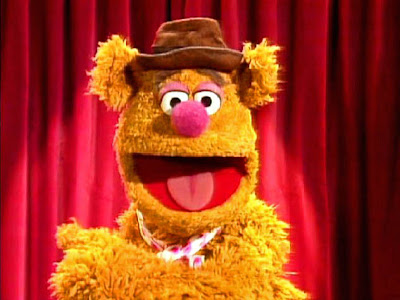
The other thing I learned is that he has a huge range of funny faces. Steve Bell thinks he has the eyes of a killer panda, whereas I thought he looked a little like Fozzy Bear.
My pictures are here, but here are the best ones. Click to enlarge.




They got it half right: there were lots of 'ordinary' people there, though the rows of people providing Miliband's backdrop for the TV cameras were carefully selected to provide a multicultural, all-ages, sympathetic representation. I have to say that the event didn't come across as completely staged. There were plenty of local Labour people, and a vast number of pushy young men in cheap suits umbilically attached to their BlackBerries, but the questions were decent and honest: you could tell it was The Dark Place because everyone over 40 was convinced that we've got the crime levels of 1970s New York and that prisons are indistinguishable from high-end health farms.
What did impress me about Ed M. was that he speaks human very fluently, perhaps even as a first language. Of course he's highly-trained in not causing offence and sounding sympathetic even when he isn't, but I was convinced. Partly because he didn't play the usual political games. Apart from one reference to treating bankers who rip off the state the same as benefit cheats, he refrained from pressing hot buttons or descending into soundbites. I kept my hand up but couldn't get a question in.
I am - as everyone should be - far to the left of Ed, but I was convinced that he's a decent, thoughtful man who has perhaps learned the lessons of Labour's rise and fall to some extent. Whether that's enough to win an election, I'm not sure.
The other thing I learned is that he has a huge range of funny faces. Steve Bell thinks he has the eyes of a killer panda, whereas I thought he looked a little like Fozzy Bear.
My pictures are here, but here are the best ones. Click to enlarge.


I rather like this one - good lighting.


One for the Midlanders: TV's very own Patrick Burns
The Labour Party has posted film of the event here: interesting the way it's been edited for their purposes.
Beg Ed In Da Area
Apparently Ed Miliband's visiting The Dark Place today, holding a meeting at the football ground from 12. I'm a bit annoyed the local party's communications are so poor that ordinary members like me didn't get told about it. I should be marking but might take an hour off and try to get in. You can follow it live here.
Do push off Gove, there's a good chap
There's something rather painful about listening to a third-class mind trying to sound like a first-class one. I had the unpleasant experience of listening to the Education Secretary, corrupt house-flipper Mr. Michael Gove, sounding off about his revolutionary new schooling plan, on Radio 4 this morning. He's at an advantage: if there's one thing an expensive private education and Oxford will do for you, it's provide you with the rhetorical skills to dress up your tawdry and tired ideas.
Mr. Gove's big plan for children is 'facts… I want facts. Knowledge'.
This reminded me of something:
That's the opening paragraph of Hard Times, by Charles Dickens. Appropriate, I think, given that Gove's government is deliberately reducing the standard of living for everyone, but particularly the poor. Borrow a copy while the libraries are still open.
If Gove was an educated man, he'd be aware that his wittering echoed Mr. Gradgrind, the headteacher in the novel. This character isn't an exemplary, heroic teacher, imparting transferable skills to produce a flexible workforce. He's a bully, a man dedicated to driving out the last scintilla of imagination and holistic thinking in those children unfortunate enough to be seated in front of him.
Gove is Mr. Gradgrind. He doesn't want an intellectually capable population. His intellect is so limited that he thinks 'facts' (of which there are very few), in isolation, are important. They aren't. Children could learn lists of kings and queens (something Gove's obsessed by) without a teacher. What a good teacher does is guide the children through the various ways to understand the kings and queens: why have them; what was that particular one's reign like; what were the underlying causes of historical events, and so on? Will knowing the kings and queens in the right order give you the mental agility to understand the world around you? No: at best it'll help at pub quizzes, and the kids have mobile phones for those now.
Two further observations:
1. Having your brain stuffed with Facts won't get you into Cambridge, Oxford etc. They're looking for mental agility.
2. Never trust an Education Minister who says 'What books is our children reading?'
Mr. Gove's big plan for children is 'facts… I want facts. Knowledge'.
This reminded me of something:
'NOW, what I want is, Facts. Teach these boys and girls nothing but Facts. Facts alone are wanted in life. Plant nothing else, and root out everything else. You can only form the minds of reasoning animals upon Facts: nothing else will ever be of any service to them. This is the principle on which I bring up my own children, and this is the principle on which I bring up these children. Stick to Facts, sir!'
The scene was a plain, bare, monotonous vault of a school-room, and the speaker's square forefinger emphasized his observations by underscoring every sentence with a line on the schoolmaster's sleeve. The emphasis was helped by the speaker's square wall of a forehead, which had his eyebrows for its base, while his eyes found commodious cellarage in two dark caves, overshadowed by the wall. The emphasis was helped by the speaker's mouth, which was wide, thin, and hard set. The emphasis was helped by the speaker's voice, which was inflexible, dry, and dictatorial. The emphasis was helped by the speaker's hair, which bristled on the skirts of his bald head, a plantation of firs to keep the wind from its shining surface, all covered with knobs, like the crust of a plum pie, as if the head had scarcely warehouse-room for the hard facts stored inside. The speaker's obstinate carriage, square coat, square legs, square shoulders,-nay, his very neckcloth, trained to take him by the throat with an unaccommodating grasp, like a stubborn fact, as it was,-all helped the emphasis.
'In this life, we want nothing but Facts, sir; nothing but Facts!'
The speaker, and the schoolmaster, and the third grown person present, all backed a little, and swept with their eyes the inclined plane of little vessels then and there arranged in order, ready to have imperial gallons of facts poured into them until they were full to the brim.
That's the opening paragraph of Hard Times, by Charles Dickens. Appropriate, I think, given that Gove's government is deliberately reducing the standard of living for everyone, but particularly the poor. Borrow a copy while the libraries are still open.
If Gove was an educated man, he'd be aware that his wittering echoed Mr. Gradgrind, the headteacher in the novel. This character isn't an exemplary, heroic teacher, imparting transferable skills to produce a flexible workforce. He's a bully, a man dedicated to driving out the last scintilla of imagination and holistic thinking in those children unfortunate enough to be seated in front of him.
Gove is Mr. Gradgrind. He doesn't want an intellectually capable population. His intellect is so limited that he thinks 'facts' (of which there are very few), in isolation, are important. They aren't. Children could learn lists of kings and queens (something Gove's obsessed by) without a teacher. What a good teacher does is guide the children through the various ways to understand the kings and queens: why have them; what was that particular one's reign like; what were the underlying causes of historical events, and so on? Will knowing the kings and queens in the right order give you the mental agility to understand the world around you? No: at best it'll help at pub quizzes, and the kids have mobile phones for those now.
Two further observations:
1. Having your brain stuffed with Facts won't get you into Cambridge, Oxford etc. They're looking for mental agility.
2. Never trust an Education Minister who says 'What books is our children reading?'
Wednesday, 19 January 2011
More Wordle fun
I could use Wordle as an analytical tool. Instead of doing what I should be doing (marking), I'm doing a little research for my Anne of Green Gables paper. Here's what happens when I put the entire text into Wordle (better version here):

Interesting how little Gilbert features, considering his prominence in the popular consciousness of the book.
NHS - safe in their hands
The Tories have publisher their plan to destroy reorganise the NHS (the thing they promised not to do, during the election). The document is several hundred pages long, double the length of the document which founded the National Health Service.
Here's one way to work out what their priorities are: turn the document into a Wordle - a graphic representation in which the size of the words reflect how many times they're used. I can't reproduce Tom Moberley's excellent work in a readable version, but you can see it here. What's shocking is that terms relating to administration, commissioning and outsourcing far outweigh those related to care. As far as I can see, 'patient' doesn't turn up at all. If you suspected that the whole plan is simply to dismantle and privatise one of the jewels of British life - from a party without any mandate to enact such dramatic legislation - this proves it.
Here's one way to work out what their priorities are: turn the document into a Wordle - a graphic representation in which the size of the words reflect how many times they're used. I can't reproduce Tom Moberley's excellent work in a readable version, but you can see it here. What's shocking is that terms relating to administration, commissioning and outsourcing far outweigh those related to care. As far as I can see, 'patient' doesn't turn up at all. If you suspected that the whole plan is simply to dismantle and privatise one of the jewels of British life - from a party without any mandate to enact such dramatic legislation - this proves it.

How bonus culture works
Goldman Sachs profits down 53%
Goldman Sachs bonuses down 5%
I really, really, wish I worked in the banking sector.
Goldman Sachs bonuses down 5%
I really, really, wish I worked in the banking sector.
Lib Dems aren't the only liars
The Educational Maintenance Allowance is a small amount of money (maximum £30 per week) paid to 16-19 years old students to allow them to stay in further education. It's means tested, and covers perhaps a week's bus tickets, lunches, or some study materials. It makes a huge difference to many students, and keeps them off the dole queue (there's no alternative work: 1 million of the 2.5 million unemployed people are in the 16-24 age range.
So obviously the junta - largely millionaires privately educated at Eton and St. Paul's before Oxford and Cambridge) - are abolishing it.
The Prime Minister must be shocked by this savage attack on the young. After all, he promised before the election that it would be safe. Promised on camera. And they wonder why people don't trust the Tories.
So obviously the junta - largely millionaires privately educated at Eton and St. Paul's before Oxford and Cambridge) - are abolishing it.
The Prime Minister must be shocked by this savage attack on the young. After all, he promised before the election that it would be safe. Promised on camera. And they wonder why people don't trust the Tories.
Argument settled
My previous post discussed the role of social media in political uprisings. Thanks for your comments, by the way.
This photograph of Tunisians protesting outside the USA Saudi Arabian embassy very neatly highlights the positive role of new media, specifically Facebook - clearly Tunisians have been using the service to pass around information: probably the Wikileaks cables in which American diplomats assessed the scale of President Ben Ali's corruption. The demonstrators clearly think that all the other local dictators are vulnerable to the free flow of information.
Ironically, of course, Saudi Arabia is one of the worst human rights-abusing dictatorships in the world -- but it does control a lot of oil and buys a lot of American and British weaponry, so let's not dwell on it.
Unless this is a Facebook marketing stunt, of course.

This photograph of Tunisians protesting outside the USA Saudi Arabian embassy very neatly highlights the positive role of new media, specifically Facebook - clearly Tunisians have been using the service to pass around information: probably the Wikileaks cables in which American diplomats assessed the scale of President Ben Ali's corruption. The demonstrators clearly think that all the other local dictators are vulnerable to the free flow of information.
Ironically, of course, Saudi Arabia is one of the worst human rights-abusing dictatorships in the world -- but it does control a lot of oil and buys a lot of American and British weaponry, so let's not dwell on it.
Unless this is a Facebook marketing stunt, of course.

Other states are looking foolish too. I particularly enjoyed this Wikileaks spat, on the illegal kidnapping of terror suspects for torture:
Turkey:
"The Turkish government and state never played a part [in the secret transfers] ... and never will."Leaked American document:
"The Turkish military had allowed us to use Incirlik as a refuelling stop for Operation Fundamental Justice detainee movement operations since 2002, but revoked this permission in February of this year. We understand OSD [office of the secretary of defence] and JCS [joint chiefs of staff] have been discussing whether to approach Turkey to seek to reverse this decision"
Tuesday, 18 January 2011
I'm so cutting edge
Only because I've bought a book. It's Evgeny Morozov's The Net Delusion: How Not to Liberate the World. His thesis is that technocentric utopians have assumed that access to new media will inevitably liberate the oppressed. (In these circles, 'the oppressed' always refers to the citizens of countries you don't like: the joy of Wikileaks proves that these things are double edged).
Morozov also feels that there's a difference between online activism and street politics, and I partially agree. Joining a Facebook group calling for world peace or the immediate execution of paedophiles makes absolutely no difference to the world at all. On the other hand, TheyWorkForYou has been indispensable in my ongoing pursuit of that Tory ratbag Paul Uppal (according to his voting record, he'd like you to carry on smoking while waiting for the nuclear holocaust - he voted to legalise smoking in pubs again, once more demonstrating his acute concern for the underpaid pub workers), and the fast dissemination of information is essential to activism. That's a double-edged sword, however: all governments have new media specialists, many of which shade into organised dis- and misinformation projects.
Activists are quick and nimble: governments have power, resources and lots of men with guns. When it comes to iPhones v. M16s, M16s win. I can't see that the Tiananmen Tank Guy would have done better if he'd been Tweeting, though it's true that a lot more people (though no Chinese people) would have known about it. The attempted Iranian revolution last year was widely promoted as the Twitter revolution, mostly by American spies keen to exert influence without spending any money, but it turns out that Twitter was hardly used within Iran, and a lot of what was carried turned out to be inaccurate or untrue. The moment may well have passed anyway: so many new media organisations are happy to turn in their users to whichever government they happen to need licences from (Google bows to everyone from the US to China and Blackberry have given in to all sorts of regimes to retain business). Twitter has just been ordered by an American court to turn over the details of people connected to Wikileaks, whether they're American or not. There's certainly no security online: even if courts refuse access, you can guarantee that the security services have their own ways in.
The most interesting thing about Morozov's argument is that the Internet is becoming the Opium of the People: distracted by the feeling that Twitter, Facebook and so one actually are protest, we might not be engaging in the kind of activity which really overthrows tyrants. It's an interesting idea, though I imagine the truth lies in between. Tunisians seem to be getting on quite well without Twitter (there are a few users), and it's probably wise to distrust a lot of what gets passed around. On the other hand, I followed the student protests in London via Twitter, which was exciting and useful. Colonel Gadaffi of Libya clearly feels vulnerable: he condemned the Tunisian uprising as the product of Wikileaks distortion. I'm sure his 41 year undemocratic rule over Libya played no role in his condemnation of Ben-Ali's overthrow.
What do you think? I know Ben's a keen blogger (I've lost track of how many he has) and Twitter, and many of you use all sorts of services.
Morozov also feels that there's a difference between online activism and street politics, and I partially agree. Joining a Facebook group calling for world peace or the immediate execution of paedophiles makes absolutely no difference to the world at all. On the other hand, TheyWorkForYou has been indispensable in my ongoing pursuit of that Tory ratbag Paul Uppal (according to his voting record, he'd like you to carry on smoking while waiting for the nuclear holocaust - he voted to legalise smoking in pubs again, once more demonstrating his acute concern for the underpaid pub workers), and the fast dissemination of information is essential to activism. That's a double-edged sword, however: all governments have new media specialists, many of which shade into organised dis- and misinformation projects.
Activists are quick and nimble: governments have power, resources and lots of men with guns. When it comes to iPhones v. M16s, M16s win. I can't see that the Tiananmen Tank Guy would have done better if he'd been Tweeting, though it's true that a lot more people (though no Chinese people) would have known about it. The attempted Iranian revolution last year was widely promoted as the Twitter revolution, mostly by American spies keen to exert influence without spending any money, but it turns out that Twitter was hardly used within Iran, and a lot of what was carried turned out to be inaccurate or untrue. The moment may well have passed anyway: so many new media organisations are happy to turn in their users to whichever government they happen to need licences from (Google bows to everyone from the US to China and Blackberry have given in to all sorts of regimes to retain business). Twitter has just been ordered by an American court to turn over the details of people connected to Wikileaks, whether they're American or not. There's certainly no security online: even if courts refuse access, you can guarantee that the security services have their own ways in.
The most interesting thing about Morozov's argument is that the Internet is becoming the Opium of the People: distracted by the feeling that Twitter, Facebook and so one actually are protest, we might not be engaging in the kind of activity which really overthrows tyrants. It's an interesting idea, though I imagine the truth lies in between. Tunisians seem to be getting on quite well without Twitter (there are a few users), and it's probably wise to distrust a lot of what gets passed around. On the other hand, I followed the student protests in London via Twitter, which was exciting and useful. Colonel Gadaffi of Libya clearly feels vulnerable: he condemned the Tunisian uprising as the product of Wikileaks distortion. I'm sure his 41 year undemocratic rule over Libya played no role in his condemnation of Ben-Ali's overthrow.
What do you think? I know Ben's a keen blogger (I've lost track of how many he has) and Twitter, and many of you use all sorts of services.
Subscribe to:
Posts (Atom)