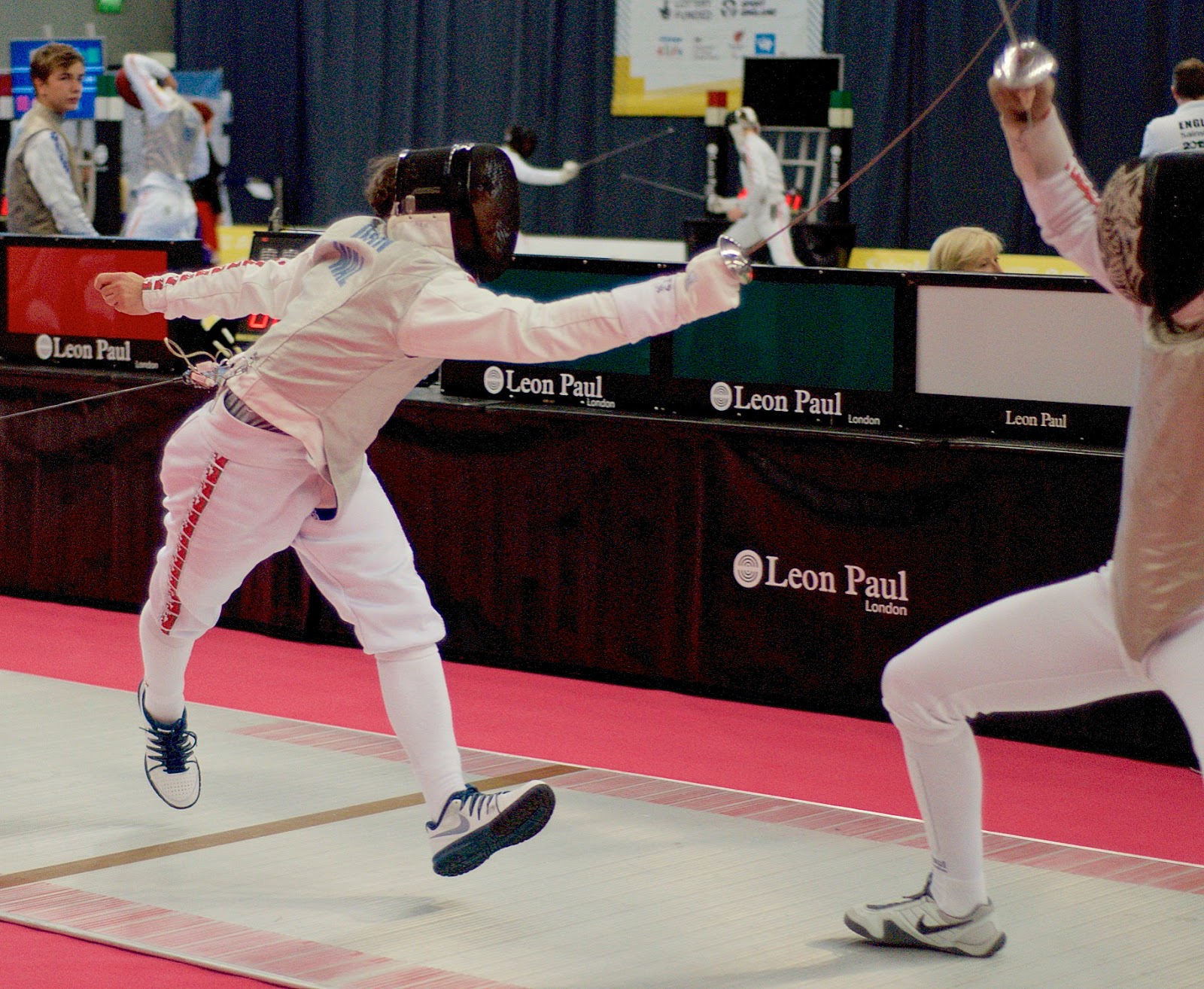
I can't honestly remember what I was doing at the Euros in Sheffield, 2011. Definitely something: I have the polyester tracksuit to prove it, but whether it was refereeing, team management or welfare I have no clue. I blame the armourers' very competitive travelling whiskey society for the blanks in my recall. I certainly didn't win any medals, that's for sure.
Anyway, there I was and I must have had plenty of time to wander around with my camera. A couple of things come to mind. I very much enjoyed watching a distant cousin on the Irish team destroy the highly-fancied (by themselves) British senior foilists, and I got up close to top-level wheelchair fencing for the first time. It's brutal. The chairs are fixed in a frame locked to the floor so the athletes are in hitting distance at all times. In ambulant fencing you can step out of the way to take a breather and regroup: in wheelchair fencing there's no escape at all. You can rock back and forth a bit, but otherwise you're exposed at all times. The bladework is ridiculously fast. I've tried wheelchair fencing a few times since and it's not for me: I'm just not good enough.
The rather sickening side of photographing the wheelchair competition was subsequently noticing that those shots were viewed by thousands more people than the rest. Delving into the usernames and their histories, it became clear that there's a thriving population of fetishists who get off on amputation. Ugh.
Anyway - this was me playing with higher-speed shots and looking for character and reaction. I got better.
Fencing has had VAR for quite some time. There's nothing worse as a ref than hearing the audience groan when they see a replay you haven't and you know you've got it wrong.
Self-reproach
Self-congratulation
Laurence Halsted - very much one of the good guys
Halsted lands one
Halsted celebrates
Rigine attacks
Unorthodox
A fléche, parried
An aerial attack
Victory and defeat
Cassara v Avola, men's foil final
Cassara attacks into Avola's preparation (don't @ me, new-style referees)
Good afternoon all. I'm sitting in the office wondering if anything's happened this week and realising that actually, quite a lot has been going on.
The best bit was a trip to London: two days in Gilbert Scott's resurrected, excessive and amazing St. Pancras Hotel where the Victorian Gothic splendour comes with cocktails containing croissants (yes, really and by the way the Spice Girls' 'Wannabe' video was filmed there too, pop-pickers).
This was to go to the ornate, plush Edwardian Noel Coward theatre to see, incongruously, Martin McDonagh's scabrous Irish terrorism comedy The Lieutenant of Inishmorestarring one Aidan Turner, whose pectorals you may recall from Poldark (or indeed the dreadful Hobbit films). Never having seen Poldark I wasn't that bothered about his thorax but the play was wonderful – really tightly scripted, packed with the darkest of jokes and ending with a feline and human bloodbath.
One or two of the specific historical references weren't quite as offensive as they would have been when the play was first performed 20 years ago, but there was still plenty to make the audience gasp. There was also a distinct difference between the English and Irish audience members' reactions to some of the darker gags, which reminded me of seeing Hunger a few years ago.
Otherwise this week I've been seeing students as they prepare for the next academic year, trying and failing to get the right access to our VLE so I can set up the courses I'm teaching, catching up with some colleagues and saying goodbye to those being shelled out of the place by the vicious know-nothings who run it, reviewing a book proposal for a university press, writing up my video games conference paper for a magazine, failing to find out how many – if any – students we've recruited this year and generally just getting into the swing of things once more. I've found yet another politician novelist and poet: the 3rd Baron Gorell. Is is stuff any good? No idea…yet. Talking of which, I got hold of the new British Library Crime Classic edition of Ellen Wilkinson's The Division Bell Mystery: she was the crusading Labour MP famous for her part in the Jarrow Hunger March, and who died in sad and mysterious circumstances. She wrote two novels, Clash and this one: Clashis seriously good, while The Division Bell Mystery is hugely interesting for its even-handed politics and its use of the detective genre to explore the political social structure. The British Library have done a lovely job with the reprint, and the introductions by Rachel Reeves MP and Martin Edwards are very good indeed. I'm just annoyed I paid £90 for my slightly tatty first edition because I didn't know a new one was coming!
I've been reading a few things for pleasure too - I whipped through Hugh Howey's feted but actually quite hackneyed Shift the other day. It's the second in his post-apocalyptic Silo trilogy (the City of Ember kids' series does a similar concept more entertainingly). Decent idea, written in a very pedestrian style: mildly diverting, and hampered by an inability to write women at all. I enjoyed Melissa Harrison's All Among The Barley an awful lot more – it's a novel about the social and political condition of the English countryside in the interwar period, narrated retrospectively by a teenage girl undergoing a psychotic episode. I did wonder whether interweaving the adolescent mental health and puberty issues with ominous political developments and a family saga, plus a huge amount of farming and nature material was a bit too much to do justice to each aspect. There's a considerable amount of purple prose and a profusion of strands meant that the ending felt a bit facile, but it's a meaty, intelligent and thoughtful book that will definitely withstand re-reading. Now I'm back to Muriel Spark's slight but entertaining Territorial Rights which I temporarily mislaid when I started it last month, and Gillian Darley's Villages of Vision. A couple of years ago we sponsored her relaunch of this overlooked classic at Birmingham Literature Festival, and I bought it then. It's essentially a gazetteer of the 400+ model, utopian, company, communal and experimental villages scattered across the UK, some of which maintain some vestiges of their founders' purposes. I'm really keen on fostering some awareness of Britain's radical and contested history, partly because my students have been so badly failed by an education system that teaches only English aristocratic triumphalism. Two who came to see me this morning were stunned to discover that Ireland, Scotland and Wales have their own languages, and were shocked by my revelation that they were suppressed by the British state. Peterloo, Toldpuddle, the General Strike, Suffrage, Invergordon, the Civil Wars, 1916… if mentioned at all, they're presented as uncouth ingratitude on the part of the oiks. I'd like to persuade them that the peoples of Britain have a proud history of resistance, independence and progressiveness that can be unearthed without too much effort, and Villages of Vision is a dream for that purpose.
And with that, I'm off. Setting up the Shropshire Open fencing competition tonight, and offering myself up as easy pickings to the youngsters who've entered the foil event tomorrow. I know I'm going to regret this…
It's been a strange couple of weeks. New office (still being built). Job interview (failed again, but at least they met me before deciding they'd rather not, unlike most institutions). Working out what it means to have a semester's sabbatical while also being an acting course leader. Going to presentations for my boss's job. And I did the School Games for the Northern Ireland fencing team. Much of what went on is the subject of investigation by no less than three governing bodies so I can't go into it in any detail, but suffice to say that spending several days with other people's children is a highly persuasive form of contraception.
One of my favourite moments was turning up and asking who the Northern Ireland coach was this year. The answer? 'You'. Shame nobody mentioned it in advance, or I'd have brought some kit. Oh well: my colleagues were lovely and highly professional, as were the vast majority of the kids. I'd also like to thank Sainsbury's for pulling out of their sponsorship deal: an unbranded Games was very pleasant.
I took some photos: click here for almost the full set or click on those below to enlarge.
The label is not related to Northern Irish politics at all.
This is how you give a medal to a 6'10" 15-yr old.
A coaching session
Tickertape
Towers Hall, Loughborough University
And I made this to mark the departure of David Cameron from public life (and the arrival of £5 with the image of that murderous imperialist Winston Churchill). The guy who said he wouldn't resign the prime ministership if he lost the referendum, then did, and who said he'd serve a full term as MP, then quit.
Happy Tuesday to you all. I'm officially on holiday so obviously I'm in the office, avoiding unpacking crates. It's been rather lovely actually: met colleagues to get help launching a literature festival, met an Associate Dean for lunch and talked about books and ideas (he's giving me Ian Jack's collection of essays, I've persuaded him to read Thoreau's Walden, which I can honestly say changed my life). It's been good to see my colleagues as we all gradually move into this shared office, and I've already held a really enjoyable (for me anyway) undergrad dissertation tutorial on the literary history of pirates. I'm really going to enjoy supervising this student, though whether she'll forgive me for making her sit through The Pirates of Penzance remains to be seen.
The other thing I'm doing is going through all the dog-eared bits of newspaper I've torn out over the summer, trying to work out why I kept them and why I wanted to buy those books and that record. At least being away from the web for a few week means that this kind of filtering process is going on, rather than me buying things on a whim immediately. So far this morning I've bought contemporary music: Henri Dutilleux's Cello Concerto, Charlotte Bray's At The Speed of Stillness, Emily Howard's Magnetite and Cloud Chamber, and Upheld By Stillness, a collection of Byrd's choral music with contemporary settings on the same disc. This is what happens when you listen to Radio 3 for too long.
Obviously I've been reading too, and not just Edwina Currie novels, though I have three of them on the go at the moment and I'll be discussing those in more depth at some later date (you have been warned). I've whipped through Dan Vyleta's alternative-victoriana novel Smoke fairly quickly: it's compellingly written and has some intriguing ideas but is rather confused by the end.The idea is that for a couple of hundred years people in a deeply authoritarian Britain have literally smoked whenever they sin, broadly defined, and that the ruling classes are those who either develop the self-discipline to minimise their errors, suppress the symptoms, or cheat. Several subversive groups interact, all after different things, until in the end our adolescent heroes decide to allow some terrorists to complete their plan of overdosing the entire country with Smoke to purge the nation through a temporary orgy of violent sin, rather than allow continued moral and political repression. Lots of ideas, large chunks of Victorian literary pastiche, but something felt oddly lacking.
The other book I'm reading at the moment is Christopher Hill's God's Englishman, his 1970 sort-of biography of Oliver Cromwell. It's only a sort-of biography because Hill, as a Marxist, is (rightly) suspicious of the Great Man theory of history and so works hard to contextualise Cromwell as a symptom of prevailing economic and social forces as well as a key figure whose personal characteristics and decisions shaped great events. Hill's very clear on Cromwell's hatred of and brutality towards the Irish, and his increasingly conservative authoritarianism, while admiring his many good instincts and impulses. I don't think it matters too much that it's 46 years old: no doubt new facts about Cromwell and the period have emerged, and obviously there are new theoretical approaches available, but Hill's book is a classic of its time and context.
I've another day in the office, then I'm off to Loughborough for my annual Week in Polyester, working at the School Games. This time I'm on the staff for the Northern Ireland fencing team. Normally I know most of the fencers but I haven't done much refereeing and managing this year so I don't know any of the NI kids. Drawing from a much smaller pool than the other nations means that they usually get a kicking but we'll see what we can do. See you on the other side.
Hi everyone. Since I last posted, I've had a rich and varied week or so: volunteering at the School Games in Manchester and Bolton, attending a full-on Communist funeral (the Internationale, Bandiera Rossa, Party banners, the lot) and participating in a twilight slow bike ride around Stoke festooned with fairy lights and soundtracked by ambient music. As I said, an eclectic set of experiences.
I only have pictorial evidence of the School Games, so those of you allergic to young people and/or sport might wish to view something else. It was an interesting Games. Sainsbury's has pulled out of its sponsorship of UK Athletics activity ahead of schedule, which is pretty churlish: this includes the Games, so while the branding continued to infest the event, budgets were clearly very, very tight.
I wasn't particularly impressed with the Opening Ceremony either, though four of my fencers were picked to take the oath on behalf of the athletes. The D-list presenters engaged in the most painful and rehearsed banter, interspersed by off-the-cuff sexist comments, while the entertainment was almost entirely female dancers dressed in skimpy sequinned costumes (or 'showgirls' as the compere called them). Very good at their job, but in front of several hundred sporty teenagers, perhaps the organisers should have considered whether it's appropriate to present women solely as decorative objects. Maybe including some male dancers would have helped. Anyway, there were some sports stars present: Ellie Simmonds was very good, while a male athlete helpfully and repeatedly explained that success is achieved by 'staying positive' and 'giving it 110%', which I personally found inspirational. He also confessed that the high point of the School Games in his day was when he put a frog in a microwave. Vile, yes, but I enjoyed the almost audible quality of the spanner dropping into the banter works.
The rest of the games passed in a haze of exhaustion punctuated by admiration and jealousy of the young fencers, any one of whom could thrash me without breaking into a sweat. It was also lovely seeing fencers I knew as tiny scared creatures reappearing as hulking great winners, and to catch up with all my friends from the fencing world.
Here are some of my favourite shots (click to enlarge) and you can see the rest here. Fencing photos are tough: the lighting's terrible, you can't use flash, my equipment is ageing, and everyone looks the same once the mask is on. So I tried to capture personality as best I could: victory, defeat, battered fencing shoes, team hugs and so on.
The Toast Rack - near my room on Manchester University's Fallowfield Campus. Formerly part of Manchester Metropolitan University
Backstage
Scotland's women sabreurs console each other after defeat
Searchlights on the roof of the Opening Ceremony venue
Soundcheck for the opening ceremony
Jess Corby reads the oath with George Morris behind her
Volunteers at the opening ceremony
The aforesaid 'showgirls'.
Generations of Adidas fencing shoes
A fistful of foils
About to be interviewed on camera
Corby under the Klieg lights
Kamal Minot taking media duties in his stride
Ken Rose (Scotland coach) discussing the fight with referee Sean Grundy
Celyn Lewis takes off
…as does Kamal Minott
The referee awards the hit and the Welsh women's epeeists celebrate
Simultaneous hit by the two Scottish women foilists Morrison and Black
Multiple exposure…very tricky without a tripod.
Battered old Adidas fencing shoe
Charlotte Slater lands a foot hit on Scotland's Paisley.
Jovial ref explains a decision to Gibbon
The referees about to launch into a ballad
The Leon Paul technical staff applaud the medallists
Sabre Selfie!
Schneider and Slater at a tense moment
Moody shot of a Scottish sabreur warming up backstage