Showing posts with label Ballard. Show all posts

Friday, 6 October 2017

Random Ramblings at the end of a long week

I'm not sure I have any coherent thoughts this week. It's the end of our first week of proper lectures. I've met a largish number of enthusiastic new students (though not as many as previous weeks), welcomed back the existing ones, and plunged headlong into a dizzying array of modules. This week I've discussed Hall and Althusser with the third-years, John Ball, Froissart's Chronicles and Piers Plowman with the second years, talked with an overlapping group of second-years about whether the Renaissance is a meaningful term and what happens to those cultures and texts which are either included or excluded, and got an entire MA module on JG Ballard going (mmm…alienated). Enormously enjoyable of course, but I'm preparing an awful lot of new material in one go. I don't let modules or text drag on, preferring to refresh everything after about three years, but this year is feeling daunting. Next week's menu is The Tempest, Gerrard Winstanley's writings, some Ballard short stories and Jez Butterworth's Jerusalem and the contested nature of Englishness.


I'm also nipping off to the Cheltenham Literature Festival for an evening of Vince Cable and Stanley Johnson promoting their novels- Cable's is a debut novel, while Stanley-Father-Of-Boris has produced quite a number over the years: I've bought them both but not yet read them. A few years ago my research colleague and I had our own slot at the CLF discussing politicians' novels, with Michael Dobbs on the panel. Our research is going slowly (see the first paragraph of this post) but I try to attend events like this to keep an eye on the way politicians frame their creative work and what audiences think. I also had a letter on the subject in the TLS last week, and someone sent in a follow-up too.

My collection of politicians' writings also gained some new entrants this week. The first was Sir Stuart Bell's Paris Sixty-Nine, long fabled as a suppressed self-published pornographic novel by the MP for Middlesbrough. In his later years he became a Commissioner of the Church of England, basically the CofE's ambassador to Parliament, and was rather reluctant to acknowledge this saucy little number. It's not actually pornographic in the sense that there are entire chapters without sex scenes, but those scenes are revolting conceptually and in literary terms. Obviously this is a family blog and I won't scar your eyeballs with quotation, but I will say that they read like the work of someone who had never met a woman, or at least not one for whom he'd ever had any respect.

Bell was accused of being Britain's laziest MP – no constituency surgeries in 14 years – but he devoted quite a lot of time to writing autobiographical short stories, some of which made into print, and the rest made available on his website for years after his death (sadly, no more). As the New Statesman implied, he had quite a high opinion of himself:
Stuart Bell MP has written another novel, Binkie's Revolution (the first in a trilogy), which chronicles the lives and loves of several families, beginning in Durham mining villages around 1900 and ending (two novels hence) in the election of the first president of the United States of Europe. The style is so fluent and racy it carries the reader along. We know this to be true, because the author says so in a five-page handout that also explains how to order the book from his publishing arm, Spen View Publications. It's being a Church Estates Commissioner that 'as made 'im so 'umble.
I haven't read Binkie's Revolution yet, but it vaguely echoes Edwina Currie's The Ambassador, which is set in a future united Europe in which the transcontinental ruling class has genetically engineered itself to retain power forever, despite the sterling efforts of a lovely English woman, a brash US ambassador and a supporting cast of outrageously stereotyped ethnic minorities.  Sadly, while there is a sequel to Binkie's Revolution on Kindle only, Bell appears never to have finished the trilogy.

The other politician's work that turned up this week is one of the very rarest and most beautiful (and expensive) books I've ever got my paws on. Lord Lymington's Spring Song of Iscariot was published in 1929 in an edition of 125 by the fabled Parisian artisan Black Sun Press, which also put out work by Sterne, Poe, Lawrence and Joyce in similarly tiny numbers. It comes in a complicated slipcase, is printed on beautiful paper with an exquisite typeface. Sadly the poetry is pretty woeful: bursting with the kind of imagery you'd get if a Vogon had eaten Freud and developed an obsession with Ezra Pound.


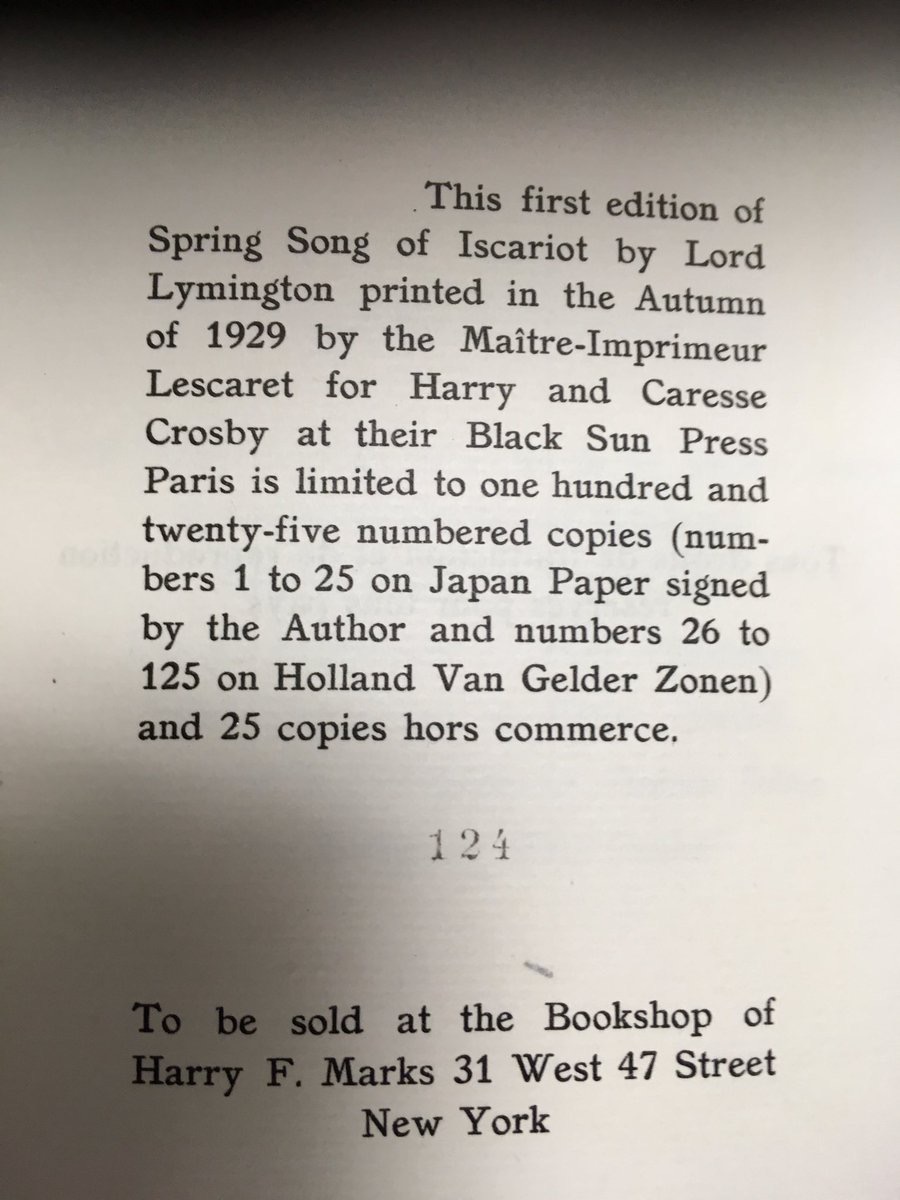


In a way I'm not too saddened by this, because after Lord L stopped being an MP for Basingstoke, he devoted his time to being a full-time Nazi, starting in the mystically-inclined blood-and-soil ruralist group English Mistery, then the English Array, the British People's Party and ultimately Kinship in Husbandry, several of whose members contributed their viciously racist and mystical ideas of purity to what became the now-respectable Soil Association. He ended up emigrating to Kenya with the rest of the despicable crew of toffs who made up the remains of the Happy Valley set.

Lymington's interesting though. Not many professional politicians wrote poetry at all (though some of the Welsh-speaking Liberal and Labour MPs did), and none associated with hardcore modernists. While the poetry isn't much good, it's ambitious and far removed generically and intellectually from the usual concerns of politician-authors. I'm not expecting Stanley Johnson or Vince Cable to start going on about the Pillars of the Womb, for instance.

Anyway, that's your lot: I've got tomorrow's Open Day talk to prepare. I think I'll leave readings from Bell's and Lymington's works until they've signed up…

Friday, 19 October 2012

Eat your heart out, JG Ballard…

Here's a time-lapse video of the space shuttle Endeavour making the two-day trip 12 miles from an airport in LA to its final resting place in the California Science Center.


It's poignant, and deeply sad, though I can't help feeling that the music and the photography does most of the work for us. JG Ballard's evocations of an exhausted near-future world in which a few connoisseurs and obsessives go mad in the tumbleweed-strewn abandoned launching pads they see as symbols of existential anomie were fundamental to my teenage years. Surrounded by political cynicism, crumbling infrastructures and above all a planet which we are consciously driving towards ruin, I felt I'd missed out on the Age of Optimism.

I grew up: I learned that the Space Race was a costly, military-driven diversion into extra-terrestrial willy-waving, sucking in billions of dollars while the poor starved in every superpower country. I learned that the Shuttle was a beautiful white elephant, its lack of ambition summarised in its unadventurous name ('shuttle': may as well call it a taxi). I mourned the loss of Star Trek's innocence as it moved into The Next Generation, harbinger of Liberal Interventionism as its crew rampaged through the galaxy enforcing neocolonialism reassured by the presence of a bloody Ship's Counsellor with her big puppy eyes. Alien and The Hitchhiker's Guide to the Galaxy and Red Dwarf presented an alternative, less idealistic version of space, as a hostile, proletarian hell in which boredom is only occasionally relieved by existential terror.

I began to understand that the exploration of space is a myth designed to distract us from our problems here and now. We're never going to other solar systems: perhaps our machines will, but the distances are too vast and the purposes too far. I still read an awful lot of SF, but in a sadder and wiser fashion, and perhaps I read sadder, wiser SF too. I don't believe in space 'races', or 'conquering' space, or any other militarist or technocratic metaphors.

And yet, I'll miss the shuttle. Useless, expensive, unreliable, unsafe but beautiful in a way that the superior Russian rockets aren't. Retiring something called Endeavour really is symbolic, even for us cynics. I would like to have been there, to have walked every step of the way. It was clearly a semi-religious experience, judging by the crowds who lined the route to see this battered, behemoth negotiate suburban streets, passing homes and strip joints and parks, stop-lights and no-parking signs, utterly out of place down here on earth. We all respect the bloodied, unbowed veteran as it's reduced from heroism to attraction: Endeavour is just such an artefact, Moby Dick turned into a heap of blubber and bone.

The end of Endeavour is the end of our space-childhood. Despite being a miserable compromise, its beauty and promise persuaded us – for a while – that we were nobler, better than we really are. But now it's time to put such childish things away and become adults; start to clear up the trash, to engage with the boring but necessary tasks required to pull ourselves out of the mire; to stop acting like the universe owes us a living. Endeavour, Enterprise and Discovery are where they belong - children's toys put aside until some younger, fresher generation finds the energy and leisure to play with them again.

Saturday, 5 May 2012

Welcome to the Overlook Hotel. Staying long?

You know what Jack Nicholson said about all work and no play…


Here I am in a corporate hotel in the arse end of post-modernity with nothing to do. I'm supposed to be working at the School Games, and they asked me to come down today rather than tomorrow. So I turned up at 3 and have had literally nothing to do. As it happens, enforced seclusion (this place is marooned in a sea of flyovers, conference centres and exhibition halls) turns out to be perfect for making me mark dissertations.

The view from my hotel room 

This is what postmodernity looks like. 

One of them was particularly good, and most appropriate: it analyses the postmodern vacuity of 'grand projects', the damage they do to local cultures, and the privatisation of public space. Marking it in an Olympic venue was beyond irony. (And right now the BBC News is plugging the Olympic Stadium dream). Sebastian Coe's on: he's made millions from his image rights, and William Hague's a shareholder… which seems a bit weird).

In case you want a reading list on this stuff, you could try Anna Minton's Ground Control (her blog's here and the book has a new chapter on the Olympics), anything by psychogeographer Iain Sinclair, or Marc AugĂ© on non-spaces. Coincidentally - and massively annoyingly because I'm in the area and free tonight but not tomorrow, Minton and Sinclair are appearing together tomorrow night.

They'll be talking about things like this:


The fictional master of this stuff is of course JG Ballard, the chronicler of the desperation and barbaric atavism underneath the blandness of the neglected quarters: he was fascinated by the non-spaces of consumer capitalism, from airports to service stations and gated communities to sports arenas. I'm not sure whether this place would be his dream or his nightmare. Try Millennium People or Kingdom Come, in which the shopping mall becomes the centre of a comforting, then dystopian bourgeois cult:
'The human race sleepwalked to oblivion, thinking only of the corporate logos on its shroud'.

Wednesday, 21 July 2010

They never did find the Clangers

Today's the 41st anniversary of the moon landing (or if you spend too much time on the internet, of the faked moon landing).


It's one of those events which brings into conflict two sides of me. The romantic, childlike side of me will never stop admiring the decision to go to space, against all the odds. Likewise, the sadness of the missions is stamped on me: the pointlessness (Shepard played golf there, FFS), the danger, that photograph, the isolation.

The adult, rational, Marxist side of me is much more cynical. The moon landings achieved nothing other than to intimidate the Russians and develop more sophisticated weaponry. They were overseen by Wernher von Braun, a Nazi whose skills meant he never had to say he was sorry. The moon program can be seen as an expensive way of diverting Americans' attention from Vietnam, from the Cold War, from campus protester killings, from the mass starvation and environmental destruction which characterises day to day life.

Perhaps, too, the moon landings were the last hurrah of a technology-based superpower, of a nation which believed that new gadgets would give them freedom and domination for ever. Instead, the space program is a sad shadow of its former self - see J G Ballard's Hello America, Myths of the Near Future and The Terminal Beach for the heartbreaking melancholy of post-space America, all drained pools and ex-astronauts going mad under the derelict towers of Cape Canaveral. Technology is more democratically available than ever envisaged, and the Big Industry of the US is in dire straits, undercut by the Chinese and soon, by India (both of which want a space programme for bragging rights too).

The space program then was perhaps a fantasy of simplicity - the fragile men alone in the void - away from the complications and demands of everyday life and other people. But it's a fantasy I like to entertain in more emotional moments.

So -what do you think? Noble endeavour? Triumph of technology? Pointless diversion? All three?

Wednesday, 8 July 2009

Gissa job. Go on, gissa job.

Sweet - my new phone's here, and my Dublin sister has jacked in her unfulfilling job, a week after my brother quit his for a new life as (cough) a lawyer, once he's done his conversion course. Add my newly unemployed New Zealand lawyer sister to the list and half my siblings are now scrounging dole scum, in the words of The League of Gentlemen. I, of course, am loving this. Having suffered the slings and arrows of these career-minded chaps and chapesses while I did an English degree, an MA in Welsh writing and then a PhD (Masculinity in four 1930s political Welsh novels), now I'm the one with a career(ish)! The worm's turned, the world's turned upside down etc. etc. etc. The family are going to hear about this for a long time to come.

Having laboured over Mark's collection of journals for hours (Sewanee Review 1966-1977 anyone), I've been rewarded with some fine books: The Trial of Lady Chatterley, Doctorow's Ragtime and Ballard's The Day of Creation. Good job I'm not being thrown out of my office.


In my absence the cricket has turned from the habitual England mediocrity into a brave stand by Collingwood and Pietersen. At least Pietersen went in his standard way - trying to be too clever. My least favourite player.
(Post title is from The Boys from the Blackstuff)

Thursday, 2 July 2009

If you believe… they put a man on the moon

Sorry for the REM reference

Today, as the Guardian's special section reminds me, is the fortieth anniversary of the moon landings. How do you feel about it? Ten years ago, I had nothing but awe for such an amazing achievement - and I still feel that way for the most part. However, in between, I've done a lot of reading. I've learned how the space programme was motivated solely by a need to dominate the Soviets, about how it was manned by pretty unrepentant Nazi rocket scientists drawing on the skills developed in the 1940s, about how it cost a massive chunk of the US GNP, and how its scientific benefits have been massively overexaggerated by NASA spinners.

The Soviets took a pragmatic approach: near earth orbits are great for science, there's nothing on the moon. So did the Europeans for that matter - manned space flight is like getting a taxi down to the shops. We might make Mars but that's as far as it goes, so let's put our energy into satellites, telescopes and probes.

And yet - the romance lingers, perhaps even intensified by the failure of our space race. Once the cold war ended, it turned out that the motivation (and money) dissipated. Instead, we're in the post-space age. Will our grandchildren remember that men walked on the moon? Will they have the energy to care, inbetween long treks for water and trying to eke out a subsistence living on a ruined earth? Perhaps the dominant mode will be anger, at the waste of multiple billions on a giant penis when millions of people starved.

Perhaps, though, the dominant mood will be melancholy. J. G. Ballard's Hello America and Myths of the Near Future depict a California and Florida of abandoned space centres, emptied pools, men and women spiritually hollowed out by the loss of technological purpose.

Monday, 8 June 2009

Celebrity guests

Neal and I had a celebrity rhyming slang dinner last night: J. G. Ballard and Alan were in attendance (i.e. a mallard and a partridge). Mmmm…

I'll get my coat. Again.

Monday, 20 April 2009

''…incubators of apathy or delirium"

I went down South this weekend, to see my friend Felix, who is exiled in Suburbia. The sun shone, I only bought two books (biographies of Melita Norwood and of Unity Mitford), ate and drank too much, and generally had a good time. I didn't get to the football because the tickets were lost, though I did notice on Sunday that Manchester United supporters were more common at railway stations the closer I got to London. Stoke City beat Blackburn Rovers, so ha ha ha ha ha ha ha ha ha ha ha ha ha ha ha to Laura, in particular.

However. Felix is living temporarily in Chalfont St. Peter, part of the very rich suburban belt around London. I find it hard to express how creepy, how strange it is. The closest I can get is to say that it's exactly as J. G. Ballard feels. I thought this yesterday, and then heard on Radio 4 that he'd died. His work had tailed off in recent years, but if you absolutely must read about the dysfunctional, savage, irrationality lying close to the surface of the most ordinary communities, he's your man.

Chalfont, Gerrard's Cross and all the areas like them are prime Ballard territory. They genuinely are different to our communities. Most striking of all is a mixed register or individualism and conformity which made me assume that they're all terrified - of each other but also of being different. Every single house had electronically-operated cast-iron gates. Virtually every house had a massive SUV - usually BMW, Mercedes, Audi or Range-Rover, despite the absence of anywhere to go off-road. Every house was a 1930s or fake-tudor modern house (with added Palladian pillars of the wrong size). Each house has a name to distinguish it, yet no name does: Hillcrest, Meadow House, Journey's End - nothing related to the specific place on which the settlement is built. The effect is so disconcerting that it would make John Betjeman, poet of the suburbs, itch.

I guess the point of the architecture, the gates and the SUVs is to show off affluence. The vehicles and the gates also announce separation. Your children aren't important - mine are. The air you breathe isn't important, mine is. My effect on you is irrelevant, your impact on my life must be eradicated. What's important is that I sit 2 feet above you, that I am invincible. It's power but it's also fear. Fear of you, fear of mixing with you, but also fear of being left behind. If the neighbours have an X5, you have to have one - or an Audi, a Porsche Cayenne, anything except a small car. There's no collective responsibility, to each other or to the environment. They're driven by the need to be the same as, yet separate from, their neighbours, whom they don't know other than as figures glimpsed through several layers of laminated windscreen or iron bars.

The gates are part of this system. I walked (subversively) past gate after gate after gate, wondering what they're for. Crime is low. Gates won't help much. Do they keep people out or in? Are these things signifiers of a desire to one day move out to a proper country estate, complete with a mile-long drive? Then I realised: they keep ME out and THEM in. The existence of the gates draws a physical line between them and us. Simply by being there, I was cast as the barbarian at the gates, and began to feel like one - excluded, demeaned, reduced and resentful. There are no barbarians until the gates create them.

Yet, the effect on 'them' is equally profound. Erecting gates separates them from an imaginary horde. It makes the inhabitants an embattled redoubt of civilisation, rather than as part of a community or society. However - what is their civilisation? It's little more than a fascism of conformist acquisition, genteel but competitive consumerism lacking values, morals, beliefs other than the vaguest of sentiments. The gates mark their failure to join a society, not their superiority. Consider this: at the height of the Roman Republic, at the Victorian moral high-water mark of the British Empire, the aristocracy built public baths and libraries, founded charitable institutions and schools, donated land for parks and joined Improvement societies. Many of them were tedious meddlers, or arrogant, or frankly scared of 'the mob', but they all realised that with power comes responsibility. In decadent phases - the Roman Empire, pre-revolutionary France, Enclosure Britain, this social compact broke down. Rich men built estates with high walls, swimming pools for themselves, home cinemas for footballers: private luxuries and a life separated from common humanity. This is the stage we're in. These middle-class gates signify insecurity, hatred and fear without responsibility. They don't want to share their country with us. They resent paying taxes, sharing schools, hospitals and open spaces - and our rotten political system has rewarded them. We make it easy for them to withdraw into private estates, expensive holidays, fee-paying schools and hospitals, then wonder why they hate us so much, why the Daily Mail has so many readers. They take the rewards of our society: cheap goods because we (and our foreign comrades) are paid badly and enjoy few employment rights, a well-educated workforce and a stable government while doing their selfish best to undermine the system which provides these pleasures.

Even worse, all the houses with gates are separated from each other. Despite living in identical houses and driving identical cars, they don't have the benefit of being a community of like-minded people because they lock themselves away from each other. Once the button is pressed, the gates swing shut and they're alone, anxiously gazing through the bars like institutionalised chimpanzees, developing paranoid fantasies and planning the next purchase of a shiny Germany SUV like the family across the lane whose names they don't know.

We should pity them. They fear us, though they don't know us. They'll never meet us. They ferry their children from gated houses in SUVs to private schools, never hearing an accent or opinion they don't like or already know. Strange voices, unfamiliar cooking smells, different skin tones, unpleasant sights never greet them because little of the world can be glimpsed through the bars they've erected for themselves. They're lonely, but they don't know it. They're scared, and they do know it - yet there's nothing of which to be scared.

Ironically, however, these gates, those metal behemoths won't keep them safe from what they're really frightened of: poverty. Each gate demarcates a patch of land, a big car, three holidays a year, a plasma screen and a clutch of school fees which now can't be paid - a parcel of debt which is a direct consequence of their fear. All these things are acquired on credit, on the assumption that moderately sized houses near London will always increase in value, because other people have them. Not having them is a source of the deepest kind of shame, driving this odd class to take on larger and larger mortgages, to put it on the credit card, then acquire another mortgage, another credit card ad infinitum. Now the party's stopped. Cars and houses are repossessed, the holidays stop, the school fees go unpaid, they move to unfashionable areas of London, swap Waitrose for Tesco or even Asda, and they get resentful and angry, as though it's not their fault. Perhaps, who knows, they revolt as Ballard detailed in Kingdom Come and Millennium People.

Should we fear these people? Pity them? Hate them? Perhaps all three? They're lost and lonely, the victims of Thatcherism, yet they hate and fear us. They despise our values, whether these are socialism, environmentalism, Old Toryism, class solidarity or a working-class version of their own ideological position. To them, we are simply a horde outside the gates. Yet if they could only overcome their fear, they'd learn that it's the gates which make us enemies, not enemies requiring gates. Only separation makes divisions between us, and only fear makes them separate. Is it their fault? Partly. They're victims of hegemonic forces (capitalism, largely, with a toxic brew of class- and race-related ideologies), yet they're intelligent enough to know that they're wrong. These SUV drivers use hemp bags instead of plastic, perhaps even offset their flights - they know that they're wrong, but they're too scared and selfish to embrace the collective future, to admit their weaknesses, their faults.

Gates and heavy cars and private schools are ways to avoid the difficult realities of life. Underneath the bluster, the snobbishness, lies terror - of us, of a life which requires responsible behaviour, responsible choices. If you know any of these people, help them out. Smash down their gates, torch their cars, burn their mortgage agreements. (Only joking. Invite them to diverse parties in poor areas. Take them to the pub. Plant a tree).
This house is available now, for £1,795,000.