I've spent the day in meetings. Lots of meetings. Mostly meetings about the student experience (I suspect that should be plural) and the recent staff survey's exposure of how my colleagues feel about life in this institution.
Lots of what we talked about was very positive, thoughtful and interesting. However, I found myself listening very carefully to the language deployed by various groups. It became clear quite quickly that there were two language communities in the rooms, representing two different cultures. I'm reluctant to give the groups names because one or both would sound pejorative, even though everyone there was present to contribute seriously.
However, one group talked about students, and teachers, and admin staff and how they experienced the university. The other group talked about outcomes, and KPIs and descriptors: you know the kind of thing. I want to stress that I'm not attacking the individuals. But: it is part of a general discursive turn which indicates major cultural and ideological shifts. I'm going to lift some ideas from Ben Knights's forthcoming chapter on 'The Politics of Enhancement' (thanks to him for sending me his work), allied to my reading of Norman Fairclough's New Labour, New Language, and my experience of the Postgraduate Certificate in Further and Higher Education.
Look out for Ben and his colleagues' work in The Politics of Literature and the Literature of Politics edited by Deborah Philips and Katy Shaw (Palgrave, forthcoming).
In the beginning, there were students and their teachers. Many of the teachers were expert researchers and very few were qualified teachers. The classroom experience was largely unexamined, and university lecturers didn't pay much attention to the origins and experiences of their students. We did, of course, just not in a systematic way. There were some pedagogy researchers, but they didn't impinge on the rest of us very much. So in English, for example, we had lectures, followed by seminars. Students were tested in exams or through essays. It was assumed that 'good' students read books, turned up, listened, thought and handed in their work. 'Bad' students did some or none of those things. Their problem. But gradually, we got a bit more sophisticated. Devised more varied ways to talk about and investigate books. More searching or purposeful assessments tailored to the kinds of students previously just considered 'bad'. This was called 'student-centred learning' and it was definitely a Good Thing (and a product of the New Left's democratic impulses). Apart from anything else, there were plenty of limited, or lazy, or floundering teachers out there, while students' views often went unconsidered. Students, like teachers, are weird. They have all sorts of different starting points, cultures, beliefs, behaviours etc. which affect what and how they learn. In English, this is easy: we know all about the Death of the Author, about Reader-Response Theory and the generation of multiple meanings within the reader's current context.
Meanwhile, something called New Public Management started to infect business, politics and public services. It seemed to hold that if something couldn't be represented on a spreadsheet, graph or by the deployment of buzzwords (employability; flexibility; solutions; going forward; customer-centred), it wasn't worth doing. Studying English (Icelandic, quantum physics, whatever) couldn't be just A Good Thing. It had to be a Quantifiable Good Thing. Similarly, the process of mastering any of these things had to be quantifiable. Suddenly teachers had bumper stickers: 'How's My Pedagogy?'

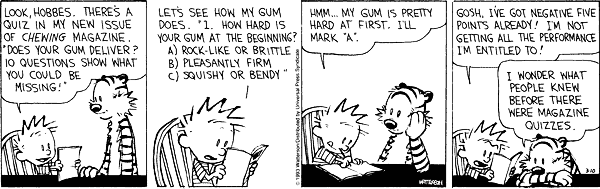 |
| Quantifying enjoyment (click to enlarge) |

What the resulting spreadsheets couldn't measure was the messy, glorious, unquantifiable nature of true education: everything else is just training. As I say to my students: a successful class is when you leave the room and the world has slightly changed. If you don't feel your head has been messed with, either you haven't been listening or I'm failing you.
There's no room for this subversive nonsense in the New Public Management world. Instead, there's a Maoist process of permanent revolution. This is reflected in the language: if you aren't Going Forward with Vision on a Mission, then you're a Curator of the Past, as a colleague was told. Thinking Outside The Box doesn't mean what you think it means: it actually means conforming to the elite managerialists' discourse, rather than critiquing it. The result of the Spreadsheet Model of pedagogy is that the students are extruded from a sausage machine. They have a certificate. They can use Powerpoint. They can write a CV and turn up to work on time. Can they tell you what a postmodern reading of your company's activity might be? Or what Little Pip would say about working in the photocopying room? Maybe, but that's not what employers and the Spreadsheet Cadre want. 'Deep knowledge' is far less important in a market economy than the superficial skills required to join a low-wage, disempowered workforce.
Even worse: those of us who passionately care about our subjects (why else would we be here?) and think that they're inherently beneficial get dismissed as the reactionaries. Which is wrong. A student who graduates equipped for an unfulfilling job furthering the malevolent ends of a rotten system isn't empowered. Instead, we've set them up for exploitation. Whereas one transformed by cellular biology, French Lesbian Poetry (which that idiot James Dyson snidely blamed for Britain's Decline) is already a winner, whether they draw on those specific things ever again or not.
Which is wrong. If business wants identikit drones who'll agree with everything, business will get them. But business won't last very long. What you need to succeed is wit, style, contrariness and intellect, tied with a willingness to stand up to those who want a predictable life: none of which qualities show up on a spreadsheet. All this talk of visions and missions is deceptive. What's wanted by the managerialists (note that I'm not saying 'managers', because there's a difference) is people who can be controlled and kept at arms length from power. If you can't speak the lingo, you don't get to play. This is why I wonder whether those fluent in Bullshit are not bullies but cowards. Individually, they may not know what all this stuff means, but they know that if they don't speak it, they'll be out. Even worse, they might be asked to explain what they mean by pesky people like us.
Rather than being empowering, the discourse of NPM is profoundly disempowering, rendering discussion about education impossible outwith the paradigm of individualistic, atomised consumer capitalism. As Knights points out, New Labour and the Tories are as one on this: 'managerial populism' (which includes treating students as customers) isn't liberating, it's a means of enforcing control down to the slightest detail, 'replacing a culture of trust with one of contract': no space for serendipity educational weirdness there! My immediate managers and my students are largely resistant to this rubbish, but their instincts are at odds with the structure. The culture of measurable learning outcomes, satisfaction surveys and the like encourage us all to view education as a quantifiable and portable personal good, like an iPod, with a discrete outcome (a certificate).
Conversely, according to Knights, lecturers are encouraged to withdraw all the off-balance-sheet effort we actually put in. Why stay late (as I do most nights, getting regularly locked in the building), put on an extra tutorial, go and sit with students at lunchtime to talk about the books a bit longer, attend their bands' gigs and all the other things we do for fun if none of this shows up on a Workload Allocation Form? Instead the culture of audit makes us feel exploited and under surveillance. On my deathbed, I won't breathe my last satisfied that my students' grade averages increased by 2.7%. I'll be pleased to hear that they're picky, critical readers, lovers, parents, teachers, colleagues, guerrillas and rulers. Find that on a spreadsheet!
I'm not saying that university lecturers are a special breed who should do whatever we feel like behind closed doors. But we should be free to share our abilities with each other, to educate each other, to learn from other teachers' ideas and practices, on an egalitarian basis (which is how the old Subject Centres worked: now abolished). Look at school-teachers. League table culture leads many of them to cut corners or produce students who (and I'm not joking) have never read in full the books they studied at A-level. Schools, and students, have been ruined by a culture of cynical results-driven pseudo-education. We inherit students who think that 'key chapters' can be used to extract 'the message' of any given text. My job in part is to teach them to read again: slowly, thoughtfully and critically. Turning students into customers doesn't 'empower' them: it demeans them and implies that they are the passive recipients of our 'product', rather than travellers on a quest.
A spreadsheet culture in universities will lead to teachers and students collaborating to game the system: short-term statistical success quickly followed by national, cultural and economic failure as we realise that certificates do not = education. Teachers will be pressured to 'produce results' or lose their jobs, and we'll end up as the last 'quick civil servants' to be enfolded into the capitalist embrace. Subject deemed 'inflexible' or not contributing to 'transferable skills' will be dumped unceremoniously.
Except, of course, in the kinds of universities our rulers attend. You know that, don't you? The discipline of the market is only applied to the poor. Northern Scum surely don't have any use for Anglo-Saxon, Norse and Celtic. Whereas the children of the élite have the delicacy of mind required. They'll find work whatever they do. The Russell Group universities even proposed to the Quality Assurance Agency that they don't need inspection because they're Good Chaps - only us oiks because it's our job to cope with the unwashed masses. It's Transferable Skills for the future photocopier salesmen of the world, Medieval Philology for the nobs who seem to find cosy Ministerial positions administering government departments without ever worrying about their transferable skills or knowing anything about their field. When was the last time the Department of Health was led by a doctor? Which is a shame, because there are many potential Medieval Philologists in my classes and on the streets of the Dark Place.
I'm sorry that this has turned into another classic unfocussed, rambling Vole Rant. I'll end with Ben Knights's fine words. Buy his book when it comes out:
…while tribal narcissism is self-evidently a bad thing, in the current historical moment there is a pressing need to defend the social and institutional bases that make critical dialogue possible. In short, we cannot afford to join in running down or de-skilling any community that preserves the seeds of knowing, thinking and behaving differently.Update: got an email from management today, asking why staff don't believe that 'the university offers quality service to its customers'. 'FFS', as I believe the kids say these days.


