One of the mandatory e-learning modules staff have to undergo at my place, alongside 'fire safety' and 'bribery' (how not to, at my level) is Prevent, the government's statutory system for making university staff spy on their students.
As a service to all but particularly my students and their families, here are screen shots of the course.
You bet they're watching. Doing the course is compulsory - failure to engage results in a discussion at appraisal then further action.

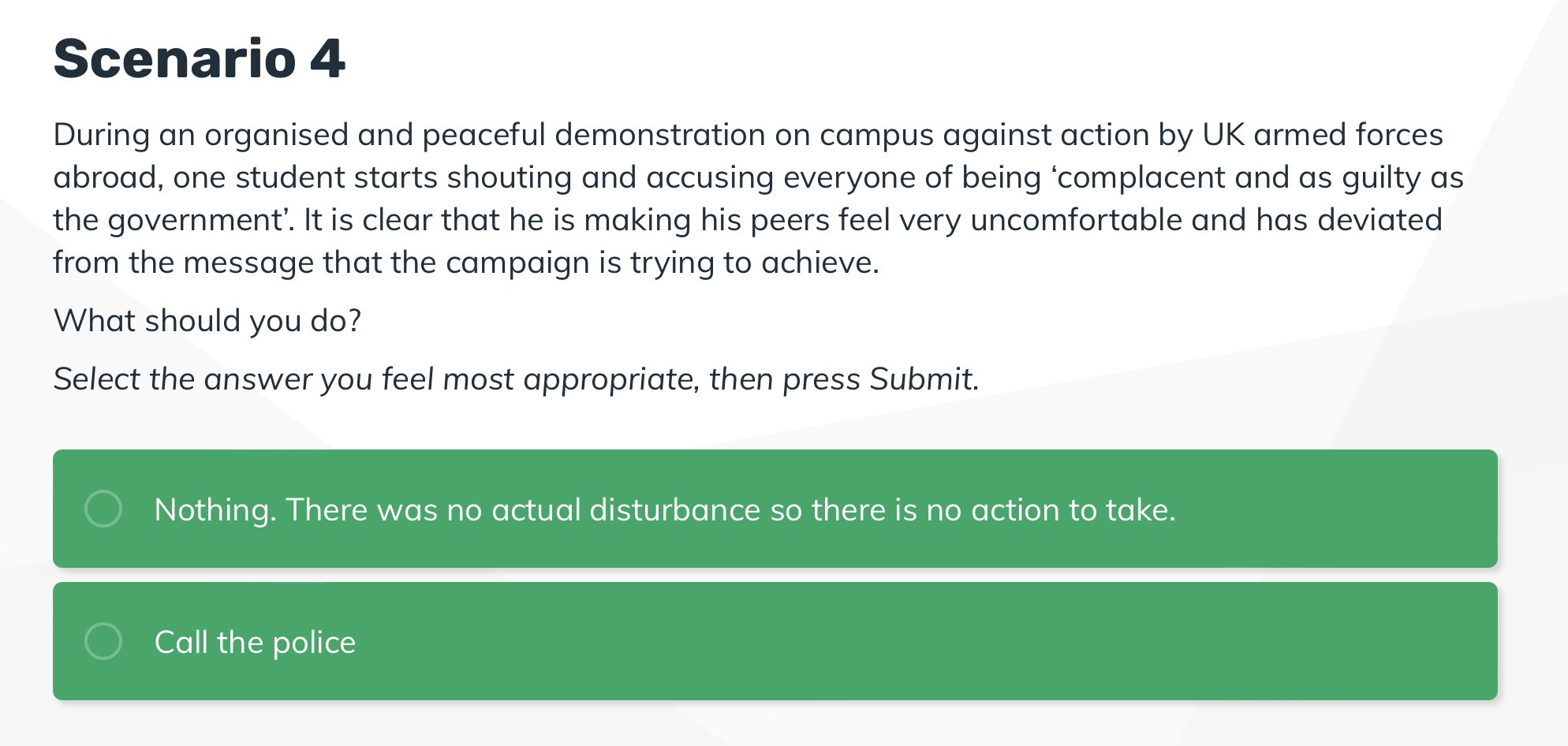
I forgot to screenshot the question this answers, but it asked whether the legislation was a response to the Omaha bombing, 9/11, or the 7/7 bombings. An odd mix of defensiveness and 'saying the quiet bit out loud': invoking the three main UK political parties to claim broad agreement, despite the fact that New Labour kicked all this off by invading Iraq and Afghanistan, while the coalition was deeply authoritarian on civil rights. Here's a tip lads: if you're going to claim that Prevent isn't targeted at Muslims, don't highlight that this kind of legislation wasn't thought necessary when white people were setting off bombs.I kind of feel this one is personally targeted because my institution had more graduates go on to postgrad work in Guantanamo Bay than any other in the UK - all were exonerated. I somehow doubt, whatever the protestations, that Prevent is applied equally.

If there's a strong link between reporting my students for things they say and the 'causes' of radicalisation, it's not obvious from this course. As we'll discover, the evil genius of Prevent is that it's marinated in the language of therapy, and thus denies any link between 'terrorism', 'radicalisation' (whatever that means) and actual reality. My grand-uncle Thomas cycled across Ireland with a bundle of dynamite in 1916, joining in the Easter Rising at the GPO. While I never had the chance to meet him, I struggle to imagine that he was radicalised by some sense of personal inadequacy, depression or hidden persuaders. I suspect it was the Famine, the banning of the Irish language, poverty and the continuing disenfranchisement of the Irish people within the UK that did it. When did he stop being a terrorist? When his side won and redefined his actions as a revolutionary. But according to Prevent, there are no external, structural reasons to be 'radicalised' (which I think means having strong views outwith the acceptable range - I don't suppose anyone's reporting Young Conservatives for wanting to abolish the minimum wage or ban abortion). Big Brother loves his students and just wants them to be happy.
As for the 'ideological challenge of terrorism', this is a big red flag. Terrorism isn't the problem, per se: carpet-bombing civilians (Dresden), rounding up peasants (Kenya) or giving your successors a list of people to be executed while running a pro-execution PR offensive (Malaya) are all terrorist acts, but they don't count because they were committed by a government (guess which). Finally: surely the way to respond to the 'ideological challenge' is to have these arguments in public, not secretly report individuals to the state under the guise of supporting them. One of the Soviet methods of dealing with dissidents was to declare them mad and send them to psychiatric hospitals - Prevent seems to operate on very similar lines.


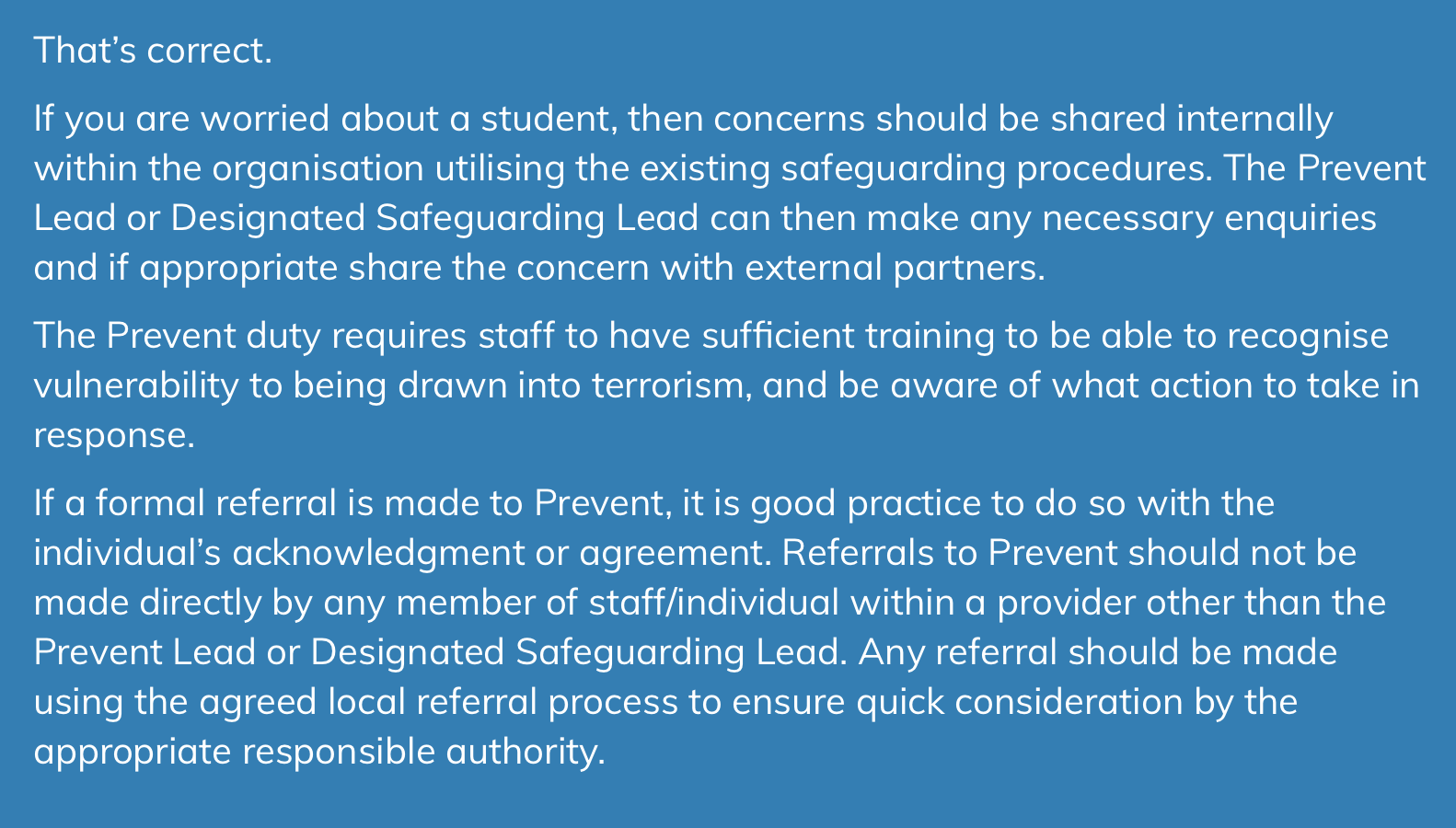
Have a set of red herrings. The 'correct' answer is of course 'Prevent is only about identifying potentially vulnerable individuals and offering support'. What could be more conducive to promoting freedom of expression than the knowledge that everyone you meet on campus, from cleaners to counsellors, is legally obliged to report anything you say that they think is a bit dodgy, so that a committee can decide whether you're mad and need reporting to shady external bodies? Consultation is a joke: the legislation is in place, the statutory duties are there, and – as all modern university executives know – most students' unions are wholly-owned subsidiaries of the marketing department. The 'ideal approach' is pure hypocrisy: the Prevent structure
is secretive (my students aren't briefed about its existence at all) and opposition is meaningless because there's no meaningful way to alter the legal requirements.
Moving on, let's talk about what terrorism is

I didn't realise a building could be terrorised. I threatened my stuck front door this morning, and should report myself immediately. More seriously: the unspoken aspect is that one of the definitions of government is that it has the sole right to use force or coercion against its citizens (and others). Given that the current government has now given the police the right to close down 'noisy' protests, it's not hard to imagine the definition of terrorism to be applied to people who block roads, chant loudly or demonstrate against hunting parties. Secondly, terrorism however defined, is a minority pursuit. Almost nobody does it. Seriously - a tiny, tiny, proportion of people. Requiring literally millions of people across a range of jobs to spend their time reporting young people is hugely inefficient, a mechanism for (ironically) terrorising people into keeping their mouths shut thus internalising a regime of ideological silence, and an excuse to build up a massive database on the population, no doubt to be processed by deeply worrying government departments and their outsourcing friends like Palantir.


I had to fill in a risk assessment for a 40-minute solo railway journey recently, and it was sent back three times for not being detailed enough - I'd failed to explain what would happen if the train was late, or if I lost my mobile phone. At the same time, I and everyone else in HE is being asked to take it on themselves to decide whether a student's behaviour might make them potential terrorists. I once got a reference request from the Navy asking me to assess whether a media studies student would make a good Royal Marine. I didn't feel equipped to answer that question (he'd skipped the exam on Advanced Garotting) and I don't feel equipped now to decide on someone's potential for violence. I've certainly challenged students, including one whose term for anything he thought was rubbish - in this case Lady Gaga's 'Poker Face' was 'Zionist') but there are way too many subjective aspects to this procedure to be safe for anyone. There are loudmouthed bigots on my campus espousing horrible views rooted in right and leftwing politics, all the major religions and a range of other perspectives. We could spend our entire working days reporting each other because there's no clear line in Prevent between 'is publicly horrible' and 'is vulnerable to becoming a terrorist' (which by the way removes all agency from the individual: I'm pretty sure grand-uncle Thomas know exactly what he was doing). Can anyone truly believe that referring a student to a system which makes reference to carefully unnamed 'external partners' for something they've said (not
done)
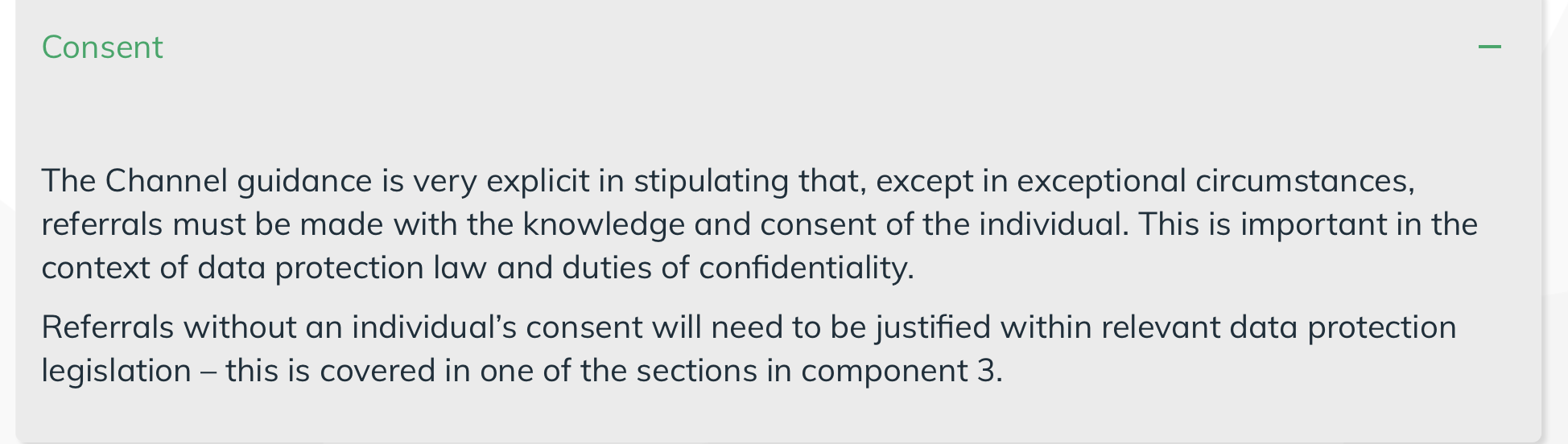
is somehow therapeutic or 'safeguarding'? The language around consent is utterly meaningless: 'good practice' is the barn door through which the cart will be driven on a regular basis.

Just because the course almost exclusively depicts brown people and uses religion as a proxy for ethnicity doesn't mean Prevent is all about Muslims! Look, we've scattered a couple of white people and references to other stuff in a not-at-all-tokenistic fashion! Pop quiz: what might 'a particular source' be? I'd love to know how many of the police officers recently revealed to be violently sexist and racist were reported to Prevent by their colleagues.
There you go! A whole list of potential threats that we're definitely treating equally. Sorry there's no space for statistics on referrals and outcomes for each category Very unfortunate! What? There's a qualitative difference between 'Extreme Right Wing' and 'Left Wing Extremism'? Really? No no.

Hmm. Tell us you only really care about brown terrorism without telling us you only care about brown terrorism. Talking of which: have another picture of a brown person to reinforce our totally non-discriminatory approach to surveilling everyone. Hopefully that will distract you while we elide the difference between terrorism and very strong views while pretending that you're free to think whatever you like (as long as you don't mind untrained people reporting you on a whim). Honestly, this is so dishonest. How does one define an atmosphere 'conducive to terrorism'? The whole population of 1770s Boston would be in trouble, as would Carson, Ho Chi Minh and every roads protestor (which is the point as you can see from the next slide).

Got a tattoo? Find yourself kettled at a protest against tuition fees, or for reproductive rights? You're clearly nearly a terrorist. Seriously, how mealy-mouthed is 'influences exerted' to 'cause a person to become vulnerable to being drawn into terrorism'? I'm about to launch a module on literary representations of the environment. Given what we're currently doing to the environment, a lot of the texts are likely to have Views, possibly Radical Views. Should I self-report?
Just look at the sneakiness of this evil. Let's be clear: having radical views (whatever that means) isn't illegal but I have a legal duty to stop you from 'being radicalised' by reporting you to a range of state organisations without any right to see what's being said and shared about you or by whom.
Because if I don't, there's only one way this can end up. We've got to institutionalise your instinct for justice as a mental illness that leads to you donning a suicide vest because that's the only potential outcome.
Maybe we should talk about the individual's complaint. Perhaps consider whether it's not an individual thing? Possibly even decide collectively whether it's reasonable?
No! Don't be a numpty. These mad people find other mad people and act collectively. Like the WI or anti-EU campaigners. No, definitely not like them. I have a Radio 4 historical documentary on the Maastricht Treaty on and an anti-Treaty Tory just said 'if these people won't listen to us we'll have to find ways to make them' but Prevent wouldn't be interested in this kind of thing at all. The worrying people are different in ways we definitely can't enunciate out loud.
Bingo! Just like that. They all egg each other on you know.
Let's move on to some case studies. How early should you report someone for being a bit dodgy? Here are a couple of case studies - one of them not even a brown person - which prove that it's never too early to report someone even though there's absolutely no evidence that Prevent could have, er, prevented what they did/
Oppose counter-radicalisation strategies? You're a terrorist. Stay in your room amidst domestic violence? Terrorist. No nuance required. Here's another brown person with another attempt to claim that Prevent is basically a big hug from 'agencies'. Don't read today's story that
MI5 and the police spied on children.
An undercover police unit regularly stored files recording the political beliefs of schoolchildren, along with photographs of them. These included reports on a 17-year-old who was said to spend “a lot of his spare time” at his girlfriend’s home, and two schoolboys, then 14 and 16, who were described by the covert officers as “effeminate”…one young man was monitored “because of some badges he was wearing when he passed through Dover which indicated that he was opposed to racism”
All in the past.
Onwards to Identifying Terrorists On Campus. Simples! Big beard? Definitely a terrorist. Check out their tats too - almost all terrorists ink 'Death to the West' or swastikas on their foreheads. People never behave per formatively or provocatively, and there has never been a case in which an organisation has endorsed as a resistance group then declared terrorist and back again. It's not as if the Ukrainian
Azov battalion wasn't a bunch of actual fascists not very long ago. We're all friends now. Just make sure you keep up with Nadine Dorries' Big List of Bad People (I think the Channel 4 logo is now on the banned list: report any student expressing an interest in nationally-owned media).
And remember: it's the ones who don't behave suspiciously you should be most suspicious of (oh, and anyone who uses a laptop in low light conditions).
So in case my students are interesting in how the system works once I've reported their tattoos and preference for mood lighting, here's what happens.
The bonus class in the posh offices persuade the government that they Really Mean It. Then they talk to 'groups and partners' - i.e. coffee with Special Branch and the local MI5 team. It doesn't take a human geographer to work out that there are likely to be more of these types in, to take a completely random example, the West Midlands than (again at random) St. Andrews or Cambridge. Rich posh people don't start wars (except for the Founding Fathers, obviously).
Q1: Do you admit Muslims?
(I'm being satirical, obviously).
Or they may not.
Silence definitely equals consent, and threats are an acceptable means of persuasion.
Feel free to monitor students' and colleagues' social media while talking about freedom of speech. 'Agreements…need to be agreed' definitely means something, we're just not sure what. And there definitely won't be any reluctance on students' parts to talk about 'sensitive' topics if they know they might be reported for feeling strongly about anything.
Will we enforce this? Don't be silly. A tame SU officer present during a 3 minute discussion with no vote at the end of a four-hour meeting fully satisfies the requirement for consultation. No need to bother the student body's pretty little heads. They're very busy. Being terrorists, probably.
So don't worry about consent: compliance is all, and OfS will be round to check:
Anyone objecting to OfS being a wholly politicised tool of the culture war will be reported to Prevent. Obviously.
Risk assessments are easy. Start with the league tables. Then ask yourself: is your university in the North, or an unfashionable inner-city area? We definitely don't racially profile your students, we just profile them. 'No provider is risk-free', but some only admit nice people and some…don't. If in doubt, quietly mention a few names to the local rozzers and see what they say. If all else fails, there's always what we call the Family Guy test, which is completely unrelated to the photo we chose for this slide.
Don't worry. Everyone's done their Unconscious Bias online training so there's absolutely no way you or anyone else will respond differently to anger or passion in say, a brown working-class man than to a middle-class white woman. That never happens. It's so unlikely that we won't be doing any equality impact assessments or reporting on the profile of those reported to Prevent.

Anyway, let's move on. This government is firmly committed to freedom of speech. Except for statue-opponents, refugee-cheerleaders, environmentalists, retainers and a few other marginal troublemakers. We're absolutely certain that making it a legal duty for everyone you meet on campus to report you for being 'radical' or 'vulnerable' whatever that means will be highly conducive to the vigorous exploration of complex ideas. No-one's going to self-censor, especially not people from ethnic or cultural minorities. If they object to you
inviting Toby Young as the surprise guest at a Christmas dinner they paid for: report them to Prevent!
*anyone suggesting that rationality is a socially-constructed concept which enabled - in some arguments - genocide, eugenics and the Holocaust will obviously earn a referral.
These gender-fluid remainer kids. Avo-on-toast is a gateway to Trans activists bombing playgrounds.
Be sure to check the Home Office FB page for today's list of terrorists and which words count as 'inviting support'

Terrorism can have many causes - it's just a coincidence that we're talking about religion a lot. And there aren't many Anglican terrorists are there. It's those foreign religions that are the problem. It used to be the Catholics talking in Latin. Now…?
Here's an example completely at random.
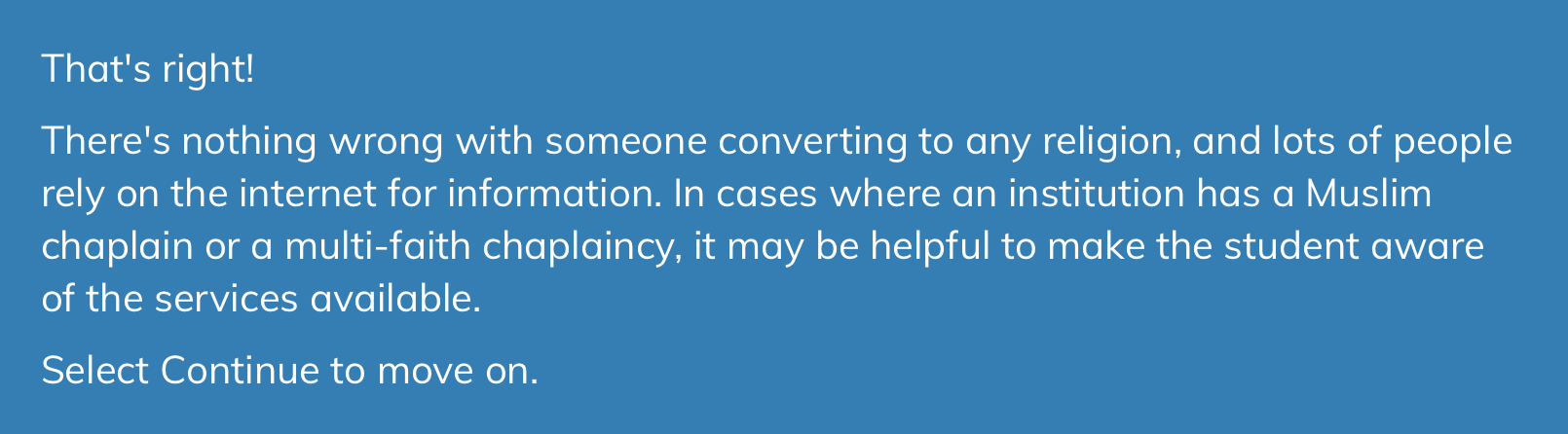
Don't worry kids: only half the people around you would have reported you for becoming a Muslim!
Then there's a break to consider chemical-biological warfare. I would worry if a student asked me this, mostly about our admissions standards. You'd think a terrorist would be a little more secretive, somehow.
Worry not though: we're back to religion which isn't at all a cover for particular beliefs and peoples.


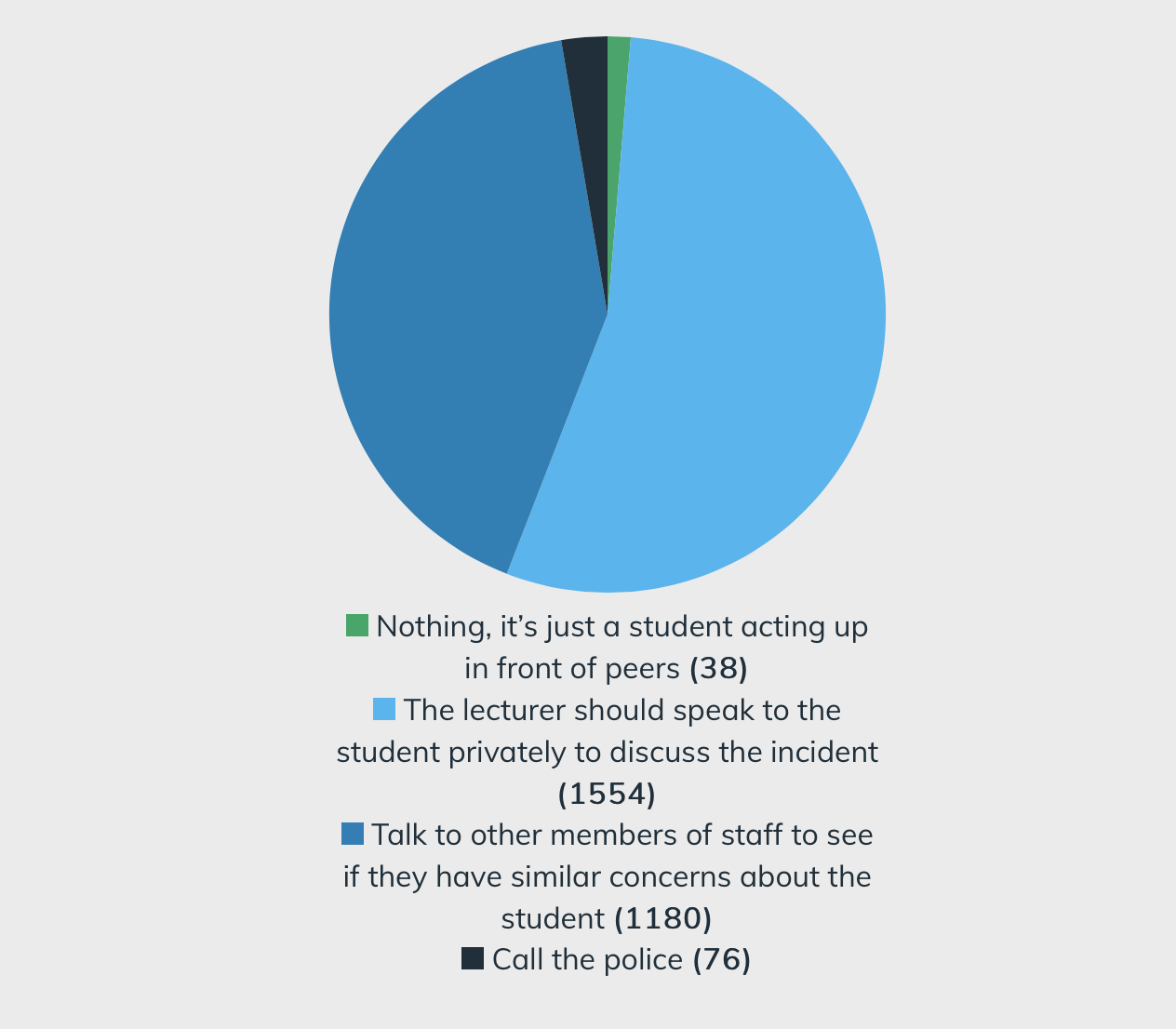
This bit is fine, though I worry about how many people want to call the cops.
If you reported this student: congratulations, you can spot a terrorist. If you didn't, you have blood on your hands because guess what:
If all else fails, there's Channel. Channel is the programme that takes vulnerable people you think are open to being brainwashed and…brainwashes them. Yes, there's a policeman involved but there's very little chance it will be one of the ones who shares racists jokes, stops and searches mostly brown people, murders women or shares sexist memes via WhatsApp. Anyone referred definitely won't go on a list forever. Perish the thought!
Careful though - the lying press are desperate to make this look a bit racist and sinister! Which it definitely isn't.
Don't worry about this bit. There's no way identifying someone as a potential terrorist might count as an 'exceptional circumstance' in and of itself for the purpose of reporting someone. Don't give it a moment's thought. Just ask your friendly local MI5 agent.
So there we have it. Nothing to worry about. If YOU get invited to a Prevent meeting, see it as an act of love. Bask in the knowledge that it's included in your fees and enjoy the fact that in the midst of an enormous, impersonal institution, some of the people at the top know your name (location, search history, library use). Feel the warmth!