It's Tuesday. I wouldn't normally post this early in the week (it's quite a while since I was blogging 4 times per day!) but the rest of the week isn't going to be normal.
Today sees the first Staff Summer Party over at the other campus. There are rides and ice-cream stalls and a bucking bronco because that's what academics really want to do apparently. Truth be told, a summer tea party after a long year is rather a nice idea, but this one falls on the eve of our strike. We all got a letter from the Vice-Chancellor explaining that we should all be satisfied with a 1.1% pay rise after 8 years of below-inflation settlements, and that he's very very disappointed with our ingratitude (I paraphrase, but only slightly). I've suggested that the party be renamed the Let Them Eat Cake bash, but apparently that's not helpful.
I wouldn't mind, but that very day the Times Higher Education Supplement published a report which singled out our VC for his 19.6% pay rise: a very handy £44,000 which should see him through the summer. The Chair of the Governors told THES that the rise is due to the VC's excellent performance, while forgetting to mention – and this is in the publicly available records – that the VC's salary is being increased to the median for the sector as a matter of policy.
Now, I'm a governor of this institution (though I'm excluded from the Renumeration Committee) and am bound by a duty of confidentiality, so I can't give you all the details, but I can give you my view. Academic staff are not rewarded for 'results': we're assessed and appraised and criticised and occasionally praised, but not rewarded. Only senior executives – some of whom are demonstrably ignorant of what goes on in classrooms – are afforded bonus payments and a salary scheme which depends on an all-universities pay survey. What this essentially means is that the senior managements of all universities are on a one-way conveyor belt of pay uplifts. If senior pay is benchmarked to a sector average, all they have to do is tell each other that this year, they've deserved an increase. Hey presto, they all get one! As we say round here, credit and money rise to the top. Only blame trickles downwards.
To be honest, if it wasn't for the sight of people on 20% pay rises sending out threatening emails telling us we're greedy I wouldn't mind so much about the salary. What I do object to is the complete absence of analytical rigour. Universities' monies are loans from students, to be paid off (over decades). I want to see a Vice Chancellor or a Head of Finance of a university – which is a charity, let's not forget – stand in front of a student and explain why he or she deserves to soak up the £9000 fees of 30 students (45 for Birmingham University's VC) while they're being taught often by insecurely-employed, part-time teachers who are expected to produce world-class research, generate external funding and top-class National Student Survey reports while often being employed on zero-hours contracts.
Academics aren't fat-cats. We're like footballers in that our careers start very late: I did 4 degrees to become fully qualified and worked on an hourly-paid basis until I was 34, so I've missed out on at least a decade of savings, pension contributions and housing costs. My female colleagues have done the same, except that those who take time off to have children lose out even more. Our pensions have been slashed while the contributions have increased. And yet I'm expected to keep quiet while the VC gets a top-up equivalent to my annual salary. We're not like footballers in that football managers don't get all the money when the team plays well.
We all know what happened to the banking sector. They were captured by a group of employees who treated their institutions as personal piggy banks, and therefore thought it was OK to use shady and often illegal methods to achieve short-term gains for themselves while bringing about a global recession for which we all paid. Education is too important to be captured by uncollegiate, self-reinforcing circles of sharp-suited snake-oil salesmen and women, convinced by their MBA training that they and they alone have 'saved' their institutions and deserve corporate rewards, while the teachers, technicians and support staff are simply fungible assets to be sweated and discarded.
Universities need managers, and the skills required to keep a complex, enormous institution like a university going aren't necessarily the same as those required to propel an academic to the top of her field – I don't think we can manage without them. However, I do now feel like the public service ideals which underpinned the collective enterprise of the academy have been replaced by a Directors and Hands structure whereby our views are unwelcome and our labour to be sweated.
How can I say to my nephews and nieces – and my fresh-faced PhD students – that they should consider a career in teaching and research when they could get a decent job at 21 with a BA or even no degree at all? My life is mostly brilliant: I spend all day talking about books and get paid for it. I spend my classroom time with students and colleagues who are a pleasure to be with – but I'm old. If I were 21 and burdened with £50,000 of debts I'm not sure that the simple pleasures of intellectual enlightenment would make up for another decade of unemployment, another £50,000 of debt, of scrabbling around for enough hours to make ends meet, followed by decades of bullying and pay cuts delivered by someone with a chauffeur-driven limo and an air of bemused contempt? That's a tough gig.
That's why tomorrow I'll be out on the picket line with my bags of peanuts (representing our pay offer) and some 'filled pockets' Whiskas treats for the fat cats as they sweep past us.
Showing posts with label strike. Show all posts
Tuesday, 24 May 2016
Monday, 10 February 2014
The name's Hunt. Total Hunt.
People have got many LOLs from Jeremy Hunt's name, particularly when it was (accidentally) transformed on live radio into an insulting and crude term for the female genitalia. It's not a term I use, and anyway, being likened to Jeremy is the most wounding weapon in my arsenal.
But what is it about politicians called Hunt? Jeremy is the Minister for Health who a) wants to sell the whole thing off to his friends in business and b) things homeopathy is a thing. The other prominent Hunt is Tristram, MP for part of Stoke-on-Trent thanks to being Peter Mandelson's friend back in the days when that wasn't code for 'corrupt Machievellian war-monger': parachuted in against the wishes of the constituency members. Tristram is of course the very exemplar of meritocracy: anyone who claims his political rise is in any way connected to the fact that his father is a Labour member of the House of Lords is just a cynical purveyor of the politics of envy. Tristram. No, like all Labour's leaders, Tristram spent a formative period underground as a miner, before embarking on the long hard slog through community activism before the acclaim of his fellow proletarians led him to set out on the long march to London to change the world.
Only joking. Tristram went to the very expensive and elitist University College School, then Cambridge. After a brief period as an academic and TV historian (very much not the same thing as being a non-TV historian), he went – surprise surprise – to a New Labour think tank and then into Parliament.
Unsurprisingly then, our Tristram is indistinguishable from the Old Right. Despite being an academic expert on Marx, Tristram shares Michael Gove's passion for private-school stylings and neo-Victorianist attitudes. He has never said anything that could remotely be described as socialist or left-wing, and is seemingly entirely uninterested in anything other than pragmatic triangulation. This of course is a shame as Michael Gove and David Willetts have turned school and higher education into a quagmire of privatisation, free-market principle, corruption, bullying and prejudice. You'd have thought that anyone with more brain cells than a nematode could manage to carve out a political space allowing him to critique this neoliberal project, but apparently not.
Tristram Hunt's descent into shame was complete today. As I and thousands of other academics and support staff picketed in response to our fifth consecutive real-terms pay cut, Tristram crossed a picket line to deliver a class on – of all things – Marxism. Which at least indicates a vicious sense of humour.
That's right. A Labour Minister for Education ignored his former colleagues and his party's history to become a scab.
Update: thinking about it like a politician, I realised I initially missed the point. Tristram is a former academic and a Shadow Minister for Education. There is no way that he did not know that a) his former colleagues were taking industrial action and that b) there would be a picket line. Knowing that, he then chose to cross that line. He could have stayed at home or done one of the many things he has to do (perhaps take a trip to Stoke-on-Trent, which he supposedly represents). He could even have arrived early and sneaked into the building before the pickets started, like some of my scab colleagues. He didn't do any of these things: he deliberately crossed a picket line to make some kind of point, presumably to curry favour with the Daily Mail. And for that reason, I'm going to write to him and Ed Miliband.
I'm a Labour Party member. That means that I've endured the endless erosion of principle and passion in the party for as long as I've been alive. I've watched my party leadership running scared from the Daily Mail in every industrial dispute going. I've seen them hand over essential public services to their scaly new friends in the City. I've seen them torture and bomb and kidnap, bug and burgle and hack and I've stayed in, hoping that one day a shred of principle might re-emerge in the only non-Tory party that has a chance at government.
My reward? To watch Tristram Hunt stab us in the back without a twinge of guilt. We're so far beneath his concerns that he won't bother explaining himself and the Party will support him. What is the point of him? What is the point of voting Labour if it's led by people entirely bereft of principle? What will Tristram Hunt do that Michael Gove won't? From here, it's pretty hard to tell.
But what is it about politicians called Hunt? Jeremy is the Minister for Health who a) wants to sell the whole thing off to his friends in business and b) things homeopathy is a thing. The other prominent Hunt is Tristram, MP for part of Stoke-on-Trent thanks to being Peter Mandelson's friend back in the days when that wasn't code for 'corrupt Machievellian war-monger': parachuted in against the wishes of the constituency members. Tristram is of course the very exemplar of meritocracy: anyone who claims his political rise is in any way connected to the fact that his father is a Labour member of the House of Lords is just a cynical purveyor of the politics of envy. Tristram. No, like all Labour's leaders, Tristram spent a formative period underground as a miner, before embarking on the long hard slog through community activism before the acclaim of his fellow proletarians led him to set out on the long march to London to change the world.
Only joking. Tristram went to the very expensive and elitist University College School, then Cambridge. After a brief period as an academic and TV historian (very much not the same thing as being a non-TV historian), he went – surprise surprise – to a New Labour think tank and then into Parliament.
Unsurprisingly then, our Tristram is indistinguishable from the Old Right. Despite being an academic expert on Marx, Tristram shares Michael Gove's passion for private-school stylings and neo-Victorianist attitudes. He has never said anything that could remotely be described as socialist or left-wing, and is seemingly entirely uninterested in anything other than pragmatic triangulation. This of course is a shame as Michael Gove and David Willetts have turned school and higher education into a quagmire of privatisation, free-market principle, corruption, bullying and prejudice. You'd have thought that anyone with more brain cells than a nematode could manage to carve out a political space allowing him to critique this neoliberal project, but apparently not.
Tristram Hunt's descent into shame was complete today. As I and thousands of other academics and support staff picketed in response to our fifth consecutive real-terms pay cut, Tristram crossed a picket line to deliver a class on – of all things – Marxism. Which at least indicates a vicious sense of humour.
That's right. A Labour Minister for Education ignored his former colleagues and his party's history to become a scab.
Update: thinking about it like a politician, I realised I initially missed the point. Tristram is a former academic and a Shadow Minister for Education. There is no way that he did not know that a) his former colleagues were taking industrial action and that b) there would be a picket line. Knowing that, he then chose to cross that line. He could have stayed at home or done one of the many things he has to do (perhaps take a trip to Stoke-on-Trent, which he supposedly represents). He could even have arrived early and sneaked into the building before the pickets started, like some of my scab colleagues. He didn't do any of these things: he deliberately crossed a picket line to make some kind of point, presumably to curry favour with the Daily Mail. And for that reason, I'm going to write to him and Ed Miliband.
I'm a Labour Party member. That means that I've endured the endless erosion of principle and passion in the party for as long as I've been alive. I've watched my party leadership running scared from the Daily Mail in every industrial dispute going. I've seen them hand over essential public services to their scaly new friends in the City. I've seen them torture and bomb and kidnap, bug and burgle and hack and I've stayed in, hoping that one day a shred of principle might re-emerge in the only non-Tory party that has a chance at government.
My reward? To watch Tristram Hunt stab us in the back without a twinge of guilt. We're so far beneath his concerns that he won't bother explaining himself and the Party will support him. What is the point of him? What is the point of voting Labour if it's led by people entirely bereft of principle? What will Tristram Hunt do that Michael Gove won't? From here, it's pretty hard to tell.
Wednesday, 5 February 2014
Are You Katie Hopkins Or A Human Being?
Another strike day tomorrow. Look out for my custom-made placards. We'll be handing out Heroes chocolates for strikers and supporters, and peanuts to strike-breakers, to subtly symbolise what we're being offered.
Here are my designs - rough and ready but they'll do.
Let's not forget too that most academics don't get full-time jobs until they're in their 30s. I was 34. So that's no savings, no pensions and no National Insurance contributions for several years while I pursued the 4 degrees required to fully qualify for a job for which the salary is back to 2008 levels, the pension have been savagely cut, pension contributions increased and for which the qualification period has been extended. Not only am I getting poorer, I won't get a pension until 2050, with the distinct possibility of that date getting more and more distant.
How are we going to attract the generation behind me? What are we offering? Bigger Classes – Research In Your Spare Time – Less Pay – Longer Hours – Worse Pension (and if you don't meet your research requirements, you can sling your hook).
Stay classy, education employers!
Here are my designs - rough and ready but they'll do.
In case you missed it, this is what professional troll Katie Hopkins said about academics and university support staff, some of whom don't even receive the living wage:
Lecturers - get your idle arses off strike and back in the lecture theatres pronto. Be warned.Which is pretty much what my management said in a charming note reminding us that
The Vice Chancellor, in his letter to staff in December 2013, indicated that a 1% salary uplift for staff on nationally agreed pay scales was both fair and consistent with what many other large public and private sector organisations were awarding. In fact, many organisations have not awarded a pay increase for several years and local authorities in our region are having to look at making posts redundant. We believe that our staff, both academic and non-academic receive better pay than many non-HE employeesI'm sure they do believe it. But then what's the comparative group? We earn more than Bangladeshi football-stitchers, but less than dentists. If the university's really starting a race to the bottom, let's start at the heights. Next time the Executives come to renegotiate their contracts, let's say to them 'I'm sorry, but people outside the institution earn less, so we're cutting your pay'. I'm pretty certain that the response will be 'but you need to attract talent'. It's incentives for them, and pay cuts for us.
Let's not forget too that most academics don't get full-time jobs until they're in their 30s. I was 34. So that's no savings, no pensions and no National Insurance contributions for several years while I pursued the 4 degrees required to fully qualify for a job for which the salary is back to 2008 levels, the pension have been savagely cut, pension contributions increased and for which the qualification period has been extended. Not only am I getting poorer, I won't get a pension until 2050, with the distinct possibility of that date getting more and more distant.
How are we going to attract the generation behind me? What are we offering? Bigger Classes – Research In Your Spare Time – Less Pay – Longer Hours – Worse Pension (and if you don't meet your research requirements, you can sling your hook).
Stay classy, education employers!
Tuesday, 28 January 2014
Striking with Seeger
So, Pete Seeger's died on the day I'm heading out to a picket line (though we've been on strike so often recently that the odds were in his favour) which seems appropriate. I've always liked Pete's music. He acquired a reputation for being a bit reactionary because his devotion to folk music purism left him marooned when Dylan went electric: some people say he tried to cut Dylan's guitar lead with an axe, he says that he only wanted to. Amazing, looking back, that such distinctions caused bitterness.
However: one moment of stuffiness against a career of devotion to music, to the working people of the United States and elsewhere, and in which he endured state persecution and critical mockery? Seeger's on the side of the angels, and sometimes sang like one too. Here's one of his, good for a strike day:
Here's one for the UKIP crowd: Seeger's vicious lampooning of Senator Bilbo, also governor of Mississippi, one of the foremost white supremacists of his day, after one of his anti-immigration campaigns.
Lisa Simpson's 'Union Strike Folk Song' is an affectionate parody of Seeger and Guthrie:
Funnily enough, after our strike, we're hosting a talk by Rhian Jones about her book Clampdown: Pop-cultural Wars on Class And Gender. In it, she points out that my entire musical youth (1993-99) was a period of reactionary misogyny and class hatred in which all the good, spiky, autonomous female and working class bands (Kenickie, Elastica, Shampoo, Pulp, Lady Sovereign etc.) were marginalised by the posh, the manufactured arrogance of the Spice Girls and by cartoonish, reductive versions of working-class femininity and masculinity, helped along by the promotion of 'chav'. It's a bit weird, having your youth consigned to History, but it's a bracing and brilliant read. We'll be playing a bit of music and asking what happened to protest music, or just music made by and for its audience rather than dropped from a great height by record labels with little regard for real lives.
Here are some of the gems you may have missed, buried under the Indie Landfill:
PJ Harvey: Sheela-Na-Gig
The Period Pains: Spice Girls
Suede - Animal Nitrate
One of my favourite Pulp singles: My Legendary Girlfriend
Helen Love and Joey Ramone: Punk Boy
Ash - Uncle Pat:
Gorky's Zygotic Mynci's lovely Gewn Ni Gorffen
I could go on… and will. But not now. Teaching awaits.
However: one moment of stuffiness against a career of devotion to music, to the working people of the United States and elsewhere, and in which he endured state persecution and critical mockery? Seeger's on the side of the angels, and sometimes sang like one too. Here's one of his, good for a strike day:
Here's one for the UKIP crowd: Seeger's vicious lampooning of Senator Bilbo, also governor of Mississippi, one of the foremost white supremacists of his day, after one of his anti-immigration campaigns.
Lisa Simpson's 'Union Strike Folk Song' is an affectionate parody of Seeger and Guthrie:
Funnily enough, after our strike, we're hosting a talk by Rhian Jones about her book Clampdown: Pop-cultural Wars on Class And Gender. In it, she points out that my entire musical youth (1993-99) was a period of reactionary misogyny and class hatred in which all the good, spiky, autonomous female and working class bands (Kenickie, Elastica, Shampoo, Pulp, Lady Sovereign etc.) were marginalised by the posh, the manufactured arrogance of the Spice Girls and by cartoonish, reductive versions of working-class femininity and masculinity, helped along by the promotion of 'chav'. It's a bit weird, having your youth consigned to History, but it's a bracing and brilliant read. We'll be playing a bit of music and asking what happened to protest music, or just music made by and for its audience rather than dropped from a great height by record labels with little regard for real lives.
Here are some of the gems you may have missed, buried under the Indie Landfill:
PJ Harvey: Sheela-Na-Gig
The Period Pains: Spice Girls
Suede - Animal Nitrate
One of my favourite Pulp singles: My Legendary Girlfriend
Helen Love and Joey Ramone: Punk Boy
Ash - Uncle Pat:
Gorky's Zygotic Mynci's lovely Gewn Ni Gorffen
I could go on… and will. But not now. Teaching awaits.
Thursday, 23 January 2014
Despatches from the picket line
So here I am, back at my desk after our first 2 hour strike in pursuit of our pay claim. In case you haven't been following it, we've been awarded 1%. Given that prices are rising at at least double that, it's a pay cut. Not the first one either: inflation's been up to 4% and our pay awards have been as low as 0.5%. When inflation is taken into account, my salary is back to 2008 levels, though my duties are very much of 2014 vintage.
To make matters worse, our pensions have been cut, our pension contributions increased and our retirement dates extended far into the future. So far, my retirement date is 2048, and it will be extended further than that before then. I fully expect to be commuting to work on a jet-pack, as a bag of bones hanging limply from a sentient metal exoskeleton, while some robot Vice-Chancellor demands to know why I'm not using the 24 hour telepathic feedback system installed for the Martian exchange students. What really depresses me is that we'll never recruit a new generation of academics. Students graduate with massive debts to pay off, and won't be attracted by a profession in which research and teaching (the good bits) are rewarded by ever-decreasing salaries, while becoming a sharp-suited upper-management axe-wielder attracts vast pay, perks and prestige.
And as if to ad insult to injury, the university's management ha budgeted for below cost-of-living settlements for the next four years, which means that teaching staff will have got poorer for an entire decade. Is the same true of senior management? Of course not: rather a lot of them are on £100,000+, while the VC is on significantly more than £200,000. They negotiate their contracts individually, making a case to a hand-picked bunch of chaps and chapesses just like them. They need to be 'retained' by massive salaries of course: shame they don't value our service just the same. Take the Vice-Chancellor of Sheffield University, who had a handy little pay rise to cover his gas bill this year: this charming gentleman is offering 1% to academic staff and refuses to raise support staff salaries to a living wage. Thankfully his new salary enables him to keep body and soul together – Sir Keith has gone from a pitiful £269,000 to a more reasonable £374,000, a modest increase of only 39%. No wonder there's nothing left in the kitty for the cleaners and teachers.
So, off we went for our strike today. In an additional burst of petty spitefulness, our Executive decided that our 2 hour strike would be punished by docking an entire day's pay, so we'll be seeing them in court very soon, as I cheerily informed the head of HR when she calm skulking round. Hoping to see a pathetic, reduced turn-out, she was greeted by a large rumbustious group which was receiving a lot of support from students despite the vile and disingenuous propaganda circulated by the management and students' union, which is sadly little more than a marketing wing of the university. Management claimed that our strike was 'disruptive' - failing conspicuously to recognise that locking us out for a full day is rather more disruptive than 2 hours of action.
Interestingly, the head of HR told the governors that they were sticking to the 'nationally agreed' 1% settlement. Now, call me a pedantic old teacher of English literature and communications, but I was under the impression that an 'agreement' needed two or more parties,
rather than the various members of UCEA, the employers' association , and that the poor illiterate must have mistyped the word 'imposed'. Either that, or she was deliberately misleading the governors, and I wouldn't like to believe that.
We're on strike again next week, and again the week after. Another day's pay lost, more disruption for students. We don't like it, but it's nothing compared with the tatty, demoralised, exhausted and downgraded condition higher education will be in if we let these grasping bureaucrats turn what used to be a collegiate profession into a low-rent, low-trust, low-quality service industry.
Oops: almost forgot. Kittens for the local paper.
To make matters worse, our pensions have been cut, our pension contributions increased and our retirement dates extended far into the future. So far, my retirement date is 2048, and it will be extended further than that before then. I fully expect to be commuting to work on a jet-pack, as a bag of bones hanging limply from a sentient metal exoskeleton, while some robot Vice-Chancellor demands to know why I'm not using the 24 hour telepathic feedback system installed for the Martian exchange students. What really depresses me is that we'll never recruit a new generation of academics. Students graduate with massive debts to pay off, and won't be attracted by a profession in which research and teaching (the good bits) are rewarded by ever-decreasing salaries, while becoming a sharp-suited upper-management axe-wielder attracts vast pay, perks and prestige.
And as if to ad insult to injury, the university's management ha budgeted for below cost-of-living settlements for the next four years, which means that teaching staff will have got poorer for an entire decade. Is the same true of senior management? Of course not: rather a lot of them are on £100,000+, while the VC is on significantly more than £200,000. They negotiate their contracts individually, making a case to a hand-picked bunch of chaps and chapesses just like them. They need to be 'retained' by massive salaries of course: shame they don't value our service just the same. Take the Vice-Chancellor of Sheffield University, who had a handy little pay rise to cover his gas bill this year: this charming gentleman is offering 1% to academic staff and refuses to raise support staff salaries to a living wage. Thankfully his new salary enables him to keep body and soul together – Sir Keith has gone from a pitiful £269,000 to a more reasonable £374,000, a modest increase of only 39%. No wonder there's nothing left in the kitty for the cleaners and teachers.
So, off we went for our strike today. In an additional burst of petty spitefulness, our Executive decided that our 2 hour strike would be punished by docking an entire day's pay, so we'll be seeing them in court very soon, as I cheerily informed the head of HR when she calm skulking round. Hoping to see a pathetic, reduced turn-out, she was greeted by a large rumbustious group which was receiving a lot of support from students despite the vile and disingenuous propaganda circulated by the management and students' union, which is sadly little more than a marketing wing of the university. Management claimed that our strike was 'disruptive' - failing conspicuously to recognise that locking us out for a full day is rather more disruptive than 2 hours of action.
Interestingly, the head of HR told the governors that they were sticking to the 'nationally agreed' 1% settlement. Now, call me a pedantic old teacher of English literature and communications, but I was under the impression that an 'agreement' needed two or more parties,
a negotiated and typically legally binding arrangement between parties as to a course of action
rather than the various members of UCEA, the employers' association , and that the poor illiterate must have mistyped the word 'imposed'. Either that, or she was deliberately misleading the governors, and I wouldn't like to believe that.
We're on strike again next week, and again the week after. Another day's pay lost, more disruption for students. We don't like it, but it's nothing compared with the tatty, demoralised, exhausted and downgraded condition higher education will be in if we let these grasping bureaucrats turn what used to be a collegiate profession into a low-rent, low-trust, low-quality service industry.
Oops: almost forgot. Kittens for the local paper.
![]() |
| 'What do we want? Fair pay in HE!' Best picket line ever. |
Wednesday, 4 December 2013
Solidarity, baby!
Hi everyone. I'm not blogging properly again: it's been one of the busiest weeks in years and I'm rushed off my feet. But here's a letter I've just sent to the President of The Dark Place's Students' Union.
Dear President,
thank you for your email asking me if I could help out with the Students’ Union’s University Challenge effort this year. As you know, I’m a huge fan of the show and would love to see our students do well.
However, I feel I must decline your request. As you know, academic staff took strike action yesterday and are working to contract. This is because our salaries have reverted to their 2008 level, with further real-terms reductions projected some years into the future. As a hard-working, committed, conscientious academic, I support students well beyond my contractual duties, as any of them will tell you. My colleagues in the library, the cleaning staff, the caterers and security guards all do their best for students, in public and in a thousand little ways which might never be noticed. This university is rightly proud of the ‘student experience’, but it never acknowledges that its success is dependent on the good will and free labour provided by staff who go the extra mile, not for money, but because it’s the right thing to do.
Yesterday, I stood on the picket line, in the cold, for hours. Between explaining to strike-breaking colleagues and passing students why I wasn’t in a nice warm classroom – which is my natural and favourite environment – I followed the Twitter feeds of fellow academics and students across the country. I saw Students’ Unions at Warwick, Birmingham, Sussex and many other places joining their friends on the picket lines, or occupying their universities.
![]() |
| What you won't see at The Dark Place |
They know that to attract and retain good teachers, cooks, cleaners and other workers who make the ‘student experience’ so good, universities need to stop squeezing their standard of living.
What did your Students’ Union do? As far as I can tell, the Student Council has no policy on this matter. The Executive decided to make policy in breach of its own constitution, and decided to remain ‘neutral’ as you put it to me. I and my UCU colleagues are not ‘neutral’. Nor are you fellow student leaders in the NUS and across the country. They know that good staff make life good for students. I am desperately sorry that the Dark Place’s Students’ Union is ‘neutral’ when faced with declining living standards.
I’m sorry I can’t help with University Challenge and wish you well. But it’s just a giggle in the end. What will really help students is solidarity in our fight to make sure that this institution can attract and retain motivated, secure staff, whatever their jobs: some of them are or will be your members. We support your members every day: when it came to the crunch, you failed to support us. Until this changes, I won’t be taking on additional duties, however much I enjoyed them.
Yours,
Plashing Vole
Wednesday, 30 October 2013
Why I will be on strike tomorrow.
Those of you who pay attention to the times I post here on Vole will be aware that far from being a lazy shirker getting fat on state-funded largesse at the expense of 'hard-working families' (copyright: all politicians), I actually find it hard to tear myself away from the dear old place. Being on campus for 12 hours per day is pretty normal for me.
And yet tomorrow I'll be standing outside my workplace, stamping my frozen feet and brandishing a placard and very politely asking colleagues and students not to enter the building. Not just to experience what I've read about in the 1930s proletarian novels I spend my life researching, but because we have a serious problem.
By most standards, I'm quite well paid: more than a schoolteacher of the same age and seniority, vastly less than a doctor or lawyer. However, that's just the headline figure. Like most of my colleagues, I've only achieved secure employment very late. After my first degree, I needed to get an MA and a PhD, which took a long time and sunk me in debt. For several years after that, I got by on hourly-paid teaching: a bit of Politics here, a semester of Sociology there, a dollop of Media Studies. The work wasn't reliable, stable or predictable. Pay arrived months late, and didn't cover the hours marking, research and extra tuition required to do a good job for my students and my colleagues. Summer was entirely income-free and a pension was a distant rumour. Financial disaster was narrowly averted a few times through gifts and by selling treasured possessions. I finally achieved permanent status (with the help of sympathetic management) in my mid-thirties, long after most people would be thinking about mortgages and families.
There's a whole army of colleagues out there teaching classes every day without a scrap of security, and carrying huge debts earned in pursuit of a moderately paid job. They spend their salaries on petrol and train tickets as they shuttle between 3 hours at X University and 2 hours at Y College in the vain hope that one day, one day a bean-counter will realise their true worth and find some way to given them a decent job. You just can't tell us apart because we're all so damned impressive in class (ahem). Even those of us with decent jobs got there very late, meaning that our apparently excellent pensions aren't nearly so gold-plated as you'd think. My retirement date is currently 2046, and it's absolutely certain that it will be extended several years beyond that by the time I get there. Most of my students think I'm a boring old fart now: what will they make of a septuagenarian trying to comprehend their cultural world by then, trapped in the classroom by the urgent need to earn enough to avoid burning my books for fuel? Academics are like footballers, only more attractive and less likely to steal each others' partners or start fights in nightclubs (some exceptions apply): our careers are shorter than in other professions, and rely on the repeated demonstration of very individual skills – a decent salary and secure pension isn't too much to ask.
The immediate cause of this strike is this year's pay offer. It's 1%, which is an effective pay-cut because inflation is around 3-3.5%. This is the fifth consecutive pay cut, meaning that we're 13% poorer than we were in 2008. I hear politicians and business leaders explaining that management bonuses and huge salaries are essential to attract talent: how are universities meant to attract the bright young academics of the future if they're left with little to eat but professional pride? You can bet your ass that most universities' senior executives aren't accepting these settlements: only dishing them out. My university is spending nearly £40m on much-needed buildings to offer students top-quality educational opportunities: if only they could find the tinier sum needed to make sure that those labs and lecture halls will be staffed by eager, motivated teachers.
My university recently renamed the Personnel department 'Human Resources'. Well, let me tell you this: Soylent Green is people! We're not just a fixed cost, or a 'fungible asset' (as one of my IT friends was once called by his boss). Yet the way the government and the more business-aligned academic leaders talk, we're no longer professionals with duties beyond the merely contractual (to society, to students, to public culture), we're disposable delivery units to be sweated and discarded.
Tomorrow morning, my students are going to be confused and upset when their classes are cancelled and they see me asking for their support. I hope they will see our cause as just, and as a microcosm of this country's ugly turn towards a low-wage, low-skill, high-dividend economy in which shareholder profits trump justice, fairness, the public good and collective benefit. Some of those students, carrying £50,000 of undergraduate debt, will be lost to academia because they can't face additional years of debt and study to qualify for a job which pays less and less and attracts only the scorn and hatred of the political class and their media lackeys.
I can live with a fifth pay cut in a row. I'm striking because I can't see where this will ever end.
And yet tomorrow I'll be standing outside my workplace, stamping my frozen feet and brandishing a placard and very politely asking colleagues and students not to enter the building. Not just to experience what I've read about in the 1930s proletarian novels I spend my life researching, but because we have a serious problem.
By most standards, I'm quite well paid: more than a schoolteacher of the same age and seniority, vastly less than a doctor or lawyer. However, that's just the headline figure. Like most of my colleagues, I've only achieved secure employment very late. After my first degree, I needed to get an MA and a PhD, which took a long time and sunk me in debt. For several years after that, I got by on hourly-paid teaching: a bit of Politics here, a semester of Sociology there, a dollop of Media Studies. The work wasn't reliable, stable or predictable. Pay arrived months late, and didn't cover the hours marking, research and extra tuition required to do a good job for my students and my colleagues. Summer was entirely income-free and a pension was a distant rumour. Financial disaster was narrowly averted a few times through gifts and by selling treasured possessions. I finally achieved permanent status (with the help of sympathetic management) in my mid-thirties, long after most people would be thinking about mortgages and families.
There's a whole army of colleagues out there teaching classes every day without a scrap of security, and carrying huge debts earned in pursuit of a moderately paid job. They spend their salaries on petrol and train tickets as they shuttle between 3 hours at X University and 2 hours at Y College in the vain hope that one day, one day a bean-counter will realise their true worth and find some way to given them a decent job. You just can't tell us apart because we're all so damned impressive in class (ahem). Even those of us with decent jobs got there very late, meaning that our apparently excellent pensions aren't nearly so gold-plated as you'd think. My retirement date is currently 2046, and it's absolutely certain that it will be extended several years beyond that by the time I get there. Most of my students think I'm a boring old fart now: what will they make of a septuagenarian trying to comprehend their cultural world by then, trapped in the classroom by the urgent need to earn enough to avoid burning my books for fuel? Academics are like footballers, only more attractive and less likely to steal each others' partners or start fights in nightclubs (some exceptions apply): our careers are shorter than in other professions, and rely on the repeated demonstration of very individual skills – a decent salary and secure pension isn't too much to ask.
The immediate cause of this strike is this year's pay offer. It's 1%, which is an effective pay-cut because inflation is around 3-3.5%. This is the fifth consecutive pay cut, meaning that we're 13% poorer than we were in 2008. I hear politicians and business leaders explaining that management bonuses and huge salaries are essential to attract talent: how are universities meant to attract the bright young academics of the future if they're left with little to eat but professional pride? You can bet your ass that most universities' senior executives aren't accepting these settlements: only dishing them out. My university is spending nearly £40m on much-needed buildings to offer students top-quality educational opportunities: if only they could find the tinier sum needed to make sure that those labs and lecture halls will be staffed by eager, motivated teachers.
My university recently renamed the Personnel department 'Human Resources'. Well, let me tell you this: Soylent Green is people! We're not just a fixed cost, or a 'fungible asset' (as one of my IT friends was once called by his boss). Yet the way the government and the more business-aligned academic leaders talk, we're no longer professionals with duties beyond the merely contractual (to society, to students, to public culture), we're disposable delivery units to be sweated and discarded.
Tomorrow morning, my students are going to be confused and upset when their classes are cancelled and they see me asking for their support. I hope they will see our cause as just, and as a microcosm of this country's ugly turn towards a low-wage, low-skill, high-dividend economy in which shareholder profits trump justice, fairness, the public good and collective benefit. Some of those students, carrying £50,000 of undergraduate debt, will be lost to academia because they can't face additional years of debt and study to qualify for a job which pays less and less and attracts only the scorn and hatred of the political class and their media lackeys.
I can live with a fifth pay cut in a row. I'm striking because I can't see where this will ever end.
Tuesday, 29 November 2011
On the eve of battle
So, dear readers, you won't be hearing from me tomorrow, unless I manage to snatch a few minutes from our pickets and rally to document the workers' struggle. I've got a Moomins flask (mint tea) and a hip flask (raw meths).
Joking aside, striking's no fun, especially in the cold and rain, but it's got to be done. Today George Osborne yet again decided that passengers on private jets don't have to pay tax. Meanwhile, he and his millionaire friends have decided that cleaners, nurses, teachers and civil servants should work longer, pay more and get less. We're not being asked to contribute more in return for a decent retirement: we're being asked to contribute more to subsidise the tax-evasion and trickery of the financial sector.
I won't get many years' pension contributions: an MA, a PhD and years of casual labour saw to that. Nor will I get many years' pension: my retirement age will be 68 and men live to about 78-80. I'm not demanding a yacht with a Zimmer frame ramp, but I would like not to have to worry about how to heat my hovel.
Some of my friends in the private sector ask why I should cling on to 'gold-plated' pensions when they don't get much. They're looking at it wrongly: don't drag us down, organise and pull yourselves up. There's no lack of money. The Teachers' Pension Fund, the NHS pension pot: they're all fully funded. Likewise in the private sector: if there's enough money for CEOs to earn on average 140 times more than the employee, there's enough money for decent pensions too.
Don't forget, pensions aren't some kind of reward: they're deferred wages. Increasing our contributions while cutting our pensions is a thinly-disguised pay cut. Oh, and to correct a common misconception: we're docked 1/260th of our wages every time we strike. This time, we've finally managed to persuade the boss that the cash should go into the Student Hardship fund, rather than into the coffers.
It's good for the economy as well. Pensions are spent, often in the local economy, whereas share dividends, bonuses and high executive pay is hidden away offshore, where it can't pay the local baker, car mechanic or cleaner, let alone build schools and hospitals. Decent wages and pensions make the economy go round.
Come and say hello tomorrow. We're not wreckers or militants. We're workers, just like you, and we're doing this for everyone. Bring cake.
Joking aside, striking's no fun, especially in the cold and rain, but it's got to be done. Today George Osborne yet again decided that passengers on private jets don't have to pay tax. Meanwhile, he and his millionaire friends have decided that cleaners, nurses, teachers and civil servants should work longer, pay more and get less. We're not being asked to contribute more in return for a decent retirement: we're being asked to contribute more to subsidise the tax-evasion and trickery of the financial sector.
I won't get many years' pension contributions: an MA, a PhD and years of casual labour saw to that. Nor will I get many years' pension: my retirement age will be 68 and men live to about 78-80. I'm not demanding a yacht with a Zimmer frame ramp, but I would like not to have to worry about how to heat my hovel.
Some of my friends in the private sector ask why I should cling on to 'gold-plated' pensions when they don't get much. They're looking at it wrongly: don't drag us down, organise and pull yourselves up. There's no lack of money. The Teachers' Pension Fund, the NHS pension pot: they're all fully funded. Likewise in the private sector: if there's enough money for CEOs to earn on average 140 times more than the employee, there's enough money for decent pensions too.
Don't forget, pensions aren't some kind of reward: they're deferred wages. Increasing our contributions while cutting our pensions is a thinly-disguised pay cut. Oh, and to correct a common misconception: we're docked 1/260th of our wages every time we strike. This time, we've finally managed to persuade the boss that the cash should go into the Student Hardship fund, rather than into the coffers.
It's good for the economy as well. Pensions are spent, often in the local economy, whereas share dividends, bonuses and high executive pay is hidden away offshore, where it can't pay the local baker, car mechanic or cleaner, let alone build schools and hospitals. Decent wages and pensions make the economy go round.
Come and say hello tomorrow. We're not wreckers or militants. We're workers, just like you, and we're doing this for everyone. Bring cake.
Tuesday, 8 November 2011
My Nuremberg
In advance of the UCU lecturers' strike (that'll show 'em) on November 30th - defending our pensions - our hitherto moribund SU is hosting a Question Time on Thursday, 5-7, in place of actually supporting us. In the absence of anyone better, I'll be on the panel with Melanie Philips, Alan Sugar and Alex James some SU representatives, students and university officials.
Post questions in advance or just turn up - it'll be enormous fun.
Tuesday, 5 July 2011
The best of a bad bunch turns out to be very bad indeed
Ed Milliband's robotic and reactionary response to questions about our strike in defence of our pensions has been widely mocked on the internet.
Here's the best version yet:
Friday, 1 July 2011
Subversives, terrorists and other threats to the British Way of Life
In honour of yesterday's Daily Mail front page ('Resist the Union Bullies'), some more examples of those bullies in action at J30, with Mail-appropriate satirical captions). The whole set is here and there are more highlights in the previous 2 posts (go here and scroll down). Click on these to be confronted with the 'enemy within' on a gigantic scale!
Indoctrinated. She'll never fear the working classes now!
Look at her, sitting down rather than working for the minimum wage and a poverty-stricken retirement.
That's right. Michael Foot has been reincarnated and he's coming for your children
Of course they're delinquents. They're under 65, which is the only qualification Daily Mail readers recognise.
Brown people expressing opinions: every Mail reader's nightmare
Lost to the tennis club and Young Conservatives. A life of drugs and abortions awaits these two.
Bono's really let himself go
Even the middle classes can be poisoned by the Doctrine of Hate peddled by subversive primary school teachers and lefty lecturers.
Behind that cute expression, she's already planning violent revolution
And what's worse, his sticker was in English until some English people walked in!
(It's Welsh for 'Fair pensions for all')
Another of the usual anarchist suspects to be found at every demonstration
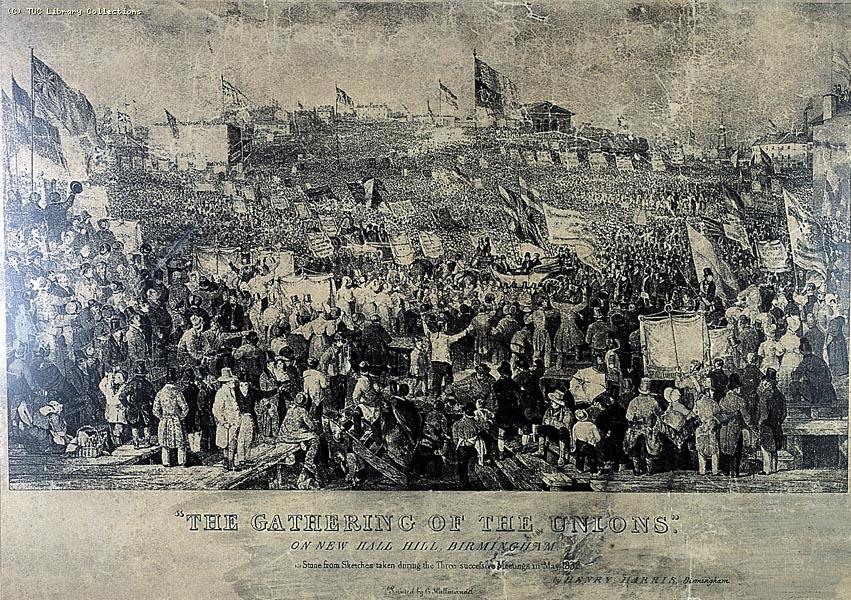
'The Gathering of the Unions', Birmingham 1832. Sorry I couldn't get a better shot. I was engraving as fast as I could, but they kept moving!
More faces of evil
J30 Special: Here are some more of the terrorists the Daily Mail warned 'parents' about (as though no parent is a public sector worker, parent of public sector workers, or descended from public sector workers). Captions are satirising the Mail of course.
That would be the newspaper which blamed us teachers for a girl's death today. That's right. 'Because' we were on strike, she sat under a tree. 'Because' we were on strike, the branch broke. 'Because' we were on strike, she died.
I wonder how the parents of this poor girl feel about the way their daughter's death has been used, and note that no reporter would actually put his or her name to this disgraceful piece:
Full set here: click these to enlarge.
That would be the newspaper which blamed us teachers for a girl's death today. That's right. 'Because' we were on strike, she sat under a tree. 'Because' we were on strike, the branch broke. 'Because' we were on strike, she died.
I wonder how the parents of this poor girl feel about the way their daughter's death has been used, and note that no reporter would actually put his or her name to this disgraceful piece:
Full set here: click these to enlarge.
Look at her evil smiling face… bet she's some kind of anarchist communist poisoning innocent children's minds
They can't even march straight
Another child lost to Satan
Ugh! Modern Art!
Celebrating the downfall of British Values!
Some of these strikers wear nice clothes! How dare they complain about their pensions!
Dreads. Brown skin. Happiness. Everything the Daily Mail fears!
He only looks innocent. Inside he's a cauldron of hatred for Middle Britain
Look at her grinning altruistic face! Burn her!
Meet the Union Bullies the Daily Mail Warned You About
This was yesterday's rather hysterical Daily Mail front page on the J30 rallies:
Now as you know, I'm a shy and retiring mammal with very little tendency towards thuggish bullying, and I suspect that the assorted teachers, lecturers, cleaners, lab techs and so on who joined me at yesterday's rally were, on the whole, not the types who would once have held your head down the toilet bowl or snapped your spectacles in the playground.
And lo and behold, they weren't! Here are some of the pictures I took. Click on them to enlarge, or see the whole set here.
The face of evil
The unacceptable face of militant trades unionism
This man is a threat to your house prices, Mail readers!
Sarcasm… it's every teacher's WMD
Nearly a terrorist.
Wednesday, 29 June 2011
What every radical subversive academic will be wearing tomorrow
I've just nipped out to do some shopping. As a fully paid-up member of what Margaret Thatcher called 'the enemy within', I came back loaded down with weaponry ready for tomorrow's strike.
Actually, I bought two new pillows and a breadbin. And this, 'designed' by me, which I'll be sporting on the picket lines and at the big rally in Birmingham tomorrow. Victoria Square, 12 noon. I couldn't think of anything catchier than 'millionaires mugged me for my pension', and didn't have time to get pictures of Clegg, Cameron, Gove, Willetts et al. Still, it will do, and I rather suspect I'll get to wear it rather too often.
I won't be blogging tomorrow, but I'll be taking a lot of pictures which I'll try to post on Friday, during out Staff Conference. Meanwhile, remember the old slogan: Educate, Agitate, Organise!
Actually, I bought two new pillows and a breadbin. And this, 'designed' by me, which I'll be sporting on the picket lines and at the big rally in Birmingham tomorrow. Victoria Square, 12 noon. I couldn't think of anything catchier than 'millionaires mugged me for my pension', and didn't have time to get pictures of Clegg, Cameron, Gove, Willetts et al. Still, it will do, and I rather suspect I'll get to wear it rather too often.
I won't be blogging tomorrow, but I'll be taking a lot of pictures which I'll try to post on Friday, during out Staff Conference. Meanwhile, remember the old slogan: Educate, Agitate, Organise!
Friday, 17 June 2011
Why I am striking on June 30th
As a member of UCU, I'm taking strike action on June 30th. Here's why.
We are striking against Con-Dem plans to:
• cut public sector pensions by a third;
• to increase the public sector pension age to 68;
Our action on June 30th will be the first major strike against the Con-Dem Government and we ask that you show your support for the public sector workers taking action to defend their pay and conditions and to defend our public services. Please sign petitions and send letters of support into your local school, college, university or Job Centre (for the attention of the NUT, ATL, UCU or PCS union representative).
Listen to this morning's interview with Danny Alexander, Liberal Democrat Chief Secretary of the Treasury, in which he explains that, notwithstanding ongoing negotiations, our pensions are going to be reduced, our contributions are going to increase, and we're all going to work for longer to qualify for them.
I'm not opposed to working longer personally: I know that my miserable life will drag on for a few more years than my parents, and the vision of me sitting at home in my pants railing in a senile fashion at Melanie Philips' satanic grandchild on Question Time 2040 doesn't appeal. But I don't see why working a few more years isn't enough to cover my pension: I'll be paying in for more years, rather than taking out.
• cut public sector pensions by a third;
• to increase the public sector pension age to 68;
• and make public sector workers pay 50% more for it!
We are not striking because we are greedy. Our pensions are a vital part of our pay. We work in the public sector because we believe in decent public services for everyone, and taking strike action is never an easy decision. Academics tend to enter contribute to pensions several years after most people because we usually need years of extra study to qualify, and full-time employment often follows extended periods of hourly-paid teaching: I did a part-time MA and a part-time PhD while picking up bits of university teaching and school supply teaching. I didn't have a 'proper' job until well into my 30s.
The next generation of academics will owe £27,000 in undergraduate fees alone, plus the cost of living for three years, before they even think about postgraduate degrees: higher contributions for a reduced eventual pension will hurt those who decide to enter our profession, while many people will decide not to become educators at all. We must strike on behalf of the next generation of academics. If I came out of a BA with £50,000 of debt already, perhaps thinking of a mortgage and raising a family, there's no way I'd spend the next few years doing more degrees then starting on £29,000 in my 30s. I'd go into something lucratively destructive like banking.
This attack on our old age is part of the Government’s attempts to roll-back public services. School budgets, libraries, the NHS, youth services, Citizens Advice Bureaus, Legal Aid, leisure centres, access to college and university and more services are being attacked as the Government attempts to undermine the notion of decent public services available to all.
Naomi Klein's The Shock Doctrine explains the process: any economic problem is to be used to institute hard-right free-market policies. The irony in this case is that hard-right free-market policies led to the recession now being used as an excuse to attack us. These changes are not a temporary response to an emergency: they are part of an ideological assault on this country's values.
Rightwing politicians and thinkers are claiming that we are 'feather-bedded' or over-privileged, and that we should be treated the same as private-sector workers. This is untrue and misleading: rather than reduce our conditions, why should those in the private sector not earn decent pensions and conditions (and as their directors and executives currently do)? Let's not race to the bottom to enrich the billionaires: let's work to get everybody's lifeboat floating higher. I vocally supported the BA strikers and every other industrial action in recent years - don't swallow the tabloid lies about fat-cat teachers and social workers.
In any case, public-sector workers aren't living a life of luxury: the average public sector pension is only £4000. In teaching, over 95% of pensions are less then £10,000. Unlike the millionaires in the boardrooms or those in our Cabinet, we will not get a ‘gold plated pension’.
Our action on June 30th will be the first major strike against the Con-Dem Government and we ask that you show your support for the public sector workers taking action to defend their pay and conditions and to defend our public services. Please sign petitions and send letters of support into your local school, college, university or Job Centre (for the attention of the NUT, ATL, UCU or PCS union representative).
Tuesday, 29 March 2011
Colleagues: FYI
This is stuck up in my office.
If you scabbed - and we know who you are - then you shouldn't expect any social niceties from me henceforth. I'm very proud that nobody in either of my departments is a picket-line crossing selfish traitor. I've already met one of these worms and declined to pass the time of day.
It's a simple rule. You don't scab, and you don't cross properly constituted picket lines. For instance, I'd have ignored the fuel protesters a few years ago because they were selfish bastards already in receipt of subsidies, demanding higher profits at the expense of the public and the environment. But in most cases, strikes are a collective last resort and should be supported or respected.
By crossing the picket line, these co-workers declared that they were somehow special, better than us, and stronger as individuals. There's a good lesson in Lewis Jones's We Live (1939), in which collective strength is demonstrated by the union members letting go of the coal cart on an incline. The man who refused to join the union is taught the virtues of solidarity as he strains to stop it rolling over him - after a few minutes he's begging for help.
Certain of my colleagues could do with this kind of demonstration - and will get it when they find their former comrades strangely reluctant to stand up for them in a tight spot.
If you scabbed - and we know who you are - then you shouldn't expect any social niceties from me henceforth. I'm very proud that nobody in either of my departments is a picket-line crossing selfish traitor. I've already met one of these worms and declined to pass the time of day.
It's a simple rule. You don't scab, and you don't cross properly constituted picket lines. For instance, I'd have ignored the fuel protesters a few years ago because they were selfish bastards already in receipt of subsidies, demanding higher profits at the expense of the public and the environment. But in most cases, strikes are a collective last resort and should be supported or respected.
By crossing the picket line, these co-workers declared that they were somehow special, better than us, and stronger as individuals. There's a good lesson in Lewis Jones's We Live (1939), in which collective strength is demonstrated by the union members letting go of the coal cart on an incline. The man who refused to join the union is taught the virtues of solidarity as he strains to stop it rolling over him - after a few minutes he's begging for help.
Certain of my colleagues could do with this kind of demonstration - and will get it when they find their former comrades strangely reluctant to stand up for them in a tight spot.
Tuesday, 22 March 2011
Solidarity, Baby!
We're striking on Thursday (not me, I'm away, damn it), and the National Union of Students fully supports us:
Well, not quite. The President of our SU is a minion of management and takes a rather different view.
He seems to have forgotten that he's elected to take the bigger picture - not act as a complaints desk or shop assistant. Students will miss a day's formal teaching. If the university and government get their way, they'll miss out on staff being able to pick them out from a crowd, staff who aren't working two jobs, and staff who aren't completely demoralised.
Clearly his election didn't include a literacy test either.
NUS President Aaron Porter was quoted in the Guardian on Monday saying "huge cuts to university budgets ideologically imposed by this government pose a massive threat to jobs and education. NUS has worked closely with UCU throughout our campaigns to oppose government cuts and stands in solidarity with their strike action next week." The NUS has also written to the Employers’ Pension Forum urging them to meet UCU to resolve the dispute over USS.
Well, not quite. The President of our SU is a minion of management and takes a rather different view.
As a union we have to promote the idea of using the time to study. We are encouraging students to who are affected to use the time to catch up on work. Remember that there are two main unions at this university, UCU and Unison. Unison are not striking.
I had a meeting with X [the man he seems to think is his boss] last week to discuss the University's stance on this. He informed us that the university will not be re-running any missed lectures and have no obligation to do so. All they will do is make the work available for students. For me, this is unacceptable as it means students are missing out. Lecturers are not providing an alternative for students and it is because of this that we are unable o support.
the groups decision is that that we do support lecturers but we have to put "students' First", A should have made this clear to you.
As I'm sure you will understand, we find ourselves in a difficult situation here, but we are a Students' Union and our first duty is always to you the student. Students are affected adversely by the strike abut are not to blame for the situation we are in. Students expect to be taught and receive the education they have paid for.
He seems to have forgotten that he's elected to take the bigger picture - not act as a complaints desk or shop assistant. Students will miss a day's formal teaching. If the university and government get their way, they'll miss out on staff being able to pick them out from a crowd, staff who aren't working two jobs, and staff who aren't completely demoralised.
Clearly his election didn't include a literacy test either.
Friday, 18 March 2011
All for one and one for all
This one's for my students, some of whom read this blog.
You might be aware that your teachers are on strike next Thursday. You've had a highly partisan e-mail from management making us sound like a selfish and greedy bunch.
Here's why we're striking.
Firstly, our jobs are increasingly insecure. Last year, 150 people lost their jobs because the executive (salaries: £100,000-£240,000) managed to misinform the government about how many students we had, and got fined several million pounds. None of the people responsible for this lost their jobs. They then said that everything was OK again and we could all relax.
Now we find that another 25 people are being fired. We also get offered a 0.4% pay rise, which is effectively a 4.3% pay cut because inflation is at 4.7%. So we're actually getting poorer. Did management take the same hit? No: the Vice-Chancellor took a rise of 3.5%, neatly covering inflation at the time it was agreed. For those of you who like hard figures, that's a pay rise of £7000.
Additionally, they're attacking our pensions. The deal in education is that we accept we're never going to be rich, but we have decent pensions. No longer: we're being asked to work for several years longer, pay more for our pensions and get lower pension payments. I don't personally mind working a bit longer, given we all live longer than ever, but I think those extra years of paying in rather than taking out should cover any shortfall.
Students may well be unhappy about missing a day's lectures (no, really, it's possible). But I'll say this: an overworked (we're seriously understaffed) and poorer teaching staff is far more detrimental. Too many classes, too many students and money worries don't add up to cutting-edge research-informed teachers.
Think about next year. Your brothers and sisters will be paying £7000-9000 per year, several thousands of pounds more than you're paying. Will the money be dripping off the library shelves, or paying for more staff and smaller classes? No. But the Vice-Chancellor will still be on more than £245,000.
We care about students. Please join us on the picket line next Thursday. We don't want to strike, but our employer isn't listening to us.
You might be aware that your teachers are on strike next Thursday. You've had a highly partisan e-mail from management making us sound like a selfish and greedy bunch.
Here's why we're striking.
Firstly, our jobs are increasingly insecure. Last year, 150 people lost their jobs because the executive (salaries: £100,000-£240,000) managed to misinform the government about how many students we had, and got fined several million pounds. None of the people responsible for this lost their jobs. They then said that everything was OK again and we could all relax.
Now we find that another 25 people are being fired. We also get offered a 0.4% pay rise, which is effectively a 4.3% pay cut because inflation is at 4.7%. So we're actually getting poorer. Did management take the same hit? No: the Vice-Chancellor took a rise of 3.5%, neatly covering inflation at the time it was agreed. For those of you who like hard figures, that's a pay rise of £7000.
Additionally, they're attacking our pensions. The deal in education is that we accept we're never going to be rich, but we have decent pensions. No longer: we're being asked to work for several years longer, pay more for our pensions and get lower pension payments. I don't personally mind working a bit longer, given we all live longer than ever, but I think those extra years of paying in rather than taking out should cover any shortfall.
Students may well be unhappy about missing a day's lectures (no, really, it's possible). But I'll say this: an overworked (we're seriously understaffed) and poorer teaching staff is far more detrimental. Too many classes, too many students and money worries don't add up to cutting-edge research-informed teachers.
Think about next year. Your brothers and sisters will be paying £7000-9000 per year, several thousands of pounds more than you're paying. Will the money be dripping off the library shelves, or paying for more staff and smaller classes? No. But the Vice-Chancellor will still be on more than £245,000.
We care about students. Please join us on the picket line next Thursday. We don't want to strike, but our employer isn't listening to us.
Friday, 5 November 2010
Spot the scab
There's a BBC news journalists strike on today and tomorrow, over pensions (despite the senir management being paid telephone numbers, most BBC staff aren't on top whack).
Because radio and TV news are so public, it's going to be really easy to see who's a dirty, class-traitor scab. Take down their names and remember them - when they need help next time, they're on their own.
Conversely, respect to the famous and rich presenters who've manned the picket lines in solidarity with their lower-paid colleagues, such as Paul Mason, Newsnight's economics editor and all-round good egg. Wearing a suit to a picket is a particularly nice touch. Joining him in solidarity if not in physical form were John Humphrys and Sarah Montague from the flagship Today programme.
Mark Thompson, the director-general of the BBC told them that:
Because radio and TV news are so public, it's going to be really easy to see who's a dirty, class-traitor scab. Take down their names and remember them - when they need help next time, they're on their own.
Conversely, respect to the famous and rich presenters who've manned the picket lines in solidarity with their lower-paid colleagues, such as Paul Mason, Newsnight's economics editor and all-round good egg. Wearing a suit to a picket is a particularly nice touch. Joining him in solidarity if not in physical form were John Humphrys and Sarah Montague from the flagship Today programme.
Mark Thompson, the director-general of the BBC told them that:
"The public – many of whom are facing difficult employment and economic pressures – will find it very hard to understand why the BBC's service to them should be impaired in this way,"Mark Thompson earns £834,000 per year, with commensurate pension.
Subscribe to:
Posts (Atom)