Showing posts with label office. Show all posts

Wednesday, 24 August 2016

Super summer round-up

Hello everyone. I'm back from my holiday and settling in to my new life in a 14-person call-centre style shared office in which we'll be able to work collaboratively without disturbing anyone, do cutting-edge research, see students and have confidential conversations. At least that's what management says from the comfort of their individual offices, though another section of the same institution has a very different view. A veal-fattening crate (as Douglas Coupland called it) is our reward for last year's 100% NSS satisfaction stats (yes, I know they don't stand up to a moment's scrutiny). Still, I've gained an insight into my colleagues' lives:


I've been in Ireland for a couple of weeks, enjoying the world-famous (in Kerry) Puck Fair and watching a lot of Olympics. I shifted off the sofa for a couple of swims in the Atlantic but not very often. The RTE  coverage of the Games was rather good: nowhere near as nationalistic as the BBC, wildly excited about the few medals and near-misses and hosted by a thoughtful and expert team, including Jerry Kiernan as The Grinch, a role you don't get on the Beeb:


It helped that the head of the Irish Olympic Committee, Pat Hickey, was arrested halfway through in a version of the FIFA hotel-raids with elements of French farce: nakedness and ridiculous lies from his wife. It added both gaiety and a degree of hard journalism to the coverage, and everyone I talked to enjoyed it enormously as this global equivalent of the gombeen man finally got what was coming to him.

You probably don't want to see my holiday snaps, but they're all here. Some of my favourites (click to enlarge):


Chapeaux!


I'm ready for my close-up…

The cattle fair was cruelly re-branded.

R2D2 in the Fancy Dress competition

A fortune-teller


I took a big pile of books with me to supplement my three-newspapers-a-day habit (Guardian, Irish Times, Irish Examiner): two Edwina Currie novels for research which I didn't get round to reading, and some others which I did. The first one was Sean Latham's Am I A Snob? Modernism and the Novel. I've had it on my shelves for a few years now and regret not reading it the moment I bought it. IT traces the changing definitions of snobbery from its early days (popularised by Thackeray in his Punch column 'Mr Snob', then analyses the tensions between aesthetic difficulty and democracy in the lives of three modernist novelists and their works: Virginia Woolf (particularly To the Lighthouse), James Joyce and Dorothy L. Sayers. Woolf in particular felt torn between fear and disdain for the lower orders and her cerebral socialism, hated being popular but liked the income. Latham traces the change in Sayers' Lord Peter from deliberate posh stereotype to subtle portrait of a damaged, complex character within a low-brow genre, and examines Ulysses in particular as a case-study of what's produced in the fusion of demotic and difficult. All three chapters are revelatory readings of these texts and suggest that the snob is an ideal character for examinations of the characteristics of modernism. I'm not sure Latham entirely grasped the erudition routinely expressed by ordinary Dubliners in conversation then and now, but it's a minor cavil. It's a wonderful book.

After that I read Christina Henry's Alice, an interesting horror-fantasy retelling of Carroll's novel. I don't habitually read horror or fantasy (though I read hundreds of the latter as a teen) but I'm interested in retellings in general, so I thought I'd give it a go. I liked it: it was disturbing but not gratuitous, and highly imaginative. On the down side, the plotting became a bit too intrusive and detracted from interesting character-driven explorations of madness and how women are written off: it was clear from fairly early on that a sequel and perhaps a series was being lined up. It would make an excellent film or even computer game, and I'm glad I read it, but I'm not sure I'll get Red Queen.

I then read Faulkner's The Sound and the Fury: I've read a lot of other Faulkner but never this one for some reason. It's the story of the decline of a formerly upper-class slave-owning white family in the American South and their black servants and neighbours, told in the first person by three family members and their principal servant. Astonishing: formally experimental, moving, sickening and compelling. Also brutally frank for 1929. Having read Eimear McBride's A Girl Is A Half-Formed Thing and seen it as a response to Irish modernism, I'm wondering if it's also influenced by this novel.

Finally, I read William Gibson's Spook Country. I've been reading his work for a long time now but I'm getting less and less out of the experience. By this point I could pretty much write my own. All you have to do is name an awful lot of expensive-but-obscure brands then imply that they're worn/driven/fired by mysterious intellectual terrorists/spies/capitalists/illuminati with damned good taste and large budgets. For instance, the Cuban-Chinese Communist-santeria devotee all-purpose criminal facilitator wears an APC jacket, while Hubertus Bigend the Belgian taste-maker/corruption hunter doesn't just drive the plutocrat's vehicle of choice – a Maybach – but a version customised to be even more exclusive: a Brabus-Maybach. Somewhere amongst the thicket of signifiers I found myself wondering if Gibson any longer has anything meaningful to say. Unless his point is that there's no longer anything meaningful to say about the state of the world other than to urge us to dress well while we're promoting or fighting international conspiracies.  I was quite hooked by one thing though: one character spends his downtime reading an unnamed book about medieval European millenarians. It's clearly Norman Cohn's The Pursuit of the Millennium, which I read recently and found fascinating. Gibson's obvious parallel is that there's a global Elect in the post-Iraq settlement which is impervious to ordinary rules, laws and morality. It's certainly stylish and there's a political anger there, but it doesn't quite work on a literary level.

And now it's back to reading politicians' novels. Come on Edwina, show me what you've got…

Friday, 10 January 2014

The Books Are To Remind Us What Asses And Fools We Are

Apparently my career can now be reduced to two words: 'fire hazard'. 

My shared office was just inspected for untested electrical equipment and hazards. They found some interesting stuff, like an integrated TV/VHS player I'd never noticed sitting on top of a bookcase. The printers didn't impress them either, despite being new and in daily use. But most of all, the tools of my trade (Weapons of Mass Instruction) shocked my visitors. It's true that I have a lot of books, and a lot of them are in the office, but it did feel slightly depressing to hear them discussed as a threat rather than as the means to a better (rather than 'next' life). All very Fahrenheit 451 especially in a university!

Everyone must leave something behind when he dies, my grandfather said. A child or a book or a painting or a house or a wall built or a pair of shoes made. Or a garden planted. Something your hand touched some way so your soul has somewhere to go when you die, and when people look at that tree or that flower you planted, you're there. 
There must be something in books, something we can’t imagine, to make a woman stay in a burning house; there must be something there. You don’t stay for nothing.
The next comment was 'I bet you're unmarried. Or divorced', which I thought was quite funny. 

It's true that there are a lot of books here, but there are also a lot of uncollected essays and I don't hear anybody offering to take those off my hands. Still, it could be worse. I've had students describe purchasing and retaining books as 'stupid…like my mum' and more than one has told me that s/he doesn't like reading. Having a lot of books in the office isn't just convenient and necessary for work: it's performative. It's good for reading-resistant students to see us working with books, enjoying books, appreciating them. I wouldn't want them to fetishise the book as an artefact (collectors are a royal pain, little better than train-spotters) but I do think cherishing physical books is an attribute to encourage.

I admit that a large number of books can be overwhelming. My flat has very little in the way of artwork on the walls because most of the space is taken up by cheap Ikea shelving. I too occasionally look round and desire clean, uncluttered, minimalist lines. Or at least somewhere I can hang the stacks of framed prints currently residing in an office corner: a 70s pop-art poster of Angela Davis

I can't find a version of my Davis poster online, but this is fairly close

the Tree of Literature and Renaissance Tree (in Danish), 


a batik seascape given to me by a friend, 6 reproductions of classic CND posters and David Jones' Cara Wallia derelicta:


I would like to live neatly and tidily, but not at the expense of the books and objects that make up my personal history. I find minimalist design sinister, like a Speer building: forbidding, life-denying and inhumane. Life's messy. We acquire things. Some are lost along the way. Some of the significant things may not be beautiful, streamlined or convenient (like my sorry carcass) but they're what we are. I couldn't imagine disposing of books, even the ones I've hated or struggled with. One day I might read them differently, and even if I don't, my feelings about them are part of me. I have an iPad and I can see the attraction of carrying texts around electronically. Light, clean, efficient – but there's more to a book than the marks on a page. I like the inscriptions, the leaflets that fall out of my Left Book Club volumes, my handwriting (and others') in the margins, the nicks and marks that turn a medium into a message. 

I couldn't cast a book out into a cruel and indifferent world, to fall into the hands of some unthinking lout! Just today I received a copy of Muriel Jaeger's 1926 utopian novel The Question Mark. Jaeger was an interesting author of a handful of SF novels and a lot of non-fiction, published by the Woolfs and associated with Dorothy L Sayers, Winifred Holtby and other intellectual Oxford women of the 1920s. My copy is special in another way too. It has an owner's tag:


Maybe it's just because I'm a boring unattractive fire hazard, but that makes this book special. It's crossed the Atlantic, it's spent decades in a place I'll never visit (except when I read The Wizard of Oz and its sequels) and it belonged to someone interesting. Professor O'Leary wasn't just a provincial teacher: he spent time at Oxford University, his wife was a leading Jewish intellectual activist and his son was a prolific sports writer and journalist. Perhaps he wrote about The Question Mark or just enjoyed it, but he was clearly a man interested in the future at a time between two apocalyptic wars when hope was in short supply. I don't know when the University of Kansas decided that it didn't need his books any more, but there's a cultural history tied up in just this one book. I look around all the other books I can see from this desk and see not just the texts and their authors, but phases in and aspects of my own life so far. Anthologies and textbooks for teaching, critical works waiting for assessment, my recently-acquired pile of Beverley Nichols novels atop the rest of my posh-30s buys (Laver, Powell, Connolly, Bryan Guinness, the Mitfords) designed to widen my experience past the proletarian novelists I know most about. There's a pile of books about Anne of Green Gables from a previous research moment, unread journals staring me in the face, rows of texts bought online during fascinating conference presentations in a rush of enthusiasm… you get the picture. 

Every so often I tidy up, and I've read more books than I've bought. I feel for my colleagues in the office who have to share space with me. But they'll have to dig me out of a book-fort before I'll let them take away these extensions of myself. And anyway, I'm not as bad as two of my colleagues. I helped one move office. After emptying one bookcase and taking down the book wall behind it, I was shocked to discover a previously unknown window. The other one had to dispose of part of his collection because a surveyor said his house's structural joists were giving way. Until my books threaten the physical integrity of the university, they're staying here! 

One final quotation from Fahrenheit 451:
The books are to remind us what asses and fools we are. They're Caeser's praetorian guard, whispering as the parade roars down the avenue, "Remember, Caeser, thou art mortal." Most of us can't rush around, talking to everyone, know all the cities of the world, we haven't time, money or that many friends. The things you're looking for, Montag, are in the world, but the only way the average chap will ever see ninety-nine per cent of them is in a book. Don't ask for guarantees. And don't look to be saved in any one thing, person, machine, or library. Do your own bit of saving, and if you drown, at least die knowing you were headed for shore.

Thursday, 24 January 2013

From the office window

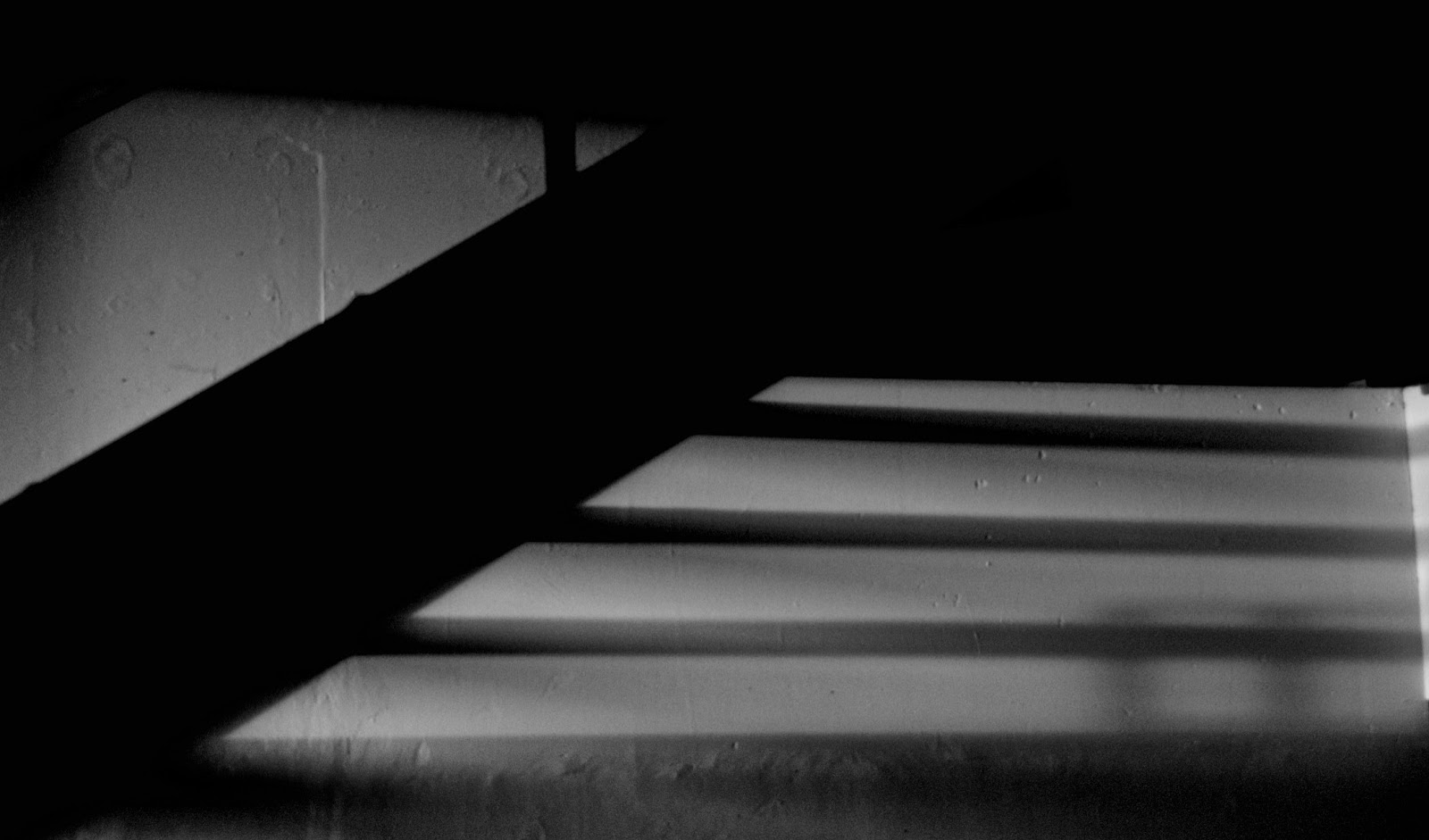
Good sunset tonight, and some pleasing light patterns on the emergency stairwell that I definitely don't use ever. The rest are at the end of this set. Click to enlarge.


Friday, 27 April 2012

Marking time

Things get a little messy when the dissertations and essays come in…