Monday, 14 November 2011

Restoration!

You may (though why should you) remember that a year or so ago, I visited Stoke's Bethesda Chapel, the grandest of the Methodist Connexion's places of worship. Having featured on the BBC's Restoration show, it attracted enough money to start rebuilding. I saw it in a pretty derelict condition - enough to make an atheist like me mourn.

I went back this weekend - the chapel was open to show the public how far on they were. Structurally, this fine building is now solid and safe once more. It's got a ceiling, and only a year and a couple of million £s will finish the job.

Here are some of the latest photos I took - the rest are here. Click on these to enlarge.


I'll miss the dereliction when it's finished: I do like a good bit of decay. 

Retro nerd heaven

There's been a smug spate of iPhone owners (of which I am, admittedly, one) posting pictures of themselves unboxing their new toy.

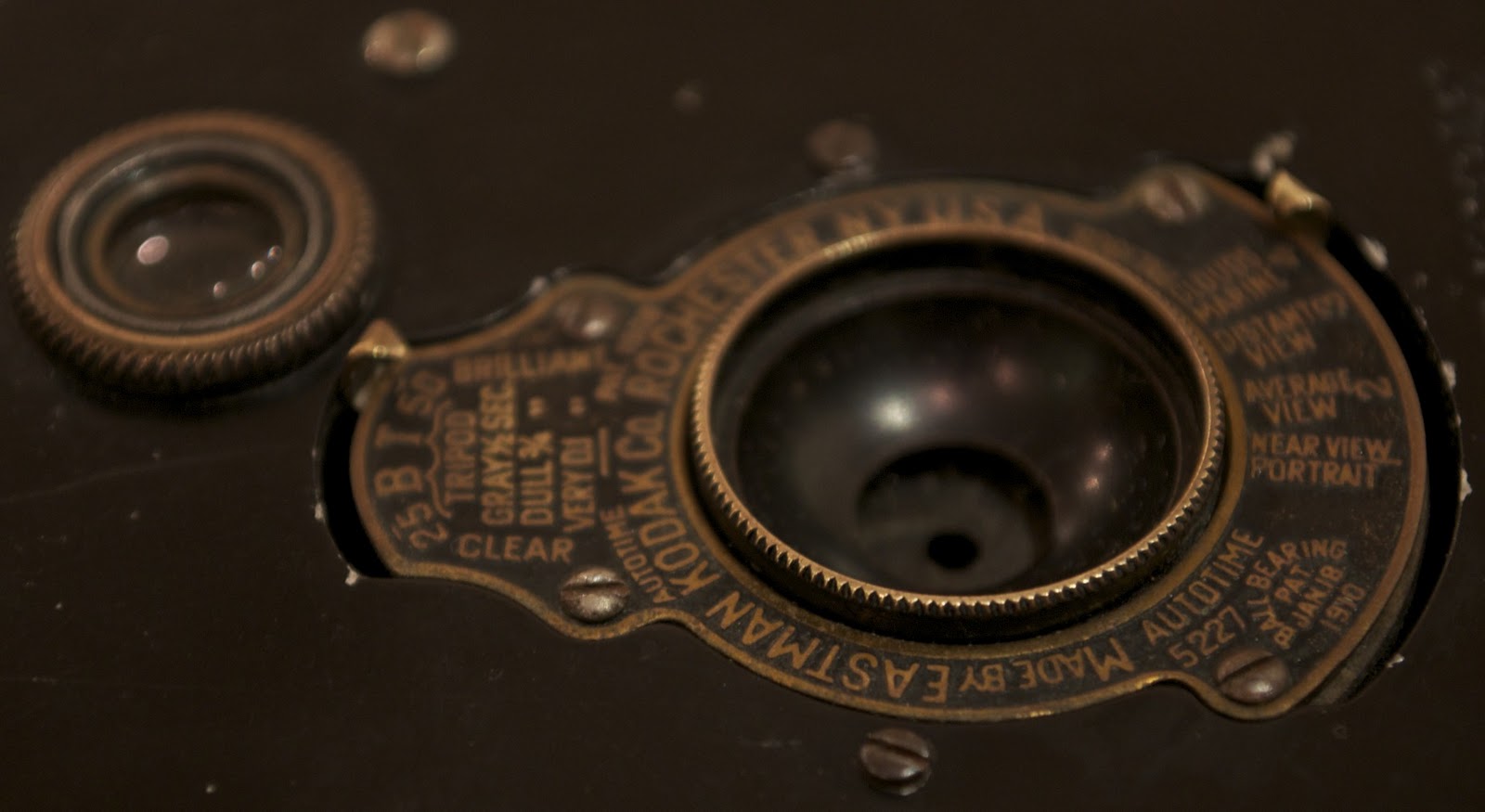
So I thought I'd post the 1910-1920s equivalent: unboxing a beautiful new Vest Pocket Kodak camera (the box says model B, but they look a little different). This looks like the comparatively rarer c. 1915 model.

But don't worry, geeks: I've made sure that there's an iPhone in there if you look carefully. You can see the full set here (or click these selections for bigger versions). If any of you know where I can get film and processing, let me know: I'd like to try this beauty out.


Why so quiet?

What a hell of a day teaching - clashing schedules, absent colleagues, complicated week = chaos. I managed to bore myself 90 minutes into my medieval literature class, so Christ alone knows what the youth made of it. Then straight into a class on new media: the students appeared to have vaguely heard of digital media, but preferred not to express and opinion either way: very difficult to talk about social capital, apply theories of community or discuss what it's done to notions of time and space when nobody seems to care either way.

Ah well. To cheer you up, another contender for worst cover version of all time: Bing Crosby doing 'Hey Jude'. You've got to listen at least until 3.13. I don't like most of McCartney's songs, and I feel sorry for him at this stage.

So much for Lord Hunt…

Lord Hunt is the Tory peer of the realm who - in a bold and radical move designed to really shake things up - is replacing Baroness Buscombe, the Tory peer of the realm who used to be Chair of the Press Complaints Commission, after an exhaustive search by the recruitment panel chaired by Tory peer of the realm Lord Black (Buscombe succeeded - yes, you guessed it - Tory peer of the realm Lord Wakeham).  


She attacked the Guardian and others for suggesting that News International might be hacking into people's phones and behaving rather naughtily. No evidence at all, she said. How did she know? Well, she'd asked News International and they said they hadn't done it. Case closed. 


This new political time-server hasn't got off to a great start. What's the major problem in media regulation, according to him?
surely the major problems occur because of the tabloids? "No," he replies, "I think the greater challenge is with the bloggers
Right. Because it's people like me who spend our days illegally tapping the phones and computers of our political enemies, conducting surveillance on anyone we don't like, printing 'up-skirt' shots (often of famous but underage females), dealing in insinuation and innuendo to an audience of millions, encouraging mass fear of (declining - though we don't mention that) crime, of immigrants, gays and pretty much anybody who doesn't share our particularly narrow-minded and prurient beliefs. For every Guido Fawkes, there's a racist knee jerker like Richard Littlejohn (that links to a magnificent encounter between Will Self and Littlejohn), climate liar Christopher Booker, climate liar Richard North and sperm-stealer, murder victim's taste-disapproving and top famine reporter (apparently Somalian hotels are awful) Liz Jones prepared to lie, distort, and shriek until our public sphere is a vicious, hysterical dystopia in which science, accuracy and altruism are left by the wayside. 


I'm not saying the blogosphere is lacking in trolls, but perhaps Hunt should read a few newspapers before he gets his secretary to show him how the Internet works.

Is he open-minded about where we go next, given that self-regulation has been a complete failure?
"I have a complete hostility to any form of statutory regulation… I come at the job with a fervent belief in self-regulation," he says, "having seen the downsides of statutory regulation."
Oh dear. Not the sign of a reflective mind. 


On the problems of newspaper editors sitting in judgement on their own practices:
He chooses to praise the code – "there is nothing wrong with it," he says firmly.
…admitting that he knows nothing about the internal workings of newspapers
But that's OK because:
he lived next door to the Daily Mail's late editor, Sir David English, for 16 years in Westminster, calling him "somebody who was the epitome of integrity"
Ah, right. He looks up to the long-term editor of the most vicious, hypocritical, racist, reactionary, misogynistic newspaper in the history of the printed word. Everything's going to be fine.

Friday, 11 November 2011

Don't watch that, watch this

Anyone seen the new John Lewis ad? It's a mawkish, emotionally manipulative tale in which a boy waits desperately for Christmas, and we're led to believe he's a greedy little bastard until it turns out that he's simply bursting to give his parents a present. Overlaid with a folk-naif cover of the Smiths' 'Please, Please, Please, Let Me Get What I Want'. (And I don't want to be too picky, but a song starting with 'Good times, for a change' is hardly appropriate for a deep recession).

So your usual Christmas ad then: attempting to disguise naked consumerism with warm fuzzy feelings. After all, a child shouldn't be expected to express love for his parents without a bloody big box of gifts, despite being economically inactive.

However, an alternative narrative is viable. By replacing the tinkly music (and how Morrissey must be turning in his grave hearing his mournful self-pity turned into a feel-good gizmo-flogging tool) with the organ from The Shining, it soon becomes clear that this troubled, lonely child is going to present his sinister parents with a dog's head, or something equally disturbing. That's the real spirit of Christmas.

Music for Remembrance Day

Although - as I pointed out earlier - I won't wear a poppy for a host of reasons, I'm not opposed to publicly remembering the victims of war, which I see as very different to the triumphalist, self-deceiving jingoism of the armchair generals and politicians who go on about freedom, sacrifice and the Glorious Dead.

War for many combatants was not voluntary, heroic or admirable. It was savage, vicious and a mark of social failure. Harry Partch, the WW1 veteran who died recently aged 111 described it as 'organised murder'. I'm no pacifist - I'm proud of my ancestors who fought against the British in the Boer War and the Easter Rising, for instance, and those who opposed Nazism, but I'm deeply suspicious of those who romanticise military service, and use it as cover to justify war. We forget that millions of soldiers came home determined to create a better, peaceful world rather than boast about their deeds.

One of my final-year students is writing her dissertation on poetic responses to the First World War (hopefully not the overly-familiar texts we all know too well), so my thoughts drifted to Ralph Vaughan Williams, the composer who volunteered for service even though he was 41. Perhaps he was caught up in the patriotic fervour of the moment - though in many ways he was a critical thinker - but the effect didn't last. He survived the war and responded to the horror by composing music which expressed disquiet about the myths of the 'Great' war, especially in his Pastoral Symphony, which uses a military bugler's false note as a key motif through which to explore the nature of war and the hoped-for peace, under the deceptive prettiness of the work's other themes.


His 'Dirge for Veterans' refuses to glorify war either - it's a serious-minded elegy for the victims of those comfortably sitting far behind the lines sending men out to die.


The other war-related piece VW produced was his 1946 Symphony No. 6: a surprise from a man popularly associated with contemplative nostalgia: it's often interpreted as a vision of the horrors of the 1939-45 conflict, and dread at what seemed to be the imminent nuclear war.

Life without the Murdochs

I've posted this clip before, but I was telling someone (can't remember who) about it recently, so thought I'd stick it up again. It's Fry and Laurie's parody of the Frank Capra film It's a Wonderful Life, in which a small-town banker facing ruin thanks to his own generosity and the machinations of the Big Banks, contemplates suicide.

The film was made during the Depression, and mixes sentiment with populist distrust of Wall Street: it's not exactly socialist, more a kind of moralism. As he stares into the abyss, a trainee angel called Clarence shows him what would happen to the community if he'd never existed, and it's a mean-minded, grasping struggling place.

Unlike life without Murdoch:


(Oh, and have a look at Matt's latest comic triumph in the Daily Telegraph)

Earth to Nadine Dorries

If you're not familiar with Nadine Dorries, she's an abrasive Tory MP with an unhealthy interest in teenage girls' uteruses (uteri?) and a fine line in abusing colleagues and constituents, inventing statistics and generally making things up.

But now isn't the time to get into all that. Instead, this is just a quick corrective. In the course of her many hectoring and untrue statements on the BBC's Question Time this week, she announced that the government's intention is to get NHS safety up to the level of the private sector.

Now, I'm from a family which has both worked for and benefited hugely from the NHS. I've seen the best and the very worst of it. But I'm not having this kind of nonsense from a reactionary blow in. Two facts:

1. The NHS was founded because the private sector failed completely. The poor were treated only by charities, in extremes. There was simply no health care: ongoing treatment, vaccinations and so on. Hospitals were often filthy, unsafe and underfunded. Dorries' so-admirable private sector specialised in the kinds of back-street abortions which killed mothers and ruined lives.

2. If something goes wrong in a private hospital, you don't get some kind of 4-star care. They call an ambulance like everybody else, and you join the queue at your NHS A+E ward. That's the secret of profitable private health: they only do easy, quick things that make a lot of money. Anything complicated, like emergency medicine or chronic conditions - off to the state with you.

Now the NHS is being privatised, it's Forward To The Past. I look forward to my children contracting retro diseases like rickets and consumption.

Meanwhile, watch David Cameron talking about the NHS as 'a business'.

Thursday, 10 November 2011

Clear your desk!

No, I'm not being fired (yet), but I have been sent Tips for an Organized Desk.

What can I say? This is my desk. It's quite tidy, for me.


What can I say? I teach in two subjects, both of which are largely book-based, and I'm trying to get some research done. The books lined up at the back are mostly related to either Anne of Green Gables or Welsh travel writing and theory. Those in the foreground and to the right are largely things I'm teaching at the moment. They're there because my bookcase is full. As is the one next to it, which I've appropriated. There are even piles on top of the bookcases. Though there is good news: only two books have come in this week, Mary Gentle's Ash and Ken Livingstone's memoir, You Can't Say That

I would like a tidy desk, but only because my office-friends are neat and tidy, and the sight of my stuff encroaching like a paper scum must horrify them. To them, I apologise. I don't particularly mind the mess per se: I am a little disorganised in some ways, but this is just surface detail. Every summer, I clear the desk completely. Then every term, it all comes creeping back.

Some of these tips are OK, but some are a bit glib:
Have as few things as possible, and you don’t need to organize.
Try to keep the desk clean, leaving only the essentials on its top. The rest goes into the drawer, boxes, the archive, or the bin. Your computer, the phone, and the paper you are currently work on is enough. 
Right. When I have one job, and less teaching: perhaps. Or an office of my own (which in some ways I'd hate - some of the best educational moments I've benefited from have been chatting with my colleagues). 
Keep everything in its own place so you don’t have to look for anything, it is immediately to hand.
I do. I keep everything in piles right by my hand. 
Purchase 1 picture frame and fill it. The easiest way to stay organized is to stay motivated, and the best form of motivation is to remember what’s important. A daily glimpse of your friends, family, pet, etc. will bring an instant smile to your face.
Ugh. I can taste a little bit of sick. As if you should ever dignify work by reference to relationships. If you're reluctantly pushing paper around for some corporate behemoth, admit it. Don't poison your genuine relationships by allowing work to appropriate some of the emotional significance. If, on the other hand, your work is intrinsically important to you - and mine is, despite occasional frustration - you shouldn't need the grinning fizzogs of your family to add emotional weight. Personally, a photo of my family would a) take up most of the desk-space and b) bring me out in hives. Given the above average sibling rivalry, and the way it's usually expressed in criticism and (if I'm lucky) needling, a photo would drive me to commit some kind of spree killing. 

There's a branch of management studies which examines corporate spaces, but I don't know enough about the field to pontificate about it. My decorations reflect my interests (communist kitsch and memorabilia, Welsh references, literary humour and a print of a photo I took), and a load of framed prints which are only here because I've filled the wallspace at home with bookshelves and don't have anywhere to hang them. Instead of pointing you towards management studies, here's a trailer for Office Space, which expresses beautifully the deadening effect of corporate blandness. The sub-plot of the waitress's battle against enforced gaiety (expressed through the 'voluntary' addition of 'flare' - badges to you and me) is a case-study in capitalism attempting to fake emotional depth.


My space is a self-selected narrative of me: largely voluntary, though not entirely. In a sense, I'm 'curating' my work-identity. It's important to academics to demonstrate their professional status, and one of the ways we do it is to assert our individuality in this way more than most people are allowed to. We aren't part of a corporate machine, we hope, and so messiness proclaims our independence. Except that our difference is minimal: most of us like endless shelves groaning under the weight of books, a bit of academic humour and a little politics. Belonging to our tribe and declaring independence might seem mutually exclusive, but somehow we manage it. 

What are your spaces like?

My Two Cents

The Guardian Higher Education Network asked for my thoughts on yesterday's student demonstration - read it, and some rather better reactions, here.

This bit caught my eye as a sign of things to come:
Coventry University College, will be opening its doors next autumn – with classes seven days a week, from 7am to 10pm weekdays and until 4pm on weekends, charging students a mere £4,800. Students will have no access to Coventry University's library, IT facilities or sports centre – despite the college being an offshoot of the university. What kind of education will be on offer to students? The spectre of similar universities, or others with worse conditions, is on the horizon.
Despite this, the government claims that all degrees will continue to be of equal value. I cannot see how a student without access to an academic library, can possibly reach the levels of a student with access to decent material.

Football's brave new frontier

Newcastle United has just announced that St. James' Park (which is next to a real park, with actual cows painted black and white to match the team's colours) is to be renamed after its owner's company: the Sports Direct Arena. For some reason, this has caused more grumbling than Arsenal, Manchester City and Lansdowne Road all being renamed in the pursuit of cold hard cash.

Naming rights to this NUFC fan's belly are still available


It bothers me because football clubs are the quintessence of real places: usually founded by local groups of enthusiasts and often staying in the heart of their communities. When clubs are taken over by financial speculators or rich men looking for a plaything, they start to become 'non-places': signified by names which are adverts and identical architecture. My own club fell victim to this in the early 90s: Stoke played at the Victoria Ground, a picturesque but semi-derelict stadium: now it's at the Britannia, named after the building society which was hurriedly taken over by the Co-op (with whom I bank) before it went bust. The new ground is exactly as you'd imagine: a smaller version of the same design you get everywhere else.

The reason for all this is - obviously - capitalism and its discontents. Corporations have (or had) the money, but they lacked one thing: warm fuzzy feelings. What they want to buy is our emotions, and there's no surer way, they thought, to make a community love a company than through its local football team. So they buy the naming rights and help build a stadium. Ironically, this is where it all goes wrong for the company and the club. Fans don't love companies - they're either indifferent, or hostile to an important part of their culture being wiped out for temporary financial gain. The stadium, too, becomes a symbol of rootless capital, rather than a palimpsest of the local.

Look at these:


The first one is Craven Cottage, Fulham's ground. It's cute, individual (especially now there's a gilt Michael Jackson statue outside) and distinctive. It's probably a financial headache for the owners and a firetrap.  The second one is the Britannia: it could be anywhere, and is in fact perched on former wasteland miles from anywhere, virtually inaccessible on foot and strangled by dual carriageways. Neither the clubs nor the companies get it: the sponsors haven't bought affection - the clubs have sold it. Sponsor names dissolve the bonds between a club and its fans. Not that the owners care: the advertising to distant viewers is far more important than the affection of local supporters.

Oh Say Can You See…

America's finest political candidates:


I'm not sure which is more depressing - that the front runner for the Republicans wants to abolish the Departments for Education (librls conspirin' to tell kids stuff what we don't want 'em to larn 'bout) and Commerce (all those nasty rules) and rip up the Environmental Protection Agency, or that he's such an inarticulate dumbass. He's George Bush's successor as Texan governor, so perhaps it goes with the job. But he's starting to actually look like Dubya. Must be all the oil seeping into their genes.

Wednesday, 9 November 2011

Words of the day

1. Mountweazel: a fake article in a reference work designed to identify plagiarists. The term is a homage to Lillian Virginia Mountweasel, the famous and entirely fictional author. Margaret Drabble (rather excellent author famous mostly for feuding with her famous author sister A. S. Byatt) put one in her Oxford Companion To English Literature.

SPOILER ALERT:

There isn't a Graeco-Roman author named Pycletius, whatever Enotes (follow that link) thinks. 

Is this a smug liberal ivory-tower parlour game? Perhaps, to an extent, but it does serve a serious purpose, and is genuinely funny. Personally, I'd like to nominate Martin Amis as a fake: I'm convinced that his father Kingsley invented him in cahoots with his friend Philip Larkin as an example of everything they thought wrong with literary fiction.

Lillian Virginia Mountweazel:

Weep for West Bromwich

I don't know if you've every been to West Bromwich. If you haven't, don't: it makes The Dark Place look like New York in the Roaring Twenties. Unless you're going to support their very fine football team (something The Dark Place entirely lacks). Otherwise, it's a case study in post-industrial decline, poor urban planning, democratic failure and political contempt.

What does a poor, abandoned town need? A bloody big 'iconic' building of course! If you give it curvy windows and a wacky name, the jobs and vitality will come coursing back. It's what Augé called a non-space and what Owen Hatherley et al. decry as the moral and intellectual bankruptcy of post-socialist politics: superficial, tricksy postmodernism which masquerades as democratic populism but is actually a cynical evasion of the tangible and unpostmodern problems facing places like West Brom. And so:


This is The Public. It was meant to be an arts centre of some sort, at a cost of £19m - because modern cultural policy assumes that people who used to make things will suddenly find themselves living in a Wonderland of jobs and aesthetic beauty if a big postmodern box is dropped on them. I think this is hugely patronising: it's cultural policy by helicopter.

It cost £31m. Nobody knows what it's for. Nobody goes there. It's going to be closed or demolished: the Arts Council of England called its own decision to build it 'a gross waste of public money', as Charlotte Higgins notes in her damning summary.

Next time, how about asking the people of West Brom what they need. They might be poor, but they ain't thick. My guess is that serious economic intervention might help. But what do I know?

Fighting your corner

Thousands of students are converging on London to speak up for the poor and young who want to better themselves.

Except from The Dark Place:
London Demo 2011: Find out why we're not supporting it, as we present our Alternative to the National London Demo...
They're putting on a Question Time debate tomorrow (I'm on the panel), but I have to say that this is disappointing. Sometimes, mass numbers on the street focus the minds of the public and politicians in a way that polite letters just don't.

I do worry about our SU: it's under the thumb of the university executive and seems to have lost all confidence in asserting the rights of its student. They've got shiny offices and ranks of computers, and seem to think that that's enough.

We have 23,000 students: 99% working-class, 45% mature students: exactly the kind of people who are already suffering. Their voices should be heard.

The annual, weary, poppy debate

It's that time of year, when social pressure means that anyone in the public eye is compelled to wear a poppy for Remembrance Day, and anyone not wearing one is looked at funny.

Why don't I wear one? Because David Cameron is just plain wrong when he says that:
wearing a poppy [is] to remember those who have given their lives for our freedom 
The poppy appeal raises money for British Army veterans and their families. It doesn't restrict funding to those who fought in the one justified war the British have fought in past centuries (WW2, in case you're wondering). It represents one side in a string of conflicts, many of which can't be justified: Ireland over the centuries, India, Kenya, Malaya, South Africa, Suez, Iraq, Afghanistan (repeatedly) and a whole string of other vicious wars of conquest and oppression which can't be justified. Most of these people haven't given their lives for 'our freedom', but for colonialism, capitalism and racial supremacy. I can't see how 'our freedom' was served by invading Iraq, arming Saudi Arabia or bombing Libya: there are arguments for and against these actions, but no Saudis have been freed, let alone the rest of us.

The usual counter-claim to this is that we're helping and remembering the soldiers, who don't make policy. There's something to this: economic conditions drive people into the armed services very often, and I wouldn't blame individuals for that - though I do note that the UK Armed Forces are professionals: nobody's been conscripted. If the poppy symbolically represented all those who did what they were told without being responsible for wars' intentions, then we'd remember all those German conscripts too.

I will wear a poppy one day: when it represents all those killed in war, without regard to which side they were on, or whether they were military or civilians, such as the Bloody Sunday victims. It's time that public discourse on this grew up: the British state is not and rarely has been unequivocally supportive of freedom and democracy. Not every war has been a 'just' one.

Support your local students

They haven't gone away you know, as a great man once said. While the newspapers have been distracted, the students have been planning another big demonstration today (though there's no sign of it here at The Hegemon).

It's the same issues: fees, the effective privatisation of universities, and the government's decision to penalise future generations for the failings of the economic models they and their predecessors promoted. It baffles me: every government (rightly) talks about the need for a high-tech, knowledge economy - but no government will ever admit that this a) costs money and b) is a public good.

So what do they do? The Metropolitan Police have decided to put down the brown envelopes for a day, and have spent the last week loudly talking about using plastic bullets - like it's Ireland in the 1980s - and harassing those they arrested last time, whether they were charged with anything or not. Clearly they've missed the days of the Miners' Strike and the Poll Tax riots, and fancy a spot of teen-bashing.

Except, of course, that it's not just spoilt teenagers. My university's intake is 40% mature students trying to retrain themselves just as governments always tell them to. A large proportion have children or other dependents. The vast majority of our intake - of any age - is from the lowest economic centime: just the kind of people to whom the EMA, or a decent level of support, will make the difference. These people aren't scroungers, demanding something for nothing: they're the nurses, classroom assistants, teachers and social workers of the future, who quite rightly don't fancy taking on £50,000 of debt to qualify for a low-to-moderate salary and a slashed pension. Would you? They ARE the big society… and they're being cut off at the knees.

Follow the protests live here.

Tuesday, 8 November 2011

My Nuremberg

In advance of the UCU lecturers' strike (that'll show 'em) on November 30th - defending our pensions - our hitherto moribund SU is hosting a Question Time on Thursday, 5-7, in place of actually supporting us. In the absence of anyone better, I'll be on the panel with Melanie Philips, Alan Sugar and Alex James some SU representatives, students and university officials.

Post questions in advance or just turn up - it'll be enormous fun.

As a service to students

Head on over to the Can I Skip Class? calculator! Input how much you've attended so far, what the content might be, whether you can borrow somebody else's notes, and voila: automated absence! It reassures me that our one-day strike won't result in a lifetime of hobbled opportunities for aggrieved students. (Thanks to MfD, who posted the link in the midst of a fascinating discussion about educational technology and rhizomatic education - the rather difficult and abstruse Deleuze + Guattari theory about education often being informal, non-linear, non-hierarchical. I think it stresses connections and quests rather than certificates and objects, but I'm not too sure, to be honest).

Talking of which: let's get our troubles into perspective - this appeared in Brighton this week:

Is journalism rotten?

Here's a little anecdote that suggests journalists have completely lost their way. A few days ago, a live microphone picked up Nicolas Sarkozy telling Obama that the Israeli PM is 'a liar', to which the American responded 'I have to deal with him every day'.

Interesting - an insight into the true nature of political relations which are usually hidden behind glib press conferences assurances of respect and accord.

The real story is this:
the reporters agreed not to publicise the remarks because of their sensitive nature
We teach media ethics here. One of the things we discuss is news values, and I have repeatedly made the point (derived from Milton, Mill, Jefferson et al.), that democracy is guaranteed by an independent press. However, if news organisations are suppressing news at the behest of power - and remember, this isn't a matter of life and death at a time of war, for example - then the citizens of France, the US, Israel and Palestine have no way to ascertain the true state of their political affairs. We become passive, excluded drones rather than active citizens, hooked on TOWIE rather than holding our representatives to account.