I'm also nipping off to the Cheltenham Literature Festival for an evening of Vince Cable and Stanley Johnson promoting their novels- Cable's is a debut novel, while Stanley-Father-Of-Boris has produced quite a number over the years: I've bought them both but not yet read them. A few years ago my research colleague and I had our own slot at the CLF discussing politicians' novels, with Michael Dobbs on the panel. Our research is going slowly (see the first paragraph of this post) but I try to attend events like this to keep an eye on the way politicians frame their creative work and what audiences think. I also had a letter on the subject in the TLS last week, and someone sent in a follow-up too.
My collection of politicians' writings also gained some new entrants this week. The first was Sir Stuart Bell's Paris Sixty-Nine, long fabled as a suppressed self-published pornographic novel by the MP for Middlesbrough. In his later years he became a Commissioner of the Church of England, basically the CofE's ambassador to Parliament, and was rather reluctant to acknowledge this saucy little number. It's not actually pornographic in the sense that there are entire chapters without sex scenes, but those scenes are revolting conceptually and in literary terms. Obviously this is a family blog and I won't scar your eyeballs with quotation, but I will say that they read like the work of someone who had never met a woman, or at least not one for whom he'd ever had any respect.
Bell was accused of being Britain's laziest MP – no constituency surgeries in 14 years – but he devoted quite a lot of time to writing autobiographical short stories, some of which made into print, and the rest made available on his website for years after his death (sadly, no more). As the New Statesman implied, he had quite a high opinion of himself:
Stuart Bell MP has written another novel, Binkie's Revolution (the first in a trilogy), which chronicles the lives and loves of several families, beginning in Durham mining villages around 1900 and ending (two novels hence) in the election of the first president of the United States of Europe. The style is so fluent and racy it carries the reader along. We know this to be true, because the author says so in a five-page handout that also explains how to order the book from his publishing arm, Spen View Publications. It's being a Church Estates Commissioner that 'as made 'im so 'umble.I haven't read Binkie's Revolution yet, but it vaguely echoes Edwina Currie's The Ambassador, which is set in a future united Europe in which the transcontinental ruling class has genetically engineered itself to retain power forever, despite the sterling efforts of a lovely English woman, a brash US ambassador and a supporting cast of outrageously stereotyped ethnic minorities. Sadly, while there is a sequel to Binkie's Revolution on Kindle only, Bell appears never to have finished the trilogy.
The other politician's work that turned up this week is one of the very rarest and most beautiful (and expensive) books I've ever got my paws on. Lord Lymington's Spring Song of Iscariot was published in 1929 in an edition of 125 by the fabled Parisian artisan Black Sun Press, which also put out work by Sterne, Poe, Lawrence and Joyce in similarly tiny numbers. It comes in a complicated slipcase, is printed on beautiful paper with an exquisite typeface. Sadly the poetry is pretty woeful: bursting with the kind of imagery you'd get if a Vogon had eaten Freud and developed an obsession with Ezra Pound.


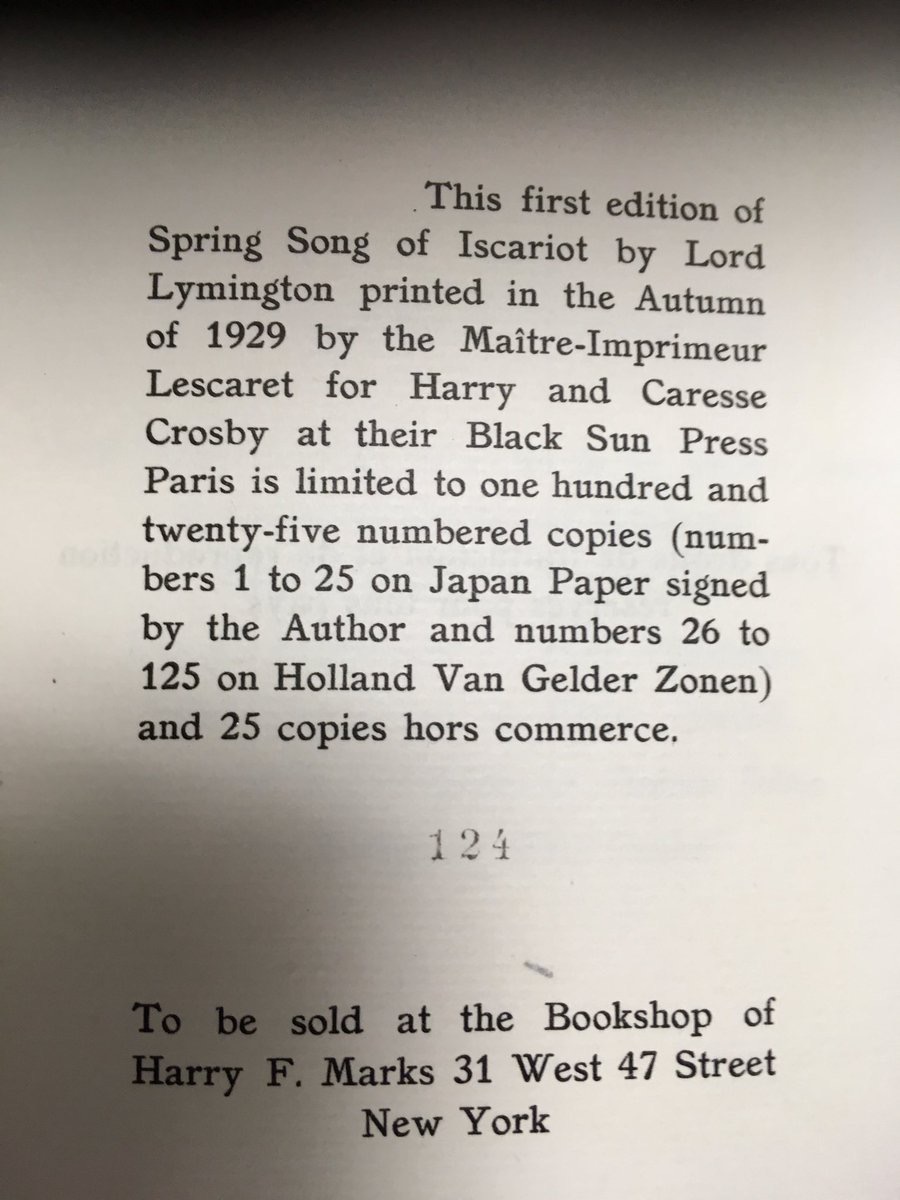
In a way I'm not too saddened by this, because after Lord L stopped being an MP for Basingstoke, he devoted his time to being a full-time Nazi, starting in the mystically-inclined blood-and-soil ruralist group English Mistery, then the English Array, the British People's Party and ultimately Kinship in Husbandry, several of whose members contributed their viciously racist and mystical ideas of purity to what became the now-respectable Soil Association. He ended up emigrating to Kenya with the rest of the despicable crew of toffs who made up the remains of the Happy Valley set.
Lymington's interesting though. Not many professional politicians wrote poetry at all (though some of the Welsh-speaking Liberal and Labour MPs did), and none associated with hardcore modernists. While the poetry isn't much good, it's ambitious and far removed generically and intellectually from the usual concerns of politician-authors. I'm not expecting Stanley Johnson or Vince Cable to start going on about the Pillars of the Womb, for instance.
Anyway, that's your lot: I've got tomorrow's Open Day talk to prepare. I think I'll leave readings from Bell's and Lymington's works until they've signed up…

