Showing posts with label Morris. Show all posts

Thursday, 23 July 2015

Labour! Back to the Future with Morris and Kropotkin!

I've largely kept my own counsel about the Labour Party leadership election. It's proving so divisive, and the arguments are so tediously familiar that it's hardly felt worth joining in. I'm a Labour member despite the attractions of more radical, purer and (sometimes) open-minded alternatives to the left such as the Greens, Plaid and various groupuscules. Mostly I'm in because I don't like vanguard parties: those who would far prefer having another purge of ideologically suspect splinter factions than actually make any effort to attain power. Labour, for all its myriad sins, wants to be elected and actually run the country. Also, the SWP is run by a rapist and his rape apologist friends. If any one of the revolutionary parties actually showed any sign of getting a revolution going, I'd be tempted but I strongly suspect that they're actually just fantasists.

So anyway, that leaves us with Labour and its interminable election. The party which encouraged its MPs to 'lend' left-winger Jeremy Corbyn enough nominations to 'widen the debate' beyond the three centre-to-right Oxbridge wonk candidates and whose higher echelons are now screaming blue murder because people listened to the debate and seem to have decided that they rather like what Mr Corbyn has to say. We're not quite at the stage of Dick Tuck's 'The people have spoken, the bastards', but several rival candidates say they wouldn't serve under Corbyn while the newspapers are full of threats to stage a coup against him if he wins. That implies that New Labour hasn't yet grasped the point of democracy yet.

The New Labour argument is that the people are now very rightwing, and if you don't become equally rightwing, you can't be elected. If you think back to the Blair government, the discourse around the poor, minorities, civil liberties etc. seemed to imply that the Masses are small-minded racists who should be pandered to, while simultaneously providing some social support to make up for the determination to become a fully-fledged neoliberal economy.

There's also the – very real – threat of the press. Politicians need the press because there's no way to communicate with the electorate in an unmediated fashion. Yes, there are social media but the research I've read suggests that it's far less important than we might think. The printed press is overwhelmingly Conservative and the BBC long ago adopted the discourse of the right.

So that's the message from Cooper, Burnham, and Kendall. The market has won, the people hate scroungers and foreigners, the state should shrink and shut up. It's the politics of fear, and of failure: they have abandoned any attempt to formulate a set of principles, and to attempt to persuade the electorate of the virtues of said principles.

And then there's Jeremy Corbyn. I read this short profile and found myself nodding. He attended a polytechnic for higher education, a much more common experience than the elevated world of the others. He grew up in the rural provinces – Wiltshire and Shropshire – and moved to London, so he's seen several sides of life. Like me, he's a socialist and a member of the Campaign for Nuclear Disarmament, and opposed the war in Iraq. He opposed apartheid actively and made links with Sinn Féin in an effort to end the war in Northern Ireland, years before it became fashionable. He supports the Palestinians without being an anti-semite. He's a cycling vegetarian who also takes the train, and he likes his stimulants to be of the Fairtrade variety.

In sum, he's everything that Orwell hated about the left back in the 30s, and that the sharp-suited managers of neoliberalism who run Labour abhor. He's that most tedious of things, a true believer. He has principles which alter not when he alteration finds.

“One sometimes gets the impression that the mere words ‘Socialism’ and ‘Communism’ draw towards them with magnetic force every fruit-juice drinker, nudist, sandal-wearer, sex-maniac, Quaker, ‘Nature Cure’ quack, pacifist, and feminist in England.” (Orwell, The Road to Wigan Pier)

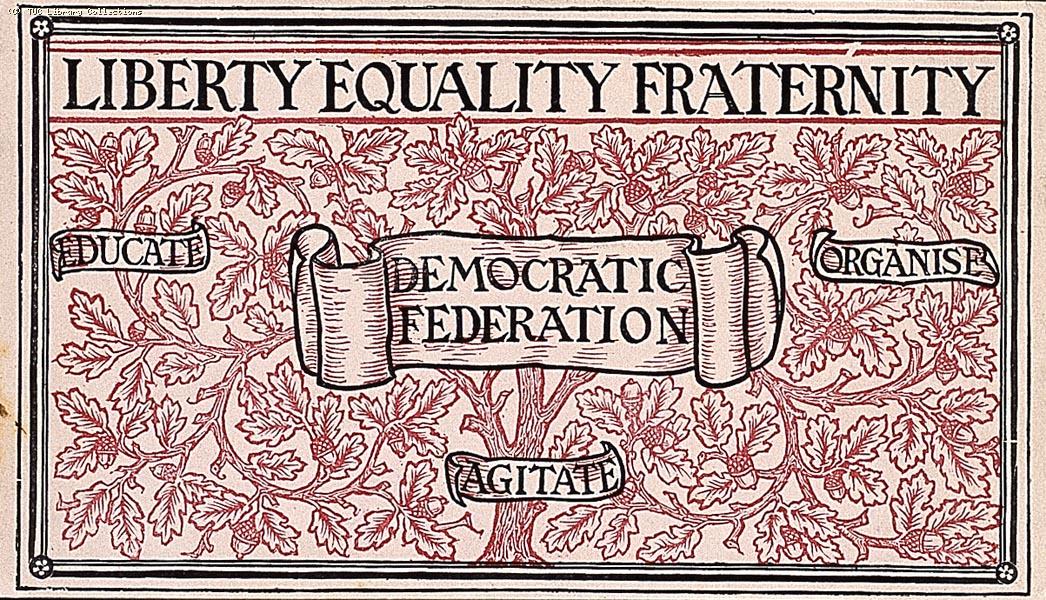
A few months ago, I suggested that Labour would win if they returned to the optimistic vision of the pre-Labour socialist movements, particularly William Morris. It's been a bloody awful century or so for Labour: always on the back foot, always struggling to protect those battered by the worst depredations of capitalism and global realpolitik (when it bothered, that is). Labour has been so preoccupied with defensive manoeuvres that it forgot to articulate any positive vision: the big ideas have all been from the right, and Labour has, in government, attempted to ameliorate them round the edges.  But if you look back to the late 19th century when London was a hotbed of leftwing debate from Kropotkin to Marx, Crane, Morris and the Socialist League, you see a left that thought the future belonged to the workers, that a new society was possible. They were confident, optimistic and articulate. That their campaign material was beautiful made the point: a socialist future was a beautiful, fulfilling future which was within reach.

Walter Crane
I can't imagine Morris or Crane designing this, for instance:


I'm being told that a vote for Jeremy Corbyn is a vote to make Labour just another purist sect with no interest in governing; that a vote for any of the others is 'serious', a commitment to seizing the reins of power. What I don't see from them is any indication that they know what to do once they get there: they are neoliberal technocrats. I don't know whether they have any beliefs because all I hear from them is tactics. Do they really think the British people are mostly selfish racists, or is it just a tactic? Either way, they depress me.
Walter Crane

I genuinely believe in most of what Jeremy Corbyn stands for. But more importantly, I think he has a value system and a programme which goes beyond triangulating the results of focus groups. I think he – perhaps naively – believes that his fellow citizens are at heart kind and thoughtful, and that if he articulates a clear vision of a better society, they will vote Labour.

Neither I nor, I suspect, Corbyn, is quite the unreconstructed Dictatorship of the Proletariat socialist he's being painted by his Labour or external opponents. We all know that industrial, economic, social and global upheaval means that a movement based on and only obsessed with skilled manual labour has little future. The miners, millworkers and factory hands are largely gone. Their work has mostly been shipped off to dictatorships so that we don't have to think about it. In its place here is a working life of insecurity and invisibility: for now it's the cleaners and call-centre workers who are exploited, bullied and fired without cause. But soon it will be almost all of us. Our jobs are becoming weightless: we work in isolation, on zero-hour contracts. Not just the immigrant cleaners and traffic wardens but the university lecturers, those who care for our old folk and those who grow our food. Being middle class won't help: virtually every job can be automated (check your job via that link). Our climate sickens and dies, but we get cheap flights and cheap clothes (thanks, Indonesian toddlers).


Trained to be individualists and isolated in the way that the factory workers and miners weren't, we've been stripped of the means to resist, but also stripped of the opportunity to formulate positive alternatives: those obsessed with the promise of Big Tech and the 'sharing economy' might like to recall that Google, Apple, Pixar and Co engage in some very Old Economy behaviour: tax avoidance and ganging up to stop its workforce becoming mobile and demanding a fair share of the profits. It is a new world, and forward-thinking socialists must generate new solutions to new problems, new ways to organise, new conceptions of the state and new arguments formulated in collaboration with the people. I think that Corbyn will, whereas I think the other candidates don't even see them as problems at all. The ultra-poor don't vote, so why bother worrying about them?

I'm voting for Corbyn because I think that a point comes where you have to shake off the fear that drives political calculation and express faith in a set of principles. I think people are sick of the petty differences between essentially indistinguishable parties. I would like to elect a leader who thinks that persuading the electorate is his or her job, rather than to assume that its darker impulses are its overriding values. In the end, I'm a democrat. I think that most people, given the chance, want to be kind, supportive, co-operative, peaceful and fair to each other: tendencies despised and rejected by the current political model. All we need is the political space to express those instincts, and I think a Labour Party led by Mr Corbyn could go some way to creating that space. And if I can't vote according to my principles in an internal party election, when can I?

Tuesday, 4 November 2014

News from Nowhere


Last Saturday, I went to Stoke-on-Trent's Potteries Museum and Art Gallery for the annual Stephen Hagger Lecture (very sadly I was the youngest there by a good twenty years, and too many of them were from the National Trust wing of Morris fans). This year's lecturer was Fiona MacCarthy, design historian and biographer of Edward Burne-Jones, Eric Gill and William Morris, whose life and influence was her subject for the day. What links these three men and those around them is a commitment to art as a way of life: from the production of goods they evolved a philosophy of community, economics and politics – especially Morris. Stoke is the perfect venue for a lecture on William Morris. The industry which sustained the city was pottery: thousands of highly skilled workers producing globally-renowned items of astonishing beauty, and yet the city is a depressing sump of deprivation and unemployment now, and always was ugly: talk about alienation in action.

Morris, by GF Watts

Morris is perhaps best known as a designer of hugely expensive wallpaper and furniture: the current revival of interest in Victorian Gothic has placed him front and centre. However, he was also an accomplished novelist, typographer, poet, songwriter and revolutionary socialist activist. From his aesthetic interest in the medieval period evolved a conviction that industrial society and production led to degradation of the spirit. From Marx, he learned that alienated work beggared us not only economically but spiritually. He learned every skill from the basics, even making his own dyes for wallpapers and tapestries, and when Morris and Co. was founded, ran the company along egalitarian lines.

Morris seems to have been a force of nature - constantly trying new things, full of energy and also enormous fun: his friend Burne-Jones's cartoons of him are affectionate as well as satirical:


Basically, he was a big fat jolly man who couldn't sit still: his death was ascribed to a doctor as due to 'simply being William Morris and having done the work of most ten men'.

I don't know if Morris's aesthetic appeals to you. I find the wallpaper beautiful but too busy, but the late period 'Arts and Crafts' furniture is really to my taste, and I'd love some of the ceramics designed by his associate William de Morgan.


a de Morgan pot


Morris developed a conviction that beautiful things must be useful things - his followers became the kind of sandalled vegetarian liberals that Orwell hated so much. The contradiction for Morris, of course, is that producing hand-made work ethically cost a fortune, so his customers were only what he called the 'swinish rich'. At least – unlike now – Morris's workers were making a decent living from selling expensive goods to these scum: in our day the shareholders profit while goods are made by slaves in sweatshops.

While I can't afford Morris furniture, glass, wallpaper or ceramics (and in the antiques context their cultural meaning is very different from what he intended), I can read his books and poetry, and I have a cheap facsimile of his astonishing version of Chaucer's work. His novel News From Nowhere is perhaps the most accessible.

News from Nowhere

It's a Utopian fantasy set in a Britain which underwent a socialist revolution in 1952. Classes, law, finance, private property and cities have been abandoned and the people live in agrarian, peaceful, small villages (we tend to part company here: I grew up in the countryside and it's more Cold Comfort Farm than communist paradise). The details are less important than Morris's underlying assumption that human nature is essentially altruistic. Our faults, he says, are those of industrial, capitalist urbanism. It produces competition, hatred, violence, oppression and (not incidentally, aesthetic ugliness).
it is the allowing of machines to be our masters and not our servants that so injures the beauty of life nowadays. And, again, that leads me to my last claim, which is that the material surroundings of my life should be pleasant, generous, and beautiful; that I know is a large claim, but this I will say about it, that if it cannot be satisfied, if every civilised community cannot provide such surroundings for all its members, I do not want the world to go on
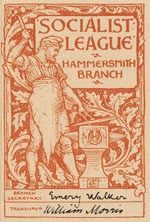
Reforming work will lead to beauty both internal and external, open to all. In this common weal, beauty is a condition of justice, and vice versa: the inhabitants, we're told, could not be happy knowing that fellow citizens are in prison, or trapped in loveless relations: mutuality is the key to social harmony (in contrast to the current Justice Secretary, who is scrapping the Human Rights Act and has banned sending books to prisoners). This was also the basis of his Socialist League


Simply the design of the membership card brings me to the real point of this rambling post. Art and labour brought together. The card is simply beautiful. It proclaims the unity of politics, life and art and above all it is optimistic. Like News From Nowhere, it assumes that the socialist future will transform people's lives for the better. When did we stop believing this? It's still there in Atlee's 1951 Festival of Britain (yes, the Tories took power in 1950 but the Festival was planned under the pioneering 1945-50 Labour government that founded the NHS and did so much more). After that? Not so much. Our supposed leaders are ashamed of the word socialist and whatever they do believe in, it isn't founded in optimism. Nor does it believe in a future which unifies love, life, joy, work, art and politics. Neither Labour nor the multiple far-left splinter groups offer anything positive. We spend our time accepting the ideological boundaries of neoliberalism and finding ways to mitigate the damage it does. I can't imagine the Milibands, Clegg, the SWP leadership or any of the others being able to understand the emotional or spiritual aspects of socialism that are integral to Morris's version.

Stunted by 'politics', they've lost us because they no longer have anything positive to offer beyond technocratic fixes. There's no way of life embodied in modern politics. There is in rightwing politics, but it too consists of joylessness: the Tories and UKIP spend their time saying 'no' to things – foreigners, human rights, the poor, community, altruism. That's OK: beyond Major's lazy fantasy of old maids cycling to communion, capitalist politics has always been about material acquisition. But it's not true of us. The left has forgotten that Marx, for all his talk of materialism, was funny, cultured and engaged with more than just economics - that's why his work is shot through with Shakespeare. Economics was part of his philosophy of life, rather than the other way round. Once the economics was sorted, he thought, our social, spiritual and philosophical ones would be too: happiness was the end, not simply material comfort. Morris knew this, and acted on it.

So why have we ended up with a political culture which would rather have us fulminating against 'scroungers', immigrants, Europe and each other, or competing over who can inflict most austerity to win votes rather than a labour movement which has a positive vision of how life could be. Last week the government gleefully announced that it would rather let African migrants drown than address the causes of their desperation. Every dead African is a vote reclaimed from UKIP, or so it hopes.

When did we forget that politics could be a vehicle for aspiration and happiness rather than a game of beggar-thy-neighbour? I believe, like Morris, that my fellow citizens are essentially altruistic and well-meaning, that given reform of our industrial, political and social structures this altruism could be liberated to achieve a better society. This is why I teach, and why I teach in an unfashionable ex-polytechnic in an unfashionable town (that and being essentially unemployable otherwise). The lesson of Morris is that all are capable of blossoming under and deserve justice and beauty – it's a socialism of humanity rather than just of economics: this isn't the 'art will civilise the brutish lumpenproletariat' argument of people like Matthew Arnold. It's the idea that intellectual and emotional freedom means nothing if it's reserved for the powerful or the 'swinish rich'. Hence Jeremy Deller's Venice Biennale painting:


It's called 'We Sit Starving Amidst Our Gold' as was inspired by Roman Abramovich mooring his mega-yacht in the middle of Venice, obscuring the views adored by Morris's hero Ruskin, without a thought for others. So here's WM, hurling Eclipse (the world's second largest yacht: two helicopter pads, two swimming pools etc.) out of the way. Morris really does seem to be having a moment.

I'd give up if I wasn't an optimist. I just wish there was a political party I could vote for that feels the same way. Suggestions on a postcard?