What did authors in Britain write about in the decade immediately following the First World War? How did they reflect upon those complex, often troubled years, 1919-1930? What did they think about sexuality and censorship; about relations between women and men; about the decline of empire; about the hopes for peace? What can we learn from them now?
• After the First World War: T. S. Eliot, The Waste Land (1922); Edmund Blunden, Undertones of War (1928); Helen Zenna Smith, Not So Quiet (1930)
• Nation vs. Nature: D. H. Lawrence, The Captain's Doll (1923); D. H. Lawrence, Birds, Beasts and Flowers (poems, 1923)
• The Social System: Virginia Woolf, Mrs Dalloway (1925)
• Sexuality and Censorship: Radclyffe Hall, The Well of Loneliness (1928)
• Ends of Empire: E. M. Forster, A Passage to India (1924)
Thinking of myself as – in part – a 1930s and Welsh literature specialist, I was intrigued by a 1920s Britain course. So much happened: the aftermath of WW1 (there's always a lag between events and literary responses); the Irish War of Independence and the ensuing Civil War and Free State; the Depression; mass unemployment in the coal-belts of Scotland, Wales and England; the impact of suffrage; the first Labour government and the Zinoviev letter. In Wales, we see the foundation of the Urdd, Eric Gill moving from Ditchling to Capel-y-ffin, the Arthur Machen craze, Kate Roberts gets going; the foundation of Plaid Cymru, Hunger Marches, Dorothy Edwards'sRhapsody and Winter Sonata, Aneurin Bevan is first elected… you get the idea. I'm pretty sure that things happened in Scotland and Ireland, and people wrote about them too. Welsh, Scottish and Irish/Northern Irish authors might even have written about things that happened elsewhere.
What's my point? This Cambridge course incorporates an anglicised American (TS Eliot) and Helen Zinna Smith, an Australian living in England. It pops out of south-east England for a quick look at DH Lawrence (though not his Nottinghamshire mining novels), but manages not to include a single Welsh, Scottish, Irish or Northern Irish author. This syllabus includes more authors from 52 Tavistock Square, London, than there are from the other nations of the British Isles. My gripe is partly about nomenclature: don't say Britain if you really mean England, and partly conceptual. These islands have long, complex intertwined histories and cultures - the complications are what makes the literature of the time so enthralling. It just seems so terribly old-fashioned to assume that the view from Bloomsbury is definitive. A Welsh-speaking miner-poet or Scottish baroness or a Hanna Sheehy-Skeffington is simply not going to have the same view as afforded the inhabitants of fashionable, moneyed North London or indeed from East Coker. Promoting the continued cultural exclusion of everything unfamiliar to white privileged south-easterners is the intellectual version of treating Downton Abbey as representative of British society.
No doubt these lectures will be fascinating and intellectually coherent in isolation, but as a whole they promote a deeply reactionary image of Britain, England and of literary studies as the valorisation of highly partial perspectives without reflecting on their partiality at all. The unspoken implication is that the study of authors from or living in one corner of England is universal, whereas the literatures produced in Scotland, Wales and Ireland, whether in English or not, are parochial. At a time when the UK is once again faced with dismemberment (not something I have a problem with), it behoves those with cultural capital to wonder whether exclusionary practices like these might have something to do with the Scots and the Welsh feeling unwanted.
What's the answer? Come to a deeply unfashionable university like mine which makes the effort to encompass a range of voices, not just those already sanctioned by dubious authority.
*Title of this post echoes the 1888 Britannica entry for Wales which infamously read 'For Wales, see England'.
You find me much refreshed by my sojourn on the west coast of Ireland - goats were crowned on towers, the Black Atlantic was swum, sun burned, rain fell, photographs were taken and many books were read.
Duelling birds
At the horse fair
#squad
Mandatory annual shot of a horse queuing for a burger
King Puck himself
A reveller in the rain
Darkness falls over Puck Fair
The banner is accurate, but cruelly unnecessary
Theresa and Boris, winners of the Fancy Dress
One of the more elaborate roadside shrines - Dingle
An fear marbh - the dead man (Blaskets)
Old and new ways - cross glimpsed through an ogham stone
As for books, I read two Carol Ann Duffy collections (Sincerityand The Bees) which I found moving in some places and bland in others. Trollope's Can You Forgive Her? was a funny read: the writing is wonderful but the underlying premise (one woman has too much sensibility to marry wisely, one is too crudely sexual; they both have to learn to love the right men, who have few virtues beyond patience and Being Right) really hasn't aged well. I read at least one Trollope every year and will carry on, but some of them really try one's patience. Tom Hillenbrand's Drone State is a German near-future surveillance thriller set in the darker corners of the EU. Good fun and some sharp commentary on any state's tendency to do whatever technology allows without moral qualms, but doesn't really bear up to close scrutiny. David Nicholls' Sweet Sorrow was a bit of a disappointment. I know that his books are always sensitive, funny stories of people learning to find their roles in life and love as they grow up, but this one felt even more formulaic than usual. The Romeo and Juliet-performance setting was mechanical but he does have some good insights into the play, and the teenage lads' dialogue is spot on. Worth reading, but I think the formula is played-out rather. I struggled a bit with A L Kennedy's Serious Sweet. Interesting structure (two troubled, traumatised people find their way towards each other through the course of an awful day, during which their pasts are excavated via flashbacks) but I clearly lack the imagined reader's sympathy for the characters required to fully appreciate it. Gavin Corbett's Green Glowing Skull was a blast. Its protagonist is also rather unsympathetic (a 40-something, aimless Irish emigré to New York) but the absurdist plot, picaresque adventures and Milligan/O'Brien-style events just worked brilliantly.
Finally, I read two big novels: Kate Atkinson's A God in Ruins and AS Byatt's The Whistling Woman. Reading them consecutively was an interesting experience. Sort-of consecutively, I should say: I read the first 250 pages of A Whistling Woman before my holiday, and decided there wasn't enough left to justify packing it. I finished the Atkinson on the way back, then dived back into the Byatt. Both novels are lengthy examinations of social and cultural change throughout the 20th century, focussed on individuals and their families who had a ringside seat. In Atkinson's novel, it's Teddy, an upper-middle class man for whom WW2 provided meaning and existential enrichment otherwise denied him. HIs experiences as a bomber pilot make him a node in a series of philosophical and moral questions which shape his life (or not, without wishing to ruin the twist): the ripples of his experiences are traced through the generations that follow him. The structure is ingenious without being particularly experimental, and the underlying assumption that ordinary people's behaviours are informed by moral depth and even the worst people's behaviour should be understood as the product of complex pressures is a good one even if it isn't innovative. It's a long book which entirely justifies its length, even for someone like me who has very little interest in the seemingly endless British fascination with WW2 (you managed to be on the right side once in a couple of millennia. Well done). So then I went back to A Whistling Woman. I like Byatt, and say that having read several books of hers that aren't the wonderful Possession. AWW is another family-saga-over-the-20th-century, the latest in a series of novels following the Potter family. They're harder to empathise with than Atkinson's characters: they're even posher, they're always at the forefront of whatever Byatt thinks is historically significant, and they all seem to excel at whatever they do. They're basically the family who always asks to see the manager.
AWW meets the 60s: Frederica is becoming a media star despite her suspicion that both she and TV are bright but superficial. Her mathematician boyfriend is losing his faith (something I thought the intellectual wing of the British middle classes did in the 1880s); an idealistic northern university is being wracked by hopelessly confused student unrest, while a nearby hippy commune is becoming a cult. Essentially, it's a novel about clashing grand narratives, with examinations of patriarchs and fatherless figures thrown in. I enjoyed it, but despite being on similar territory to the Atkinson (whose title is a bit of a give-away), it felt a little indulgent. The Atkinson was about fairly ordinary people in a society being remodelled by war and the horrors (and opportunities) offered by upheaval; the Byatt is much more self-consciously intellectual, but also much more interested in the individual than it is in social structures. Both authors are also very self-consciously literary: writers abound in both (a very funny Richmal Crompton parody and lots of Milton and Oxford English curriculum references in A God in Ruins, while writing is a recurrent theme in AWW: Lewis Carroll, Milton again and Shakespeare loom large).
It's fun spotting the literary parallels and references, and both novels are satisfying reads in that old-fashioned sense, but I found the Byatt a bit too like Iris Murdoch's most self-absorbed novels: posh people in intellectual and moral quandaries while the rude mechanicals follow their brutish instincts. It's very funny though - Byatt's suspicion of the counterculture manifests in wicked parodies of Tolkien, Tolkien fans, teenage Maoists and opportunistic Swinging Sixties types. Where it gets much more serious is its examination of the gap between the possibilities opened up for and by women in the 60s and the underlying misogyny of even supportive men. Motherhood – and its refusal – is a key issue, though ASB plumps for motherhood on the whole. The other compelling aspect is Byatt's constant battle for meaning: the Church mirrors the self-help group that becomes a cult; the University (troubled by the -ologies and by the dubious histories of its most rigorous thinkers) has an anti-University which specialises in woolly nonsense; humanities people pair up with scientists; learning and TV dance around each other. Byatt draws clear lines between Reality and Nonsense, without quite adopting entirely reactionary positions: Atkinson sees the dissolution of rules as an opportunity for both selfishness and altruism, in which kindness is the principal virtue. Byatt needs her world to make sense; Atkinson is much more open to the random stuff that constitutes life.
I suppose the power of these two novels is that I'm still thinking about them, despite Green Glowing Skull for instance being more formally experimental. Byatt and Atkinson use interesting structures and pour everything they know into these texts, sometimes too much, but this leads to a partial abandonment of realism - deliberate or not I'm not sure.
I am going on holiday. To Ireland of course, packing Factor 50 and a thick pair of gloves for use on the same day, if experience teaches anything. I hope to defy Judge Dredd by swimming in the Black Atlantic, take some photographs, read a lot of books, admire the goat on the tower and write my upcoming conference paper on Carol Ann Duffy's period as poet laureate (why yes, holidays are for doing the work you don't get time for otherwise). This evening is set aside for the pleasurable task of deciding which 20 novels make it into the suitcase – every year I intend to buy an e-reader and every year my pointless scruples about Amazon get in the way.
The last day at work finished on a slightly sour note: I went to a presentation on employee engagement, which featured a lot of warm words, some rather misleading graphs, the proud announcement that we now have an employee engagement 'branding and logo', and the astonishing assertion that a university can be ethical, caring, empowering and engaging while – as is being discussed – 'outsourcing' entire sections of the staff. Apparently you can fire the lowest-paid employees, contract a company to employ them and make a profit for itself, save money and adhere to your 'values'. I wondered out loud whether any senior management posts were being 'outsourced', which was deemed an unhelpful contribution.
Other universities, such as Birmingham and some London colleges have gone down this route. It means that you have a two-tier workforce: managers and academics on semi-secure contracts and decent salaries, and an army of the lowest paid, doing the worst jobs, stripped of any legal, moral or communal ties with their workplace. What always happens is that the former employer declares that working and contractual conditions won't be affected. They always are, at which point the university/hospital/school declares that its hands are tied because it doesn't employ these people.
My university has Fair Trade status: I don't see how this is commensurate with washing one's hands of the most insecure group of colleagues. Why should the people who cook our meals, patrol the grounds, keep the computers running and empty the bins be deemed external to the ancient ideal of the community of learning? This move has gone down very badly at other institutions and I hope that if it happens here, everyone from Professors and Executive Directors down will be on strike in solidarity. I can dream I suppose: the cause of this nasty little plan is that, like every university, we're struggling financially and like those in the vanguard of the sector, it's those given least who will be expected to give most.
Sorry, that's a gloomy way to end the academic year, but it profoundly depresses me. Universities should have the confidence of a millennia's existence and aim for the moral and social heights, rather than take on the most discredited, vicious and short-termist aspects of more recent organisational models just because the sea has become choppier. Idealism is only meaningful when there's a cost - there's nothing more nauseating than a highly-paid 'leader' explaining to those on the minimum wage that sacrifices have to be made, and oh look, it's them. Again. Let's hope it doesn't come to that.
A friend asked me to take some pictures of the rebuilt Birmingham New Street station for a book project. I have Views about the place: as far as I can see they just stuck a new shopping centre on top of the same constricted, dark, confusing and un-expanded 1960s station. It's as if Screwtape or Crowley (who designed the M25 as a satanic sigil) got his hands on the blueprint and decided to have some fun.
Anyway, I went along and took some shots of the exterior and its surroundings. Here are some of my favourites – the rest are here.
The shiny new facade next to a 70s concrete building
One of the nods towards softening the surfaces around NS
Not all of the New Street area has been gentrified.
The famous Electric Cinema, continuously operating since 1909
waiting for the bus home from graduation
The signal box - one of my favourite brutalist buildings - now listed
Colourising - a cheap bit of kitsch I couldn't resist
Sauron's Eye is watching you
Side and top view of a tram
The light at the end of this tunnel is thankfully not a train
Well, last week's post insisted that nothing happened. This week everything has happened, though not necessarily to me. The Tour de France and Ireland's corking start to the Test match against some no-hope newcomers called Ingerland or something has anaesthetised me to some extent from the pain of a heatwave and the installation of the Johnson administration.
Maybe I'm getting old (44 last week) but I look at this shower and don't see statesmen and women: I see a bunch of overwhelmingly male, white, privately-educated Oxbridge graduates who've honed their one-liners at the Oxford Union debating society, done a couple of years in the cellars of a think-tank, strolled into parliament where they've deployed precisely the same kind of I-speak-your-weight Hayekian nonsense that got the young gentlemen rolling in the aisles back in the day. I really mean this: perusing the various books, speeches and tweets of this crowd, you get the sense that they have never met anyone outside their own circle worth considering, and there isn't a reflective bone in their collective bodies. What you get instead is the self-regard of a group that thinks – like the various Spiked magazine alumni infesting the body politic – that a good policy is the one that sounds most out of step with public opinion or good sense, one that, to use a phrase currently in vogue in the colonies, 'owns the libs'.
Priti Patel (one of several ministers returned indecently quickly after being justly sacked for disgraceful behaviour) with her obsessional regard for capital punishment; Sajid Javid and his proud boast that he's only read Ayn Rand's The Fountainhead (the film of the book is his favourite movie too); ministers for the environment, housing, welfare, Europe and so on distinguished only by their hostility towards their charges. Actually, that's not fair: Robert Jenrick, the Housing minister, owns two multi-million pound London homes and lives on an estate. A country estate, but still, it gives him an insight into the lives of others I'm sure. I'm not one to sentimentalise the past, but I'm already mentally rehabilitating Gauke, Hammond and Co: while their policies were vile, they at least didn't behave like governing a major country is a student prank. Douglas Adams nailed them spectacularly in Max Quordlepleen's monologue in The Restaurant at the End of the Universe (1980):
“And thirdly,” he said, “thirdly a party of Young Conservatives from Sirius B, are they here?” A party of smartly dressed young dogs stopped throwing rolls at each other and started throwing rolls at the stage. They yapped and barked unintelligibly. “Yes,” said Max, “well this is all your fault, you realize that?”
While we're on the Hitchhikers' analogies, they also remind me of the advertising-executive contingent on the Golgafrincham B-ark, the useless section of a species sent off to found a colony on earth where they can't bother anyone, and from whom we're all descended. Gavin Williamson isn't an ad executive though: he's the Number 2 who declares war on some trees, just in case.
As you can probably tell, I'm not taking this at all well. The installation of a bunch of ultra-rightwing liars and cheats (including Grant Shapps, whom I personally thought I'd dispensed with last time, as the Guardian reported and euphemism his lies as 'overly-firm denial') is not a good background to resit marking, course admin and dealing with student complaints. I'm old now. The thought of saddling up once more and hounding these crooks and shysters just exhausts me, and there are so many of them.
I haven't even had much time for reading this week, only struggling through John Barth's proto-postmodern The End of the Road. I'm fine with the style, but the protagonist is so unpleasant that even while admiring the way he's put together, he's hard to spend any time with. The sexual politics have really, really not aged well either. I'm not sure what's next - I had planned to read or re-read some texts I've put on next year's syllabus, but rearrangement of the teaching duties mean I won't be teaching them. I've got some Carol Ann Duffy to catch up on ready for a conference I'm contributing to in September, but I might resort to closing my eyes and picking at random from the Room of Unread Books. This isn't an exaggeration for comic effect either: I literally have a room full of unread books, plus more in several locations. I haven't bought any books this week though, so I'm winning through. I just have to live to 109 to get through the ones I already own.
Enjoy your weekend. I was going to savour Ireland's defeat of England but they've just collapsed to 38 all out and lost the match. Just the last stages of the Tour de France to keep me going.
Pretty much nothing to say this week. I've just marked re-submitted essays and attempted to wrestle with the fresh new tortures added to our virtual learning environments and electronic course management tools. The students, many of whom need to confirm their timetables to plan work commitments, keep contacting me to ask when classes will run. I have no idea, and no idea when either party will know. All I hear is that one faculty identified 12,000 timetable clashes thanks to the whizzy new system that promised personalised timetables for all staff and students, with no clashes. God alone knows what happens when staff with caring responsibilities and flexible working requirements start asking for their legal rights to be recognised. So as far as next year goes, I mostly know what I'll be teaching, just not when or with whom. Situation normal, AFU.
Outside, of course, the world still burns and the New Idiocracy is about to take over, but we're all just passengers on this flaming jetliner of doom, so there's not much point rehearsing the usual anxieties. I've distracted myself by refereeing the Much Wenlock Olympian Games fencing competition last weekend (it went very well: no complaints about my decisions and no technical failures) and by turning 44. My bikes came back from repair with mixed results: the Moulton is running like a dream but the boring Forme road bike is still playing up. I've read a book or two, but not as much as I'd like: Wodehouse's Uncle Fred In The Springtimewas like a greatest hits of his top-dimwits-in-trouble plots, and I'm currently halfway through Sam Byers' Perfidious Albion, which is a funny satire about Brexit with quite a lot of thinly-disguised contemporary figures prominently featured. It's a bit like JG Ballard's later novels with more gags. I particularly liked the Theory Dudes, a bunch of bros who prefer to uncover the hidden fascism in iced buns etc. than address violence on the streets.
I do seem to have acquired a lot more books than I've read this week - all the pent-up orders from my week away. They include Geraint Goodwin's The White Farm and Other Stories; Andrew Tolson's slim The Limits of Masculinity; Kath Filmer-Davies's Fantasy Fiction and Welsh Myth; Crawling Through Thorns, Welsh Boys Too and Fishboys of Vernazza by John Sam Jones (in all my years attending Welsh Lit conferences, I don't recall anyone discussing these intriguing novels and short stories about gay Welsh life, and he seems to have no online presence); Lucie McKnight Hardie's disturbing Welsh coming-of-age novel Water Shall Refuse Them; Red Love and Love of Worker Bees by Soviet commissar and ambassador Alexandra Kollontai; the new collection of Malory Towers stories by Lucy Mangan, Narinder Dhami, Patrice Lawrence and Rebecca Westcott; some excellent old Penguin editions from a colleague, including James Thurber's Is Sex Necessary?, and Armistead Maupin's Babycakes, the fourth of the Tales of the City series. I've taught earlier ones, but wanted to teach the volume that covers the early years of the AIDS crisis. Turns out I'm not teaching American Lit after all, so I'll just read it for fun.
In the absence of any opinions with which to detain you, enjoy your weekend and tune in for another exciting episode of Lists of Books and Minor Complaints.
This is the end of a week at Gladstone's Library in Penarlâg/Hawarden - one of the few (only?) prime ministerial equivalents of a Presidential library of which there are many in the US. One can only imagine what will be in the Trump Library: tweets and subpoenas plus – one can only hope – illiterate letters to Fox News anchors written on toilet paper and smuggled out from his cell.
Gladstone's Library is rather magnificent. The core collections are his own theology, history and literature holdings, held in a lovely Edwardian-neoMedieval complex which looks like it was plucked from the banks of the River Isis and dropped in this border village. Gladstone himself was clearly a character: one of his books bears the comment 'this generally worthless volume', while the church ceiling has a patch where he impatiently decided that he could repair it better than anyone else, before giving up in the face of the scale of the task. There's a slightly feudal - and border - air to the village too: the Gladstones still occupy the local mansion and estate (which you can't even glimpse) and have endowed anything that isn't moving.
It's been a wonderful week. I've just sat here in beautiful surroundings, working away on turning my PhD into a book, and spoken to virtually nobody. Those I have spoken to have been interesting and lovely. It's going to be hard to leave, but the resit marking waits for no man. I'll be back, and next time I'll book well enough in advance to get a room here rather than in the b-and-b, good as that was.
Focussed on work as I have been, I've really only read critical texts: John Jenkins's PhD on masculinity in Valleys novels (which I examined and like a lot); Emma Smith's Masculinity in Welsh Writing in English, Harri Garrod Roberts's Embodying Identity: Representations of the Body in Welsh Literature, and William Germano's From Dissertation to Book - all highly recommended. I did zip through a battered old Penguin copy of Wodehouse's Uncle Fred in the Springtime at the weekend, and I've almost finished Stevie Davies's Awakening: a superb neoVictorian evocation of the impact of Darwinism on nonconformist belief, taking in sisterly relations, female desire and Anglo-Welsh relations along the way. It's subtle, unflashy and rather wonderful.
Thanks to the gods of the research budget (they play with us for their sport), I'm away all next week – sitting in the Gladstone Library trying to get on with turning my ancient and pedestrian PhD dissertation into a book. This should be a little more advanced, but my six-week sabbatical this semester was almost as badly impacted as my collar-bone was when I got hit by a car: this week away should help me catch up a little.
Sadly the Gladstone's accommodation is fully booked so I'm in a b-and-b across the road and won't be able to stay in the library in the evening, but it will still be good. I'm hoping to take a bike for those balmy evenings, but they're both in for repair at the moment and I'm not sure they'll be ready in time. One of the difficulties about having a rare one is that the bike shop lacks the specialist tools. What you gain in geek-points, you lose in practicality. And money.
This week has mostly been about course admin - trying to set up next year's modules without knowing what the timetable is or who's available to teach - and counselling students ahead of the resubmission day next week. Students fail for a wide variety of reasons and I have an awful lot of sympathy for most of them (and most seize the opportunity to have another go with good grace and effort), but some do try one's patience. Sending me a draft for comment that is clearly and crudely plagiarised seems rather cheeky, as does airily admitting that one hasn't read the text being written about. This is now Slide 1 of my Hamlet lecture.
Anyway, enough of that. On with the apologies. A week or two I expressed my frustration that certain very senior and entirely imaginary colleagues had wreaked havoc, behaved unethically, and failed upwards to other institutions under cover of NDAs, pay-offs and good references. I am assured by one who certainly knows that this is not the case - a relief, and evidence that perhaps I am sometimes too cynical. There's still the issue of what happened to effective oversight and accounting, but I'm happy to correct the record. And to my readers in the posh seats: just rattle your jewellery. (And while you're here, ask yourselves this: despite posters all over the place referring to the 'digital campus', why can't a course leader contact every student on a course, or in a particular year on a course, in one go?).
I've found a bit of time for other things. Sunday saw me doing refreshing my welfare officer and child protection qualifications for fencing - mostly quite repetitive, but there's a new emphasis – or panic around – social media. Perhaps understandably, governing bodies, like the law, struggle to keep up with the scary new possibilities raised by the plethora of platforms especially in the hands of the young and enthusiastic, and those with sinister intent. Thankfully the current training doesn't try to be exhaustive: keeping it simple and thinking ethically are the key aspects.
Books: only a couple this week. Stephen Baxter's H-Bomb Girl was entertaining, witty and convincingly situation in early-60s Liverpool, and well worth the 99p I paid for it in The Works. The new Kevin Barry novel Night Boat to Tangier is great - a very consciously Beckettian piece about two witty, charming, dapper, washed-up Irish psychopaths. Full-on Corkonian Hiberno-English dialogue, absolutely minimal narration, struggles to generate female characters with the same rich interiority – the women are wives, mothers, daughters, copers and escapees, but lack agency (though as the Beckett influence is strong, almost nobody has much agency). I'm currently most of the way through Peter Ackroyd's The Death of King Arthur. It's a long time since I read Malory, but I think he's managed to reproduce the structural jumpiness, Arthur's savagery (his Herod-style massacre of the infants, for instance) and the uninterest in character development rather well, despite – or perhaps because – cutting two-thirds of the story out. I'd forgotten too how close to the surface the Celtic-style ritualism is in Malory's very Anglo-Norman text.
Normally at this point of the year it feels ass if things are slowing down a little. Not this time - between the second Faculty re-structure in 18 months with its concomitant organisational and union casework challenges, the slowly-dwindling repercussions of being off sick, the magic new timetabling system (much vaunted, not yet spotted in the wild), terrifying recruitment figures – non-recruitment would be more apt, workload challenges, external examining duties and research deadlines approaching, I'm exhausted and more than a little worried about the future.
Also, and on an astonishingly mundane level, my beloved Bridgestone Moulton bike is starting to show signs of age: it shouldn't be preying on my mind nearly as much as it is! At the moment I can't use the highest gear – the new chain (made up of two shorter ones) just won't engage with it, which is infuriating as I virtually never use any of the others. My local bike shop does its best but they haven't seen most of its odd-sized components before, and some of them are no longer made. Ideally I'd trade up to a Moulton NS Speed but I don't happen to have £16,000 plus change lying around and work's Cyclescheme doesn't quite stretch to it… I do have a boring normal road bike but that's playing up too. I don't know what I manage to do to them.
As for the rest of the week, it's been hectic but fun. My dramaturge friend Emi Garside popped up, so it was good to see her. I had two days at Swansea University, fitting in a little light external examining on their English and Welsh MA courses between walks along the beach, fine ice-creams and good company; I talked to students about resits and continuing projects, and I read some books. I enjoyed MT Hill's post-Brexit dystopian novel The Zero Bombespecially the vision of an illegal underground version of the NHS post-privatisation. Ben Aaronovitch's latest in the Rivers of London series, The October Man is set in Germany's wine country and was good fun - it's a novella that didn't add anything special to the overall series, but was very enjoyable nonetheless. After that I read Stevie Smith's 1936 Novel on Yellow Paper. It's been on my shelves for at least a decade, picked up for £1.99 from The Works. How I wish I'd read it as soon as I bought it. I didn't realise how much fun it was, nor how compelling the narrative voice is. The narrator is a businessman's secretary, Pompey, and the story is her jumbled thoughts on everything from the Jews for whom she feels some affection while also believing herself naturally superior (rather uncomfortable at this distance, though I suspect a fair representation of her class and time, and Pompey learns the error of her ways once she visits her German friends), the Nazis (against), suicide (for, in principle, and thinks it should be presented to children as a reasonable option), art, sex (very much for), marriage (rather undecided) and aunts (ambiguous). I moves between witty chat and genuinely profound. She performs constantly – as a family member, a friend, an employee – while knowing exactly how large is the gulf between how 'normal' people behave and how she wants to behave. The style is somewhere between Woolf, Flann O'Brien, Wodehouse and Daisy Ashford of The Young Visiters fame, and it's hard to tell how knowing or naive it really is. There are counter-Betjemanesque touches – like the image of the young woman lingering by the tennis courts in the hope that some young chap will propose to her – and Mansfieldesque ones when the Pompey takes a moment to examine her condition. I liked the line 'I do not like this riot of emotion. I do not like it at all'. Anyway - highly recommended.
Finally, I'm most of the way through Kate Atkinson's latest Jackson Brodie crime novel, Big Sky. Like all of the series, its power derives from knowingly flitting between literary fiction and detective fiction mode. I'm not sure the balance is quite right this time: the repeated reminders that the author and the characters are aware of what happens in crime thrillers are a bit laboured, especially when the plot – paedophilia and people trafficking on the Yorkshire coast – is so dark, contemporary and compelling. The bad men are nicely made, but the real triumph is Crystal, a damaged child who single-mindedly self-fashions herself into a trophy wife and becomes the moral core of the novel. Jackson himself, a great creation originally, seems to be a bit-part player to some extent, the vehicle for many self-deprecating jokes about his inability to connect with the younger generation (they all have mobile phones and don't talk to adults much, and you can't make them climb chimneys for a living) which sometimes shade into a sense that Atkinson herself is finding generational change a bit hard to take. That probably sounds harsher than I feel, but there is a problem here. The darker side of the novel is operating on the territory of David Peace's horrifying, political representation of South Yorkshire as a failed state, Red Riding Quartetand the best bits of it are equal to that series, but the jokes and cosier aspects keep detracting from the grimness.
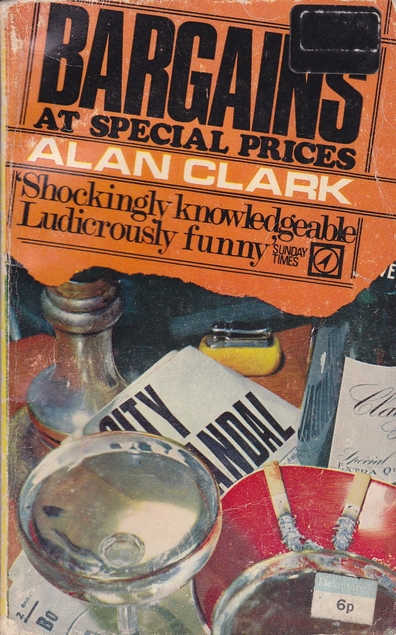
Next up – if I finish the manuscript I'm reviewing – is Kevin Barry's new one, Night Boat To Tangier. Amongst the new books acquired this week are Levy and Mendlesohn's Children's Fantasy Literature, David Runciman's How Democracy Ends and philandering MP Alan Clark's 1960 Bargains At Special Prices in a beautiful 1967 Arrow cheap paperback edition. The BBC showed a version of it in 1964 but I doubt any tapes survive.
For a few years, I was one of my sport's child protection officers – advising on good practice and helping to investigate complaints. It was harrowing occasionally, and led to some fairly uncomfortable conversations and situations, but it was important work.
One of the cultural barriers to being effective was the tiny size of the field: pretty much everybody knew everybody else, while livelihoods – and sporting careers – depended on the outcome of complaints. The governing body was largely made up of big fish: influential people closely tied to a lot of those about whom complaints were made, invested in the appearance of harmony and continuity. There was a lot of resistance to setting up open structures which encouraged referrals: more than once a senior person said that a newspaper report about a coach being suspended or arrested would damage the sport as a whole. Our argument was that denial would lead to the death of the sport: what parent would entrust their children to an organisation which claimed there wasn't a problem when every sport manifestly did have a problem? We watched some sports' governing bodies confront their inner demons and thrive because new entrants respected their honesty and determination to do better; others hushed everything up and lost the confidence of their participants.
Eventually the culture changed: go to any fencing event now and you'll find a welfare officer and discreetly circulated details about how to talk to somebody, and most people now think the structures are impartial and trustworthy. The bureaucracy can be daunting and – to the generation which talks about snowflakes – paranoid, but it clearly works.
All this came to mind while observing the latest academic merry-go-round, in which senior managers disappear mysteriously take months of leave, 'resign' to seek 'new opportunities' with the best wishes of senior management, then pop up somewhere else, sometimes in more senior positions. As the months go by, the personal, structural and economic damage they've wreaked will emerge but no blame will ever be attached to them, to those who appointed them, or to those who put in place manifestly inappropriate structures that enabled incompetent, corrupt and sometimes criminal behaviour. In a system which privileges institutional power and leadership prestige, there's no benefit to transparency or honesty: the institution doesn't want regulators poking their noses in, and it wants the departing individual to go quietly, so it's non-disclosure agreements all round, a bland-to-positive reference that doesn't even hint at any disquiet, and everybody's free to 'go forward' without recriminations or reflection. Some credit cards are withdrawn, there might be a short period of enhanced auditing, but there's no serious critique of the social or cultural context which led to a series of poor decisions. Restructures and job losses (not of those responsible, obvs) will follow to solve the immediate challenge and references might quietly be made to bad apples. The barrel will remain unchanged. Horses will remain unscared and the niceties will be observed at agreeable conference dinners. The departing individual will wreak further havoc in his or her next institution and nothing will change. Some union representatives might be rude enough to refer to unfortunate events but confidentiality will be invoked as a reason not to respond.
This is, of course, entirely hypothetical.
Anyway, it's otherwise been a ridiculously busy week - more progression and results boards, resit meetings with students, a bit of research planning (not any actual research of course) and preparing for my own external examining visit elsewhere. I did manage to fit in some relaxation: caught up with some friends I hadn't seen in 20 years at a wedding reception, and saw Stereolab on Sunday, fulfilling a long-held dream. They didn't disappoint.
I finished Manon Steffan Ros's Blasu, which took a while to grab me. The structure is very obvious: interlinked characters across several generations in a village whose secrets and traumas are expressed by their relationships with food. Each chapter moves between characters' perspectives, and each is prefaced by a recipe. I got the point but it felt a little programmatic, and the central secret wasn't hard to work out. However, where the novel really earned all the prizes and acclaim was the slow unfolding of character and subtle enmeshing of these often complex, damaged people as the plot unfurled – from being a bit distracted by the self-conscious structure I ended up being deeply moved.
In total contrast, I also read Shada, Gareth Roberts' novelisation of Douglas Adams's abortive Doctor Who scripts from the late-70s. Hilarious, witty and the perfect mash-up of Dirk Gently with the Whoniverse. Not sure what book's next: something lightweight, that's for sure. I also finally got round to listening to the new Clinic album, Wheeltappers and Shunters, and an interesting collection of choral music called Supersize Polyphony: it is as unsubtle as the name suggests. If you've already got some von Bingen or anyone else's recording of Tallis's 'Spem in Alium', you really don't need this release.
It's been a hectic week or so since my last substantial post. Two unexpected days in Ireland for a wake/funeral, and all the admin associated with the end of term: sample scripts, moderation, moderation forms, module statistics, module statistics pre-board response forms, organising resits, the formal boards, appraisal planning, workload planning: it all mounts up and much of it is necessary, if not efficient.
Next year promises to be efficient without necessarily being progressive: the move to compulsory online marking means I won't be chasing people for scripts, photocopying them, filling padded envelopes and posting them to external examiners to puzzle over gnomic crabbed comments: everything will be instantly visible in some low-rent typeface on a computer screen. I know there are a lot of arguments (starting with the environmental) for online marking, but I think my department's current compromise (handwritten marginal comments, typed substantial feedback on a coversheet) strike a happy medium between organic artisanal response and ease of comprehension. It bodes ill for me too: having decided not to have an internet connection at home so that I don't live on my favourite sites 24 hours a day (Moulton Bikes, Librarything, Jobs.ac.uk – and The Guardian, obviously, because I'm a stereotypical bleeding-heart liberal) and because I wanted a complete separation between work and home, I'll now have to stare at a screen, in the office, for even longer. I think this means I'm old.
Anyway, it wasn't all work last week: I managed to read a couple of books at least. One of them was Zadie Smith's Swing Time. Having left it on the shelf for a couple of years, I took my second-hand copy on the flight to Ireland with me. Thoroughly engrossed, I read it there and back, finishing it in the air on the return leg. Or rather, not finishing it. Some absolute rotter had removed the last page! It's not exactly a murder mystery, and there's no whodunnit to be revealed in the closing lines, but it left me utterly bereft and helpless. Thank heavens for Twitter and the numerous kind people who sent me photos of the missing paragraphs while I was on the train home: closure was achieved. Though not for the central protagonist. I heartily recommend it. Can't believe Madonna didn't sue though.
I also read and enjoyed Alison Plowden's zippy In A Free Republic: Life in Cromwell's England - lots of good detail and useful quotations from letters and diaries (mostly Royalist) but weirdly unedited: chapter titles had little to do with the content, and pages could swing between examinations of the Rump Parliament to details of common dietary or skin complaints. After that I read Gary Shteyngart's Lake Success, which I thought was much less successful than his Super Sad Love Story: it tried to be a Travels With Charley/Tom Sawyer/On The Road encountering-the-real-America, plus The Big Short and Bonfire of the Vanities and American Psycho all at once, while simultaneously signalling its author's and protagonist's hyper-awareness of this literary tradition (the central character, an awful hedge-fund trader who has a mid-life crisis and travels across the US seeking his lost love, his spiritual progress measured in the number of women prepared to give him a redemptive shag, recalls his university creative writing class assignment, which featured a banker seeking redemption through rediscovering his lost love). It pulls its punches: you can't critique the damage caused by and inner emptiness of the 0.1% and make sure that your hero lives happily ever after without changing his fundamental views or behaviours at all, despite having gone on a literal and metaphorical journey. He ends up with $100 million in the bank and a strong relationship with his ex-wife and autistic son. The son - convincingly on the extreme end of the spectrum for most of the novel – miraculously turns out to be highly-functioning, loving and intellectually-gifted by the end. It's almost as if Shteyngart is deliberately parodying bad writing. But he isn't, unless I've completely missed the point, which is always possible.
(As a side-note, I automatically don't read anything described as The Great American Novel: size and significance don't correlate, and any attempt to represent a large and complex polity is pretty much bound to be a form of cultural imperialism, usually of the macho variety. I'd far rather read a lot of short novels covering less ground with less confidence written by people who aren't rich white men who went to Harvard and think that gives them a panoramic view of the country).
I'm obviously alone in this view though: my paperback copy is stuffed with august reviewers' declarations that Lake Success is a work of satirical and comic genius. I thought it was fatally wounded by sentiment and smugness. Not sure what I'll read next. Probably a Course Specification Template or two.
I’d be the first prime minister who has been an entrepreneur – creating hundreds of jobs in a way that goes to the heart of what we as a party stand for.
So said Jeremy Hunt, many times in the past weeks as he runs for the leadership of the Conservative Party.
Oh yeah? My image of an entrepreneur is someone who comes from nowhere and makes their fortune with a good idea, struggling against the entrenched interests of the establishment.
Jeremy Richard Streynsham Hunt emerged neither from a slum nor a ghetto. He did not scrabble. Rather, he is the product of entirely of aristocratic breeding and state-funded privilege. Little Jeremy was not found in a box: he is the son of Admiral Sir Nicholas Hunt, who went on to share several major companies once he got off his boat, and Lady Meriel Hunt. Young Jeremy attended Charterhouse, which currently costs £40,000 per year and brings with it an enormous amount of social capital: not the typical background of an entrepreneur. Who paid the fees? Well, we did. Some indirectly through Daddy's Navy salary, and, I suspect, directly via the Continuity of Education Allowance that pays for services' kids to go to private schools.
Either way, Jeremy's head start in life was entirely funded by those of us who do not have access to an elite school, nor to the social and cultural networks that are the unspoken side-benefits of attending such places.
Where did Jeremy go next? Well, despite coming across as slightly limited in the cerebral region, his hothouse education landed him a place at Magdalen College Oxford. Luckily for the country, pater didn't have to scrape his pennies together to fund this: Jezza is another of those Tories who benefited from a free university education and subsequently kicked away the ladder. Active in the Conservative association, Jeremy rubbed shoulders with a wider set of rich kids, and went into management consultancy. All this, therefore, is underpinned not by the free market, but by the efforts of the state, paid for by us.
Wait: the entrepreneurial stuff must be coming, right?
Well, up to a point, Lord Copper. He did set up a couple of companies that went bust, and a PR company, and then hit gold with Hotcourses: a website which aggregates university course details for potential students. Sounds perfectly legit, until you wonder where the raw material comes from? The reality is that state-funded institutions make their data available for free - and then pay to advertise on the site. One of its major customers is the British Council, i.e. another arm of the British Government. He sold it for £15m and went in to some very fishy-looking property deals. Oh, and the 'hundreds of jobs'? 300. In four countries.
Enterprising, yes. Not exactly entrepreneurial though: a career built on scraping other people's work, paid for many times over by the taxpayer, and arrived at after the rest of us generously funded the kind of education and access we could never dream of. Not exactly a model for the masses.
What to write about this week? So much has happened, but most of it I either don't understand or haven't had the time to process, as my life is entirely taken up by marking and marking-related administration.
Amongst the things I'm glad I can't concentrate on are:
– The European elections. An utter disaster made worse by the British electoral system. At least Northern Ireland uses a proper system of proportional representation. The last 20 years has been an object lesson in how the British constitution – and its political class – are about as useful as the proverbial confectionery tea-receptacle whenever anything complicated happens. They deserve everything that's coming to them: it's just a shame that the suffering will be shared far and wide. My suggestion is that everyone who voted for Brexit be moved to the Isle of Man and given whatever political and trading arrangements they want. If after 10 years life there is paradise, we'll all adopt it. If not, we'll airlift out any survivors and carve Nigel Farage's, May's and Corbyn's faces on the cliffs of Dover as a stark warning to anyone who entertains passingly sympathetic thoughts about Britain or thinks it might be a nice place to live.
– The Augar review of HE and FE funding and provision. Currently being hailed by journalists with short attention spans as a bold plan to reduce tuition fees while boosting university incomes. Actually a plan to make them pay a lot more over a longer period while reducing funding to universities, closing courses that don't suit Oxbridge arts' graduate ministers' idea of what the proles should be doing, and leading to the closure of the kind of universities that their kids won't be going to. Like mine. Not many countries have ever decided that future prosperity and happiness requires less education, but Britain's proudly joining 1970s Cambodia and the US, which is seeing its 8th year of university-entrant decline.
– Of interest only to my fellow academics, and something of a repeat, I'm also not understanding the way senior HEI executives define 'leadership'. My faculty is being abolished and my Dean has chosen to start a 'fresh chapter' in his life, after being subject to a vote of no confidence and a mysterious departure on 'extended leave'. No doubt the non-disclosure agreements are watertight and fully compliant with the Nolan principles of public standards, so I won't speculate on the reasons for all this, but I will just point out that the people who set up the structures now being abolished, and who chose their senior management, are conspicuously silent. 'Leadership' seems to be about taking credit when there's a press release to be sent out, not taking responsibility when things go wrong.
I'm well aware that university managements think of their staff as sanctimonious armchair revolutionaries who in fact operate solely to protect their vested interests, while university staff tend to picture vice-chancellors as people who occasionally pop in between first-class jaunts to dictatorships solely to negotiate their own pay rises and move everyone onto zero-hours contracts – and I'm not saying either position is entirely untrue – but the pernicious notion of 'leadership' has become a sick joke: HEI executives have absolved themselves of almost all responsibility while reaping huge rewards. No doubt I shall return to this subject like a dog to its own vomit, until the day I retire.
– The Conservative Party leadership election. It takes a special kind of solipsism to decide that a national crisis is the perfect time to overthrow an individual for failing to solve the Kobayashi Maru test.
Theresa May's awful personal and political characteristics aren't what has caused the Brexit negotiations' failures: it's an unwindable situation. Watching the denizens of various disgusting think tanks slither from under their rocks to announce that they alone can cut the Gordian knot is a sickening experience. If there's one thing I tell my students, it's that everything is more complicated than it looks, and that's what makes thinking fun. It's frankly unhelpful for the political class to wander round pretending that there's a simple solution to everything: 'Brexit means Brexit', 'Just leave', 'WTO terms', 'delivering what the people voted for' and so on. The referendum proved that you only get stupid answers if you get stupid questions. Now we're faced with a tiny, unrepresentative group of party members electing whichever slick bullshitter most closely aligns with their prejudices: 'Boris' with his hair and his lies, 'The Saj' with his fourth-hand Ayn Randisms, Dominic Raab with his Reddit-acquired distillation of Friedrich Hayek's wet dreams, Kit Malthouse (which I previously thought was PG Wodehouse's euphemism for a gentleman of hefty stature), Andrea Leadsom's manifesto for hedge-fund bros, Jeremy Hunt's millionaire, private-school interpretation of Samuel Smiles and even Rory Stewart's Toynbee Hall do-gooder Etonian gap-year Victorian muscular Christianity shtick. He reminds me of the furrowed-brow centurion in The Life of Brian who hands out the crucifixes but finds it all a bit awkward.
I know there are other candidates but they've blurred into one Oxford Junior Common Room 1985 election hustings and frankly I'd rather write another module specification template than think about them any more.
Anyway, it's not all work. I can't concentrate on anything particularly challenging when I'm marking, but I've managed to read a few books this week. I enjoyed Chris Beckett's Dark Eden, which uses the framework of an inbred community descended from marooned astronauts to examine the conditions from which war, toxic patriarchy and religion emerge – it's a very satisfying novel of ideas and written in the style of Hoban's Riddley Walker and Self's The Book of Dave. I've ordered the sequels. After a very entertaining presentation by Daryl Leeworthy at AWWE19, I bought Kingsley Amis's That Uncertain Feeling - another comic novel about male inadequacy in the face of female sexuality, with added barbed comments about Welsh culture. Some funny lines, but too programmatic and incapable of empathy for entire swathes of society. Rachael Kelly's big robotics/environmental collapse/noir-SF novel Edge of Heaven was very enjoyable: basically Bladerunner from the replicant's perspective. Finally I read a collection of SF short stories interspersed with commentary from scientists who'd hosted the writers, When It Changed(named after a Joanna Russ short story): some of the stories are good, some aren't, and I enjoyed detecting which scientists thought their authors understood the field.
This weekend's reading is Zadie Smith's Swing Time and Alison Plowden's In A Free Republic: Life in Cromwell's England. Both of them have been on my shelves for ages and I can't remember why I haven't already finished them. Plowden's take on the Commonwealth is more conservative than most of the histories I've enjoyed (such as Christopher Hill's work) but taking in other perspectives is certainly no bad thing. For the record, my view is: Revolution: much needed; Charles I's execution: fine; Cromwell: rapidly became a reactionary defender of the landed interest; murder of Catholics and Irish: psychopathic; suppression of the Diggers and Levellers: unacceptable; Protectorate: last gasp of an exhausted regime with no ideas beyond holding on to power; Restoration: defeat. Overall: a missed opportunity and reminiscent of Ireland 1916, Iran in the 1970s and Egypt recently: progressive forces harnessed to overthrow illegitimate regimes, then murderously suppressed to ensure the domination of elites.
Finally, on the subject of books, I've just paid £84.99 for the CUP AHistory of 1930s British Literature. Each individual chapter is informative and interesting. I just can't help thinking, though, that if you're going to use the word 'British', you should probably mention that a) British literature of the 1930s included work in Welsh and Scots Gaelic and b) featured quite a lot of work in English from Wales and Scotland. (Northern Ireland isn't in Britain, so we'll have that argument another day). Ironically enough, there are more references in the index to 'xenophobia' than there are to Wales or Scotland. Lewis Jones and Lewis Grassic Gibbon are mentioned briefly by Nick Hubble; a chapter on 'Beyond Englishness: the Regional and Rural Novel' talks about some interesting texts but rather relegates two cultures to 'Other', while even Dylan Thomas gets one mention. Neither Gwyn Thomas; no Richard Llewellyn despite the enormous success of his neo-nazi romance How Green Was My Valley, no room at all for whole swathes of prominent and/or popular authors from 'the regions' outside England. It's not the fault of the chapter authors: it's an editorial failure. By contrast, I've just spent a similar amount of doubloons on Charles Ferrall and Dougal McNeill's Writing the General Strike: Literature, Culture, Politics, a much slimmer volume which managed to include chapters on Scottish modernism and working-class Welsh modernisms.