Tuesday, 27 October 2015

Reaching the peaks - literally and figuratively

So last week I had an afternoon off and went to London for the launch of the new Norton Shakespeare. It's 3500 pages long and 7.3cm thick (3 inches). In case that's not enough, there's an awful lot more online: more variants, facsimiles, renditions of the various songs). The overall editor is Stephen Greenblatt, the eminence grise of New Historicism, a mode of analysis that I find fascinating though with some reservations. To do extreme violence to its subtlety, it holds that texts should be examined alongside almost any kind of other contemporary texts from shopping lists to diaries, because they'll all feature in some way the cultural and social anxieties which can be found in the texts (even if they're detected through their studied absence).

I'd received a desk inspection copy of the Norton volume and received an invitation, so I decided to go along. I'd be an idiot to miss a lecture by one of the world's greatest living Renaissance scholars. Besides, I could sneak off to the Shard  - that monument to speculative plutocracy - and fulfil my ambition of doing some photography from Europe's highest tower.

Both experiences were fun, but also a bit disappointing. The Shard first, as it doesn't matter in any meaningful way. I'm no architect, but I do think that if I'd built the highest photography spot in Europe, overlooking one of the world's greatest cities, I might just have spent a little extra on non-reflective glass. Just a suggestion. Anyway, I bought a Day and Night ticket for £35, allowing me up the monstrosity in the early afternoon and again at night (Greenblatt was speaking at sunset).

The view is just astonishing - the flat geography of the London region is laid out in front of you and you can see the weather changing from miles away. From this height (much like a tower in Jacksonville, I was informed by a fellow visitor) you can see the city as a system: transport, topography and infrastructure, rather than as a habitat. It was a bit of a dull day so the light wasn't great but the place still looked good. Click these to enlarge, and the rest of the photos are here.


A patch of sun


The open bit at the top of the Shard


Sun over IKEA

Decorative strip reflected on the windows
The Globe Theatre from the Shard

St. Paul's from outside the Globe


Perhaps my favourite picture of all


The night-time shots are a bit clichéd perhaps, but still stunning – mostly for the amount of light pollution.

As to the Greenblatt event, it was fun but a bit of a missed opportunity. Beforehand I had a pint of beer and a piece of cake in the theatre as a Shakespearian homage – I'm sure you'll remember these lines from Sir Toby Belch in Twelfth Night (apologies for the weird formatting - Blogger won't let me fix it):

Out o' tune, sir: ye lie. Art any more than a
steward? Dost thou think, because thou art
virtuous, there shall be no more cakes and ale?

Thou'rt a scholar; let us therefore eat and drink.

Marian, I say! a stoup of wine!

Then it was on to free prosecco surrounded by the most eminent Shakespeareans in the world and their impossibly hip PhD students (all of whom appeared to be auditioning for the role of Fey Quirky Belle and Sebastian LP Cover Star).


I knew I was in trouble when Greenblatt asked for a show of hands from those who had like him edited Shakespeare for publication. A veritable forest went up - I haven't edited so much as a limerick. Anyway, Greenblatt was very funny ('why is my edition 3500 pages long? Because you physically can't make books any bigger') and informative about the volume, as was Gordon McMullan, the other editor present. But what didn't happen was a full-on reflection from his critical perspective of the demands and purposes of editing, or anything like it. 30 minutes between the two and it was back to the fizz. Entertaining enough, but rather more lightweight than I'd expected.

Monday, 26 October 2015

Tax Credits and the Constitution

In case you missed it, the government's plan to cut tax credits (a form of social security payment) to the working poor has attracted some opposition both in other parties and on their own backbenches. Lacking a majority to overturn it in the House of Commons, the Liberal Democrats are tabling a 'fatal motion' to reject it in the House of Lords, while the Labour Party is offering a delaying motion in that house.

The Conservative Party is furious. They say there's a constitutional convention that the unelected House of Lords doesn't overturn finance bills, and manifesto commitments. The opposition points out that the tax credit cuts weren't in the manifesto (the Prime Minister even promised they wouldn't happen) and that if the Tories were serious, they'd actually legislate for the cuts rather than use a statutory instrument.

Nevertheless, the Labour Party in particular seems very scared by the Conservative threats to flood the Lords with new Tory peers and take other forms of revenge: the peer tabling the fatal motion has discussed these threats over the last few days.

I don't know what Labour's problem is. The facts are these:

1. The Liberal Democrats tried to get House of Lords reform through when they were in coalition.
2. The Conservative Party blocked it. They wanted the unelected house to carry on as it always has (it's massively bigger than the elected chamber now).
3. Now the Tories are threatening the Lords to stop it doing what it's allowed to do under the rules the Conservatives fought to uphold.

Labour should call their bluff. The Tories opposed constitutional reform and must now face the consequences. They can't moan about having a democratic mandate having fought strenuously to avoid making the Lords have one. If the Tories do stuff the Lords with placemen, hopefully the electorate will start to vote for actual democracy. Or perhaps they won't.

Wednesday, 21 October 2015

Back to whose future?

It is, they say, Back to the Future 2 Day: the date Marty McFly arrives on from 1985 in the sequel and lots of spoiled millennial are making smart remarks about hoverboards. I have to say that I have a huge soft spot for the films – they're sharply scripted, do odd things in a blockbuster setting (intergenerational incest as a comedy plot driver?) and revel in pop culture without being entirely driven by immediate cultural pressures. And yet because I'm a literary critic here I am about to pull apart the thing I love.

I used to think that the series was entirely progressive. Look, 1955 Hilldale has unsegregated diners! The 1985 Mayor is Goldie Wilson, a black man! The dystopian 2015 Hilldale is a creation of unrestrained capitalism, polluted, dangerous and brutal! 1985 Hilldale is a wreck, caused by Reaganite economics. The Brown mansion has been sold off to developers. While the suburbs are tidy and aspirational and life for their inhabitants revolves around the Mall (formerly a farm) and the golf club, the town is a hollow shell: the park benches are sponsored and occupied by the homeless, the clock on the town hall goes unrepaired, the cinema is now a downbeat fundamentalist mega-church, and local businesses tend towards the porn and pawn variety as you can see in the second half of this clip.


It looks, on the face of it, like an indictment of 1980s America. The solution, however, is a fantasy. 1955 is a fake. The town is neat and clean, the races are starting to respect each other, the businesses are independent and their products All-American.


And yet…the goods the 1985 characters desire are all foreign, from De Loreans to BMWs to that scourge of the environment, the 4x4. In all the films, politics are absent other than in the broadest terms. Social and environmental degradation is the product of individual bad eggs in the form of Biff rather than the collective failure of the people: democracy clearly provides no counterpoint to evil (though as future Biff strongly resembles current Presidential candidate Evil Donald Trump, perhaps Spielberg's right).


Culturally too, the films' weakest point is their strongest dramatic moment: when Marty celebrates his continued existence by leading the band in a rendition of Johnny B. Goode and thus revolutionises music. That's right: the white boy from the future teaches the black band how to play one of the foundational rock and roll songs of (ahem) 1958 by Chuck Berry, not a man who needed white people to show him how to do anything and even steals his moves. Unforgivable and that's not even considering the appalling caricatures that are the 'Libyan terrorists'.


We have a word for this: appropriation. Thus a film which along the way appears to promote racial harmony in its ideal setting actually removes agency from the minority. And let's not even get into the discussion of why the heavy metal improvisation at the end of the song is somehow meant to be a vision of a better, inevitable future…

So is Back to the Future progressive in any sense? We can see what the director likes: old cars, neat town squares, good weather, racial harmony and individual fulfilment within a cohesive community. He doesn't like bullies, pollution or isolation. But looking more closely at what constitutes the ideal society, we find something like a white supremacist, bourgeois idyll in which a yuppie version of the white picket fence American Dream can be achieved if only the one or two bad apples can be defeated. A BMW for dad, an SUV and the girl for the hero, a slim waistline for Mom and Van Halen for all (actually I could live with this last bit). It all starts to look a bit repressive under the surface.

Which all means that I've managed to ruin one of my favourite films for myself. Damn it. Still, as the philosopher said, better a man dissatisfied than a pig, satisfied (eh Dave?).

Monday, 19 October 2015

Hip Tunes for Hep Cats

Happy Monday one and all. There's so much going on between work and the usual dreadful events in the world that I don't feel capable of expressing it all and anyway, you must be bored with me ranting. Instead, how about a musical interlude - a round-up of what I've been enjoying recently?

Firstly, Euros Childs' latest album. He releases a faux-naif solo album every six months or so, always with a hand-written card tucked inside. I've bought everything all the ex-Gorky's Zygotic Mynci personnel have released since they split up. Nothing's quite like the unhinged Welsh teenage psychedelia they specialised in, but nothing they've done has ever been uninteresting. Annoyingly, Euros never tours near me.


Sticking with Welsh psychedelicists, the people behind Ectogram, Parking Non-Stop and various other groups have released what is for them a rather straight-forward album of lovely melodic songs under the name Spectralate.

crocodile tears from Robert Zyborski on Vimeo.

The follically-challenged chap was relentlessly rude to me about my taste in musics twice a week for ten years when I went to Cob Records, but we're great friends now and I have to admit (though you may not agree) that my tastes have if not improved, at least widened.

I've also recently bought the 4CD Bridget St. John album - a 60s/70s folk-rock singer I'd never come across before. She sings like Nick Drake mixed with Nico and the songs are reflective, thoughtful and lovely. Wish I'd come across her work before. The discs include this French live version - delightful to hear an English person speaking passably in another language for a change.


Radio 3 has been making a slight effort to include more female composers recently, which is good. Not because they should play anything by female composers just because, but because there are lots of really excellent ones who've been shamefully overlooked. R3 introduced me to Rachel Clarke's Viola Sonata: I love violas in general and this is a humdinger.


As it happens, I've bought loads of music by female composers recently so here are some of my favourites by Sally Beamish (more viola), Julia Wolfe and Pauline Oliveros (experimental drone accordion - what's not to like?).


I've also bought the latest New Order album, Music Complete partly because I buy everything they do, but partly because something interesting must be going on if they're referencing musique concréte. But I haven't had a chance to listen to it yet, mostly because I've been listening obsessively to Gwenno Saunders' Welsh-language SF-inspired solo album, Y Dydd Olaf. She was in the rather lovely English-language band The Pipettes, but this album is entirely different: electronic, political, futuristic and compelling:


Slowcore heroes Low's new album Ones and Sixes hasn't quite grown on me yet - I'm quite an obsessive follower but this one doesn't have quite the impact so far as the albums I think of as their classics: C'Mon, Drums and Guns and I Could Live in Hope. It may be a grower though.

The final album I've been playing an awful lot is one I'm just not sure about. I went to Andris Nelsons' last concert as conductor of the CBSO, which was marked by a premiere of a new piece by Eriks Esenvalds, the Latvian composer. The piece itself isn't out yet but it was interesting enough to persuade me to buy his orchestral work Liepaja Concerto and one of his choral pieces.


The orchestral one is pretty good - quirky European modernism with a Baltic twist, but Northern Lights is troubling me.


It's just too pretty (I love the glasses though). There are heart-stopping moments of beauty but I'm not convinced that that's what contemporary classical music should be doing. It's where the post-minimalists went wrong, and Esenvalds' choral music is at least partly within the Baltic 'mystic minimalism' strand. I can see where it came from: even extreme modernists like Penderecki went from this to this as religion countered the version of communism in which they grew up.  I'm not against beauty per se: we need it, but I do think that modernism in music (and literature) attempted to represent the world as it is – ugly, dissonant, often incomprehensible – rather than as we'd like it to be, and that seriousness requires us to confront what is (not just modernists: hurray from Oliver Cromwell demanding his portrait be painted 'warts and all'). The mystical minimalists (see also non-Baltic Lauridsen and Whitacre and here for a fan's view) moved a musical language on from one which exposed the beauty of structures to one which returned to a form of magical thinking (if I'm not careful I'll start throwing around words like ineffable), or of propaganda, despite often being a pointed response to propaganda.


It's like 21st-century novels which tell a nice neat story about comprehensible coherent characters who overcome challenges to live happily ever after, all within 250 pages. Hard to do with a clear conscience in the midst of decay, decadence, mass murder and environmental degradation. And yet that's what we all (me included) read and listen to most of the time.

Which is all a very long way from Esenvalds, but what I think I'm trying to say is that his choral music is too easy, too comfortable. I know we all need to relax occasionally but I distrust escapism as reactionary. You don't have to be miserable to be serious: lots of humour does it too (I liked Hope: a Tragedy as an example of serious hilarity) but I think my definition of Literature or Culture in general is work which refuses to reinforce the artistic status quo, even if only in small ways. It should unsettle, or nudge your perceptions in some way. Gwenno's Y Dydd Olaf does that musically, lyrically  (for non-Welsh speakers, just by being in Welsh) and politically. While existing in the far reaches of 'high culture', Esenvalds manifestly does not.

And now I'm going to listen to Pantera's Vulgar Display of Power as an antidote.

Monday, 12 October 2015

Back down to earth

Well, I'm back again. Where have you been, I hear absolutely nobody ask? But this is the blogosphere so the existence of a reading public is of no import. What matters is recording things, not reading them…

In actual fact, I've been nowhere. It's just that a combination of freshers' week, the start of teaching, preparing my Cheltenham Literature Festival gig and contracting a particularly debilitating dose of Repetitive Strain Injury means that I've barely had a chance to put sore fingers to keyboard. Even though I'm a cyclist and a fencer, I think it was editing photographs that brought on the inflammation. That and extreme old age and a dissipated, dissolute lifestyle. Some nights I'm out so late I miss The One Show. Crazy times, man, crazy times.

Blessed by a paper-thin pseudonym, I can just about afford to be completely honest about my students, but there's no need for puffery anyway this year: both the returners and the new students are a delight. We had a social event last week which was a huge success: friendly, funny and really enjoyable. Despite my witty colleagues directing students with a burning desire to learn Anglo-Saxon in my direction - a few weeks tuition in 1994 is hardly a qualification. So anyway, institutional 'challenges' notwithstanding, I'm full of optimism about teaching this year. This feeling will last until 5 p.m. on October 19th, which is when the first batch of marking comes in.

The major event was the Cheltenham Festival gig. Back in January I had to go to Swindon for a workshop and pitch day run by the Arts and Humanities Research Council, neither of which nouns I had any taste or aptitude for. In the morning we shared our ideas with the other applicants and discussed how to improve them. In the afternoon we sat silently in an anteroom as one by one, we were called to present our big idea to a panel in three minutes. The prize was a slot at the Festival and my pitch was to discuss the history, character and context of the hundreds of politicians' novels, poems and plays which exist. Amazingly, although there are excellent books about politics in novels, nobody's written so much as a journal article about work by politicians. Instead you occasionally get newspaper pieces about why they're all so rubbish. My colleague and I reckon there are some interesting things to say about them, including whether the fact that the vast majority are murder thrillers implies that even politicians have lost faith in the boring, quotidian advance of democracy. Though I must admit that being in the same room as Jeremy Hunt would make me fantasise about murder too.

Somehow I managed to win (it was either my witty and topical jokes about Winston Churchill's novel or their overdeveloped sense of pity) and my writing partner and I were passed over to the Festival people to plan our session. They picked a panel for us (Robbie Millen, Literary Editor of the Times, Michael Dobbs (Tory lord, author of House of Cards) and Anne McElvoy (The Economist and Evening Standard) as the chair.

Come the day and we arrived, as did a charabanc load of friends and family (the cringeworthy highlight of my day was discussing the nipple count in Widdecombe's novels in front of my mother, aunts and young cousin). Our fellow panellists hadn't read any of the politicians' work which gave us at least the upper hand. It was also our first taste of being 'the talent', if only for an hour or two. Sitting in the hospitality tent we observed the way each entrant would pause in the doorway, scan everybody to see if they were worthy of an air-kiss, and pass quickly over those of us deemed insufficiently famous. We sat quite close to Salman Rushdie, which looking back might not have been the safest berth on the ship. Thank heavens the Russians are keeping ISIS and co busy at the moment.


The event went – I think – quite well. Michael Dobbs was as patrician as you'd expect ('you're a very naughty girl' he told my colleague afterwards, which is rather toe-curling), and said many interesting things from the author's point of view. We managed to get some of the serious points in without detracting from the light-hearted tone, and I swallowed the unpleasant partisan jokes I'd lined up. 

In my mind, all Plashing Vole readers dress like this chap

The discussion wasn't quite as heated as this shot implies


The questions from the floor were good and McElvoy was such a good chair - nobody got talked over or ignored. The room was full and I hope they got their £8 worth. Afterwards I went off for tea and chat with my relatives and a few friends, while the coach load from work hit a speakeasy for multiple gins. 

Going back to ordinary lectures today was a struggle. No Salman. No flowers and sound engineers. No applause. Back to reality… And now we have to produce the research. 

Friday, 2 October 2015

Support Your Striking Doctors

Doctors eh? Public school rowdies who spend most of their time fiddling with their bow ties, groping nurses or playing golf. Overpaid, constantly skiving off to do private work, probably Freemasons, rude, uncaring gits.


I should know - my parents are doctors. Some of the stereotypes are true: they have the social skills of a truculent whelk.

Actually, they largely aren't. Last time I spent much time with unrelated doctors they fulfilled another stereotype entirely: they looked like teenagers, which tells you how old I am. More specifically, they looked like well-paid teenagers who'd just caught a taxi from an indie all-nighter to their surgical round. Directional haircuts, pointy shoes, floaty dresses and manicured facial hair (not all on the same person).

Clothes aside, they looked like they'd just tumbled out of a nightclub because they were fashionably dishevelled, by which I mean they looked exhausted, not self-medicated at all. That would never happen. It wasn't even what's privately known as Death Week. They were junior doctors: the skutters of the medical profession. They've got their degrees but need lots and lots of hands on experience with real live (for now) bodies to translate theory into practice. They work insanely long hours on a schedule that would drive the rest of us mad, in conditions that a crane operator or lorry driver wouldn't be permitted for safety reasons, and they don't get paid nearly as much as you might think. Those bow ties and Rolls-Royces come much later.

They do get some extra payment for unsocial hours, outside 7 p.m. to 7 a.m. Monday to Friday, seeing as that's when most of us like to sleep or see our friends and families or just stare vacantly into space without anybody's life depending on us. But now the Secretary of State for Privatising Health (a devotee of homeopathy by the way) has decided that 'normal' hours are 7 a.m. until 10 p.m., Monday to Saturday. A basic pay rise is mooted but there are no details. Lots of doctors doing emergency work will probably get a bit poorer, or more likely follow the massive crowd of medics packing flights to Australia. Lots more just won't go to medical school. Why spend every night with your arm up somebody's bottom for an eventual middle-class salary when you have the grades to go into banking and gamble with everybody's pension for a shedload of cash and no responsibility at all. You still get access to high quality drugs after all.

The juniors may strike soon – not emergency care, but routine activity, for very short periods. I know it's hard to generate much sympathy for a gang which is paid very well by national standards, has never supported the rest of the union movement and has a hotline to those in power (no Health Minister wants an appendectomy from a displeased doctor) but we need to understand that in the new economy, doctors, legal aid lawyers and a whole host of groups who used to think that they were the bourgeoisie and thus rising with the rentier class are actually all workers now. Their jobs – like those of educators and a whole host of others – are being mechanised, downgraded, sold off and casualised by a class obsessed by profit and a reductively-defined notion of efficiency. Like it or not, doctors are becoming as disposable and subject to the whims of the market as factory line workers. Their wages and conditions are to be degraded as much as humanly possible and their professional objections will be dismissed as special pleading. I certainly don't want a tired doctor on a reduced salary wondering how to pay off her £100,000+ student debts without going private or fleeing the country.

We need to support the doctors because if it hasn't already been you, it will be your turn next.

Friday, 25 September 2015

Death: at least make it profitable

Occasionally, you see a publicity stunt so inept, so tone-deaf, that you wonder how it got through the planning stage. Here's a humdinger folks.

This morning I got an invitation to the university's Macmillan Cancer Coffee Morning. I decided to  go along, if I'm free. I'm largely against death in general and I've had enough friends and relatives die of cancer in recent years for me to be against the misery and suffering of that particular diseases for me to want to support efforts to prevent or cure it.

Then this Tweet caught my eye:

Isn't that sweet? A massive engineering firm helping its employees contribute to curing cancer in a fun and cute way.

Hold on a minute. BAe Systems Air? I'm sure that rings a bell. I know that 'Systems' is a nice bland word that doesn't give much away but there's something nagging away at the back of my mind.

Ah, yes, that's it. BAe Systems is British Aerospace as was, and BAe Systems Air makes big fast stuff.

What kind of big fast stuff? Well, Typhoon fighter-bombers and Paveway IV bombs, amongst other things. Just for you students of Anglo-Saxon literature there's also a Beowulf all-terrain vehicle, described as 'poetry in motion': Auden apocryphally said that 'poetry makes nothing happen' but the Beowulf can insert heavily-armed killers into any crowd of pesky protestors in minutes.

And they don't just make this stuff: they 'support' their own customers just like football teams have sponsors. BAe Systems has picked the cutest underdogs in the league: the Sultanate of Oman, a violent dictatorship rated by Freedom House as 'not free'.


So that's BAe Systems. I guess their PR department knows that it needs all the love it can get, between the core business of providing mass death to any customer, no questions asked, and the awkward business of all those bribery and corruption allegations and convictions. A coffee morning for charity, heavily promoted on social media is just the ticket.

But what of Macmillan Cancer Care? I know it's hard to say no to eager volunteers, but did nobody at HQ wonder if a charity working hard to prevent suffering, misery and death might look a teensy bit hypocritical hosting an event and taking money from a company whose whole raison d'être is the aforesaid suffering, misery and death. Perhaps they had a big banner hanging above the coffee and cakes: 'Death From Above, Not From Within'. Perhaps they can have a little competition like the Great British Bake-Off?

Ah yes. The Bombe Surprise. It's hard to pick just one winner when your normal method is to kill them all and let God sort them out.


Oh look: double points for this one as it manages to promote the company, grovel to its customers and threaten death from above, all the while polluting the timeline of a cancer charity.

Perhaps there's a perfectly rational way of looking at it. From BAe's perspective, every cancer victim is a potential target lost. It is clearly not against premature and piteous deaths, it just wants to find the profit in it, and quite frankly carpet-bombing is far more efficient than cancer (and besides, quite a few munitions are subsequently carcinogenic to the inhabitants of the unfortunate lands visited by their customers). So if Macmillan cares to open an outlet in say Syria, it's guaranteed some repeat customers. Everyone's a winner!

Joking aside, this is a superb case study for PR students. For Macmillan a nice idea has become appropriated by a major arms manufacturer to whitewash its reputation: for both BAe and Macmillan it's an object lesson in giving a moment's thought to the credibility of your activities. If this story grows, they'll have a representative on the airwaves trying to normalise what it does, and claiming that events like the cancer coffee morning demonstrate what a good corporate citizen it is: we see the same thing when Labour MPs in places like Barrow defend the retention of nuclear weapons because it 'provides employment': in the short term, it does. In the long term, as Keynes put it, we are all dead, and I guess the survivors of a nuclear exchange can find fresh employment burying the remains and decontaminating the scorched earth.

As for me: I think I'll find a cancer charity that doesn't think it's OK to be used as part of a PR campaign. Though weirdly, this happened:


Tuesday, 22 September 2015

The wanderer returns

Where have I been? Well, I gave a paper with my co-author at a conference in London on Rediscovering Class Consciousness in Contemporary Literature last week. It was held in the Senate House, University of London, that great Deco bulk on Malet St. While we talked books, an FBI thriller called Undercover was being filmed downstairs, which provided some amusing juxtapositions of scholars and gun-toting stars. I intended to sneak off to see the Terry Pratchett Archive in the library but the other presenters were too good to miss. Ian Haywood was the keynote speaker: one of the greats in the field. He spoke about the Beano chapter of The Ragged-Trousered Philanthropists, Robert Tressell's ur-proletarian novel and socialist touchstone. It was hard to imagine there's much more to say about it, but Haywood managed to do so, leading into a fascinating discussion of literary representations of leisure and sex on the beach in 20th century fiction.

I also enjoyed Phil O'Brien's discussion of Anthony Cartwright's Black Country masterpiece, The Afterglow - Cartwright's work is hugely under-rated. It turned out that Phil read it because I'd mentioned it to him at a Radical Studies Network conference a couple of years ago, so I'm quite proud of making a contribution. David Peace's work also heavily featured: a panel and another paper elsewhere on the schedule. I'm a huge Peace fan: I like his ambition and experiments with form, which deliberately disorient the reader to make her experience the cultural, social and political disorientation its subjects undergo. The conference focussed on his Red Riding quartet and GB84: the former cover late-70s Yorkshire and the hunt for the Yorkshire Ripper, while the latter is loosely about the Miners' Strike. Every time I read them again I think he was some kind of seer. Peace's Yorkshire is a failed state: rotten to the core. The State is a series of self-interested fiefdoms. Policing is utterly corrupt and largely the pursuit of personal gain or serving the sectional interests of the powerful. As the fish rots from the head, the hollowing out of morality, public duty and the organs of the state lead to total social degradation. The public realm becomes a place of strife, decayed and dangerous. Democracy is a remote and irrelevant concept in his novels: power is wielded against the people and the ideal of the public good is forgotten. I get the sense from history texts that this isn't far removed from reality, but the revelations of Jimmy Savile, the inquiries into Orgreave and other events suggest that Peace was spot on, and that the effects (and causes?) are still being felt.

My session also featured Mark Schmitt of Dortmund Technical University talking about work by Irvine Welsh, John King and Niall Griffiths. As Niall is a friend and colleague of mine, I enjoyed emailing him snippets – he was pleased to be the subject of a paper and that Mark understood him, which is more than I can claim: Niall thinks Wreckage is his weakest novel, whereas I think it's his best! Scotland was very much prominent: there was another piece on Irvine Welsh and Corey Gibson gave a fascinating and hilarious tour of the post-Referendum literary scene and the role of authors in the debate. Lisa and I did a comparison of representations of working-class lives in Welsh writing in English and Welsh: we feel that the English texts are pretty despondent, which manifests itself in recurrent images of zombies, haunting and memory, whereas the Welsh-language ones are – with some exceptions – more open to the complexities of class, culture and the everyday. Nobody else there had any Welsh so couldn't discuss some of the texts in depth, but there was a lively discussion afterwards.

After that, I went to a session on working-class lives on stage (about which I knew nothing, other than loving Jez Butterworth's play Jerusalem), then the plenary session: the stand-out one was Kathleen Bell and Nicola Valentine's 'Reclaiming Class: a Complex Negotiation'. The day was hugely enjoyable: I bought a lot of books that I clearly should have read years ago, and it was good to be amongst scholars committed to keeping class alive as a topic when the dominant discourse is keen to stifle it. I don't see the neoliberal, techno-economy as a post-class one: further divides are opening up, but old ones are being reinforced. How could we understand the attempt by Google, Apple, Pixar and a host of other Silicon Valley companies to conspire together to keep salaries down other than by referring back to Marx? Those techs might be rich, pampered nerds but they're clearly part of the proletariat, however many gadgets they own.

Following the conference I headed off to Cardiff for a new experience: an international rugby match between Ireland and Canada. I always watch Ireland matches on TV, but rugby's not my favourite sport. However, it was a great occasion. The city was a sea of green, leavened by a few hundred Canadians, and everyone was in festive mood. I don't often get to Cardiff, so it was lovely to reacquaint myself with an unappreciated place. I paid the compulsory homage to Spiller's Records (bought albums by Gwenno Saunders and Meilir) and finally got hold of some laverbread. If you've never had it, get some. It's the best seaweed-based foodstuff there is. The match itself was thrilling – although Canada was bound to come off worst, they had two tries disallowed and played much better than the official gulf between them, and the score, suggested. Afterwards, we returned home the slow route through Abergavenny, Herefordshire and rural Shropshire, all deserted and breathtakingly beautiful. We stopped for dinner at the Stockton Cross Inn, a 16th-century country pub in Herefordshire. This plaque was attached to the back of the toilet door:


Since then, I've been fixated by our graduation ceremonies, which always thrill me because it's great to see my students grown up and going off, but I'll miss a lot of them an awful lot. We gave poet Jo Bell an honorary doctorate: her work is great and her speech was a model of encouragement and inspiration. 'Ask for help', she told them, 'but never for permission'. 

The other big stories of the week of course are Pig Gate and the VW story. You'll no doubt have followed Pig Gate, the claim by Lord Ashcroft that David Cameron had to insert his undercarriage into a dead pig's mouth as part of an Oxford society's initiation ritual. Such things do happen in rich, spoiled circles, though I think I'm safe in congratulating my own students in getting through a degree without once sexual molesting a dead animal to ingratiate themselves with their friends. It's a gruesome thing to do but basically the kind of inane things the children of the establishment indulge in to fool themselves that they're rebels, before they go off and run the country. Quite astoundingly pathetic, really. 

The real story behind this is the fragmentation of the Conservative Party. Ashcroft is quite clear that his motive in raising this claim is revenge: he gave the Tories £8m and was only offered a junior position in government. Both sides agree on one thing: ministerial jobs in this supposed democracy are for sale in return for party donations. What's in dispute is merely a matter of scale. Ashcroft called  the post he was offered 'declinable', whereas Cameron obviously thought it was OK. Ashcroft may have a point: Lord Nash acquired a seat in the house of Lords and a job in the education ministry, where he oversaw the privatisation of schools while simultaneously opening a load of 'free' schools of his own, having forked over less money than Ashcroft: as blatant a case of corruption as I can imagine. Ashcroft was, of course, domiciled in Belize for tax purposes for most of his political career.

Neither Cameron or Ashcroft (or Nash, or any of the others) seem to believe that democracy requires that government jobs should go to people who a) pay all their taxes according to both the spirit and the letter of the law, nor b) that jobs in a government should be subject to the approval of the electorate via the ballot box. Instead they become rewards for donations to the party, just as the Americans give Ambassadorships to big party donors rather than to professional diplomats. 

The other interesting aspect of the story is the role of the Mail. There have always been two wings of the Conservative Party: the hardline neoliberal economic conservatives and the social conservatives, essentially the City and the Country wings. One lot wants to privatise everything and doesn't care what you do with your genitals, while the other wants to go hunting and doesn't like the nouveau riche. There is of course some (uncomfortable) overlap: the PM wants to go hunting while selling our schools to the highest bidder, but there's a basic tension between conserving things and exposing them to the whims of the Market. 

The Mail is the voice of the middle-class Country wing of the Conservatives: its readers are largely urban but they are deeply suspicious of slick billionaires and money-men, hence that paper's hounding of the bankers over recent years, which may have surprised some people. The Mail doesn't like foreigners, gays, liberals, socialists, feminists, the Scots, Welsh-speakers, Eurpoeans and anyone else who thinks Britain could do with changing. It likes 1952. It distrusts Big Money for the same reasons I do: it sees them as a global elite of asset-strippers. It also suspects that David Cameron is a Tino: a Tory in Name Only. It hates his supposed social liberalism and thinks – bafflingly for me – that he's going to see Real Conservatism down the river. So it's got into bed with Lord Ashcroft, who is the very personification of City Conservatism: a man with billions acquired from dubiously labyrinthine business deals, multiple passports and a buffet approach to tax residence. There's also a deeper irony: while the Mail masquerades as the staunch defender of Country Conservatism and Englishness, it's owned by a man who claims to be French for tax purposes, via a series of shell companies located in some very distant islands. Much like Ashcroft, in fact. 

So what we have is a civil war in British conservatism, in which personal vendettas between Cameron and Ashcroft, and the Mail and Cameron, mask deeper and often contradictory struggles for the definition of conservatism. The pig-boffing is probably untrue and if true, probably unproveable, and has given millions (including me) a day of joy, but it's a distraction from the real arguments. 

The other big story is the one that almost nobody has noticed, which is a shame as it's far more important and instructive than the one about the Prime Minsterial Appendage and where it might or might not have been. The American authorities, acting on a tip-off from a European pressure group, has caught Volkswagen cheating on its cars' emissions. It fitted software that detected when emissions tests were being conducted, and altered the exhaust gases to conform to the legal limits. When the cars were out on the roads, they emitted forty times more NO2 than the law allowed. I'll type that again: forty times above the legal limit


In fact a lot of this deserves spelling out in italics and probably bold. One of the biggest corporations in the world took the deliberate decision to a) make cars that are FORTY times more poisonous than an already lax law allowed, then b) decided to find a way to hide this fact and c) invented a mechanism to do so. Then they did it. They produced 11 MILLION of these vehicles, worldwide.

This isn't a rogue engineer fiddling with a couple of test vehicles. VW is a global corporation worth hundreds of billions of euro. To install a device on a range of cars required work by engineers, software developers, chemists, accountants, lawyers and directors. Multiple committees will have held meetings to agree that they would deliberately break the law and add massively to global warming, pollution, and to damage the health of millions of people. It's not an accident, it's a conspiracy. Car manufacturers have always fiddled their performance and emissions results: it's well known that the figures in unreadable text on adverts are produced in lab conditions with heavily modified vehicles rather than in ordinary driving conditions, but this is way beyond that kind of game-playing, and it's likely other manufacturers will have done the same. 

My point, I think, is that you can't trust corporations. They are liars and cheats. They spend a lot of money persuading us that they care and that they are progressive contributors to a better future. Car manufacturers always promote efficiency, safety and green credentials. They make and sell a few hybrid or electric vehicles and make sure they get press coverage. Here's what Volkswagen claims, for instance:


It produces a Sustainability Report and claims it will become the 'world leader in environmental protection'. 

This is lies from start to finish. Greenwash. Tony Benn once said that 'the way migrants are treated is instructive, because it shows you how governments would treat the rest of us if they could get away with it'. Volkswagen treats us this way because it thought it could get away with it. Like every other capitalist institution, its purpose is the immediate acquisition of profit. It has no conscience, green or otherwise. Producing a few thousand electric cars is part of a PR operation, not a commitment to mitigate the destructive effects of the internal combustion engine. When faced with the opportunity to make billions, it deliberately opted to poison us all and break the laws of the most powerful state on earth. 

Volkswagen is not an outlier, or an outlaw, or an aberration. It is a mainstream, ordinary company, and it behaves the way all companies do if they think they can get away with it. Will anyone go to prison? Probably not, though the American authorities are tougher on this kind of thing than you might think. 

And people wonder why I'm a socialist…


Friday, 11 September 2015

Epiphanies in Chintz

I was listening to the wonderful The Reunion on Radio 4 this morning, which gathered Alan Bennett and the living actors and producers who made his seminal series Talking Heads back in the 80s. Every one was a quiet triumph of democratic art: closely observed revelations of the profound moments that all of us experience, often unnoticed by ourselves and others in a noisy culture which tends to overlook people like his subjects: older women, northerners and the petit-bourgeoisie.


It reminded me of half an hour I spent in a café in Newcastle-under-Lyme in late 1996, a half-hour which was as close to a Talking Heads script – as funny and sad – as anything I've ever experienced. I was enduring one of my short periods of unemployment, between graduation and starting an MA. Living in the depths of the countryside, I had to walk a fair distance to catch the twice-daily bus into town to sign-on for the dole, a magnificent £24 per week. Having hours to wait for the return trip, I would spend hours in the library, then splurge £1.20 on tea and toast in a very chintzy café, accompanied by the old broadsheet Guardian. I liked the pots of tea and patterned china, proper tablecloths butter knives.

That day, the only other customers were two old ladies. They wore hats, sensible raincoats and floral dresses: prime Alan Bennett characters. They had tartan shopping trolleys and small dogs (also wearing tartan). One was recently widowed and struggling to cope with her new condition. She explained to her companion that the hardest part was meeting old friends. I can still hear the desolation as she said 'I've seen them spot me coming and cross the road because they don't know what to say to me'. I'd been to plenty of funerals by that point and lost enough relatives to appreciate the situation: even now I find it hard to say anything that isn't cliched, patronising or useless. But what really moved me was that she wasn't bitter or angry: despite her loss and grief, she understood and even empathised with what her friends felt.

I can't remember what her colleague said – I think it was supportively sympathetic. But then the conversation took another turn. They started discussing the deceased's funeral, which they agreed was a fine send-off for a decent man. Good turnout, nice hymns, decent spread afterwards. The only problem, the widow explained, was the argument she'd had with the undertakers the day before. Clearly snatched from life unexpectedly, her husband had been to Marks the week before, and they'd bought him some new pants. 'Nice white ones - best they had. He always got his pants from Marks'. Denied the chance to wear them in life, his widow told the undertakers that he would wear them in death. For some reason, they demurred, explaining that while the body would be dressed in a suit, they didn't see much point in putting on underwear too. 'But I told them flat. He'd wear his new pants and that's that. You can't be buried in no pants, I told them. It's not right'.

By this point, I was torn between tears and laughter, and the sound of my newspaper rustling in my shaking hands was becoming obvious, so I left in a state of both admiration and sympathy for her. I don't know whether all undertakers are that difficult when it comes to corpsewear, but it struck me as an unnecessary bit of cavilling in a moment of grief. I liked her for her insistence that certain standards apply beyond the requirements of practicality, and I'd learned something devastating about how we deal with loss. I don't know if I'm a particularly nice person, but I think that half-hour taught me that I wasn't the star in the drama of life, and that kindness and a little empathy is more important than any of the brasher passions.

Thursday, 10 September 2015

Fun and (School) Games

Hi everyone. Since I last posted, I've had a rich and varied week or so: volunteering at the School Games in Manchester and Bolton, attending a full-on Communist funeral (the Internationale, Bandiera Rossa, Party banners, the lot) and participating in a twilight slow bike ride around Stoke festooned with fairy lights and soundtracked by ambient music. As I said, an eclectic set of experiences.

I only have pictorial evidence of the School Games, so those of you allergic to young people and/or sport might wish to view something else. It was an interesting Games. Sainsbury's has pulled out of its sponsorship of UK Athletics activity ahead of schedule, which is pretty churlish: this includes the Games, so while the branding continued to infest the event, budgets were clearly very, very tight.

I wasn't particularly impressed with the Opening Ceremony either, though four of my fencers were picked to take the oath on behalf of the athletes. The D-list presenters engaged in the most painful and rehearsed banter, interspersed by off-the-cuff sexist comments, while the entertainment was almost entirely female dancers dressed in skimpy sequinned costumes (or 'showgirls' as the compere called them). Very good at their job, but in front of several hundred sporty teenagers, perhaps the organisers should have considered whether it's appropriate to present women solely as decorative objects. Maybe including some male dancers would have helped. Anyway, there were some sports stars present: Ellie Simmonds was very good, while a male athlete helpfully and repeatedly explained that success is achieved by 'staying positive' and 'giving it 110%', which I personally found inspirational. He also confessed that the high point of the School Games in his day was when he put a frog in a microwave. Vile, yes, but I enjoyed the almost audible quality of the spanner dropping into the banter works.

The rest of the games passed in a haze of exhaustion punctuated by admiration and jealousy of the young fencers, any one of whom could thrash me without breaking into a sweat. It was also lovely seeing fencers I knew as tiny scared creatures reappearing as hulking great winners, and to catch up with all my friends from the fencing world.

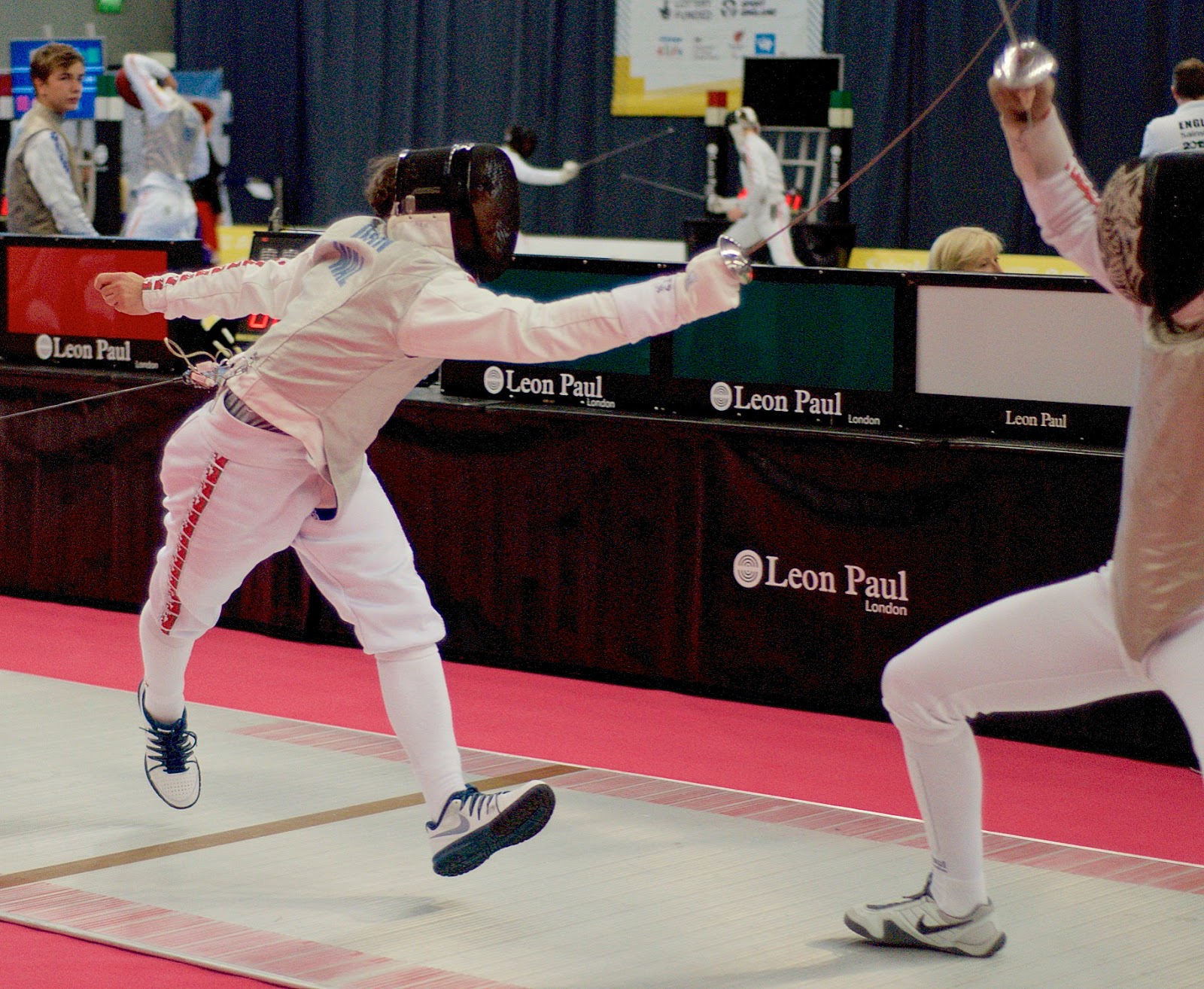
Here are some of my favourite shots (click to enlarge) and you can see the rest here. Fencing photos are tough: the lighting's terrible, you can't use flash, my equipment is ageing, and everyone looks the same once the mask is on. So I tried to capture personality as best I could: victory, defeat, battered fencing shoes, team hugs and so on.

The Toast Rack - near my room on Manchester University's Fallowfield Campus. Formerly part of Manchester Metropolitan University


Backstage


Scotland's women sabreurs console each other after defeat


Searchlights on the roof of the Opening Ceremony venue

Soundcheck for the opening ceremony

Jess Corby reads the oath with George Morris behind her

Volunteers at the opening ceremony

The aforesaid 'showgirls'. 

Generations of Adidas fencing shoes

A fistful of foils

About to be interviewed on camera

Corby under the Klieg lights


Kamal Minot taking media duties in his stride

Ken Rose (Scotland coach) discussing the fight with referee Sean Grundy


Celyn Lewis takes off

…as does Kamal Minott

The referee awards the hit and the Welsh women's epeeists celebrate

Simultaneous hit by the two Scottish women foilists Morrison and Black

Multiple exposure…very tricky without a tripod. 

Battered old Adidas fencing shoe

Charlotte Slater lands a foot hit on Scotland's Paisley.

Jovial ref explains a decision to Gibbon

The referees about to launch into a ballad

The Leon Paul technical staff applaud the medallists

Sabre Selfie!


Schneider and Slater at a tense moment


Moody shot of a Scottish sabreur warming up backstage

Philip Slater celebrates with his coach


Slater, defeated in the team event.

Taylor takes off.

The selfie

Welsh women's epee team celebrates


Edwards and the Welsh coaches celebrate

Yellow card for Dolan